

From January 1, 2026, business license tax (fee) is officially abolished in Vietnam under National Assembly Resolution 198/2025/QH15. This guide covers the abolition roadmap, impacted businesses, accounting procedures for transition, and compliance strategies to avoid risks during the changeover.
What Is Business License Tax (Fee)?
Business license tax (now termed business license fee) is an annual charge applied to organizations, individuals, and business households engaged in production and commercial activities. It is not a tax based on income or revenue, but rather a regulatory fee linked to business entity status and operational scale.
From an administrative perspective, although the business license fee amount is modest, it represents a compliance obligation because declaration and payment procedures typically coincide with the start of the fiscal year, when businesses are handling year-end summaries, tax settlements, and accounting closures. The official abolition from 2026 reduces administrative workload and compliance costs for finance and accounting departments.
Legal Basis and Abolition Roadmap
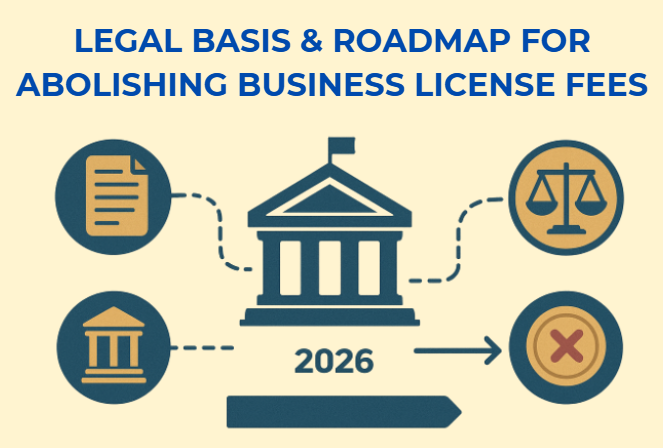
On May 17, 2025, the National Assembly issued Resolution 198/2025/QH15 on special mechanisms and policies for private economic development. Article 10, Clause 7, explicitly states: “Stop collecting and paying business license fees from January 1, 2026.” This is the direct legal foundation establishing the abolition effective immediately and applicable from 2026.
Effective 00:00 on January 1, 2026, businesses, households, and individuals conducting business are no longer obligated to declare or pay business license fees from that date forward. All obligations for prior periods (such as outstanding fees from 2025 or overdue penalties) must still be resolved under current law. The abolition applies only to future obligations, not historical debts.
Scope of Application and Affected Entities
The abolition applies comprehensively to all entities previously subject to business license fees, including:
- Previously operating enterprises (all types) and dependent units (branches, representative offices, business locations) established from 2026.
- Newly established enterprises from 2026 onward;
- Business households and business individuals.
From 2026 forward, no business license fee obligations will exist, eliminating issues related to exemptions or reductions that previously applied to newly established enterprises or conversions from business households. Enterprises must ensure all outstanding obligations before 2025 are settled and maintain documentation for future inspections.
Accounting Actions Required
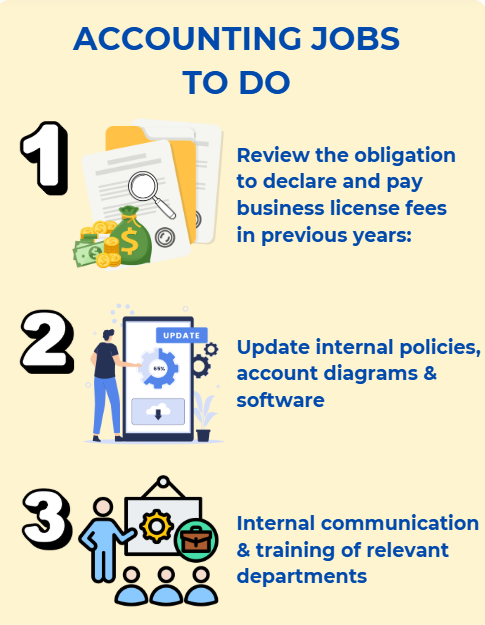
1. Review Prior-Year Business License Fee Obligations
- Compare 2025 records: Verify all declarations (Form 01/LPMB per Circular 80/2021/TT-BTC), payment documents, and expense ledger entries.
- Confirm payment deadlines: Ensure fees were paid by January 30, 2025, to avoid late payment penalties.
- Check dependent units: Confirm that branches, representative offices, and business locations established in 2025 have completed declarations and payments.
2. Update Internal Policies, Account Charts, and Software
- Amend financial policies: Remove the “business license fee expense” line from 2026 budgets;
- Account chart updates: Eliminate provisions for business license fees; reallocate related cost allocation rules from 2026 forward;
- Accounting software configuration: Disable automatic deadline reminder workflows, remove cost codes/expense items for business license fees, and update management reports to exclude this metric.
3. Internal Communication and Department Training
- Formally notify all departments about the abolition effective January 1, 2026, citing Article 10, Clause 7 of Resolution 198/2025/QH15 to ensure uniform awareness;
- Provide brief training to business and sales teams to communicate correctly to customers (no additional business license fee); prevent misinformation that could trigger complaints.
The official abolition of business license fees from January 1, 2026, is a regulatory reform designed to reduce compliance costs, simplify the business environment, and decrease administrative burden on finance and accounting departments at year-end. Enterprises must resolve all 2025 obligations, adjust processes, systems, and budgets accordingly, and communicate clearly to stakeholders. The core legal basis is Article 10, Clause 7 of Resolution 198/2025/QH15; the Ministry of Finance is initiating guidance decrees to ensure uniform nationwide implementation.
For any inquiries, contact Wacontre Accounting Services via Hotline: (028) 3820 1213 or email [email protected] for prompt assistance. With a team of experienced professionals, Wacontre is committed to providing dedicated and efficient service.
EDITORIAL INFORMATION
Wacontre Accounting & Tax Editorial Team
This article is maintained by the Wacontre editorial team. A named reviewer and review date are shown only after individual sign-off; this article does not yet have that sign-off.
Official references
Update history
- : Added editorial ownership, official references, and update history; no individual expert review is claimed.
- : Originally published.