Operating an e-commerce website in Vietnam requires compliance with government regulations. Many businesses are unaware that websites facilitating online sales must complete either notification or registration with the Ministry of Industry and Trade (MOIT) before launch. Failure to comply can result in fines ranging from VND 10–30 million. This guide explains which websites require notification versus registration, the differences between these procedures, step-by-step implementation, and how to avoid penalties while building customer trust through MOIT verification.
- What Is Website Registration?
- Key Difference: Website Notification vs. Registration
- Which Websites Must Be Registered
- Penalties for Non-Registration
- Benefits of Proper Website Registration
- The Role of MOIT
- What Is MOIT Website Notification?
- Who Must Notify the MOIT About Their Website
- Blue Badge vs. Red Badge Verification
- When to Notify Your Website
- When to Update Website Notification
- Penalties for Non-Notification
- How to Register a Website with the Ministry of Industry and Trade
- Is MOIT Notification Required for Sales Websites?
- Frequently Asked Questions: MOIT Website Registration
What Is Website Registration?
Website registration is a mandatory legal procedure for e-commerce platforms that enable users to create stores, list products, or conduct transactions online. This is distinct from website notification, which applies to businesses that sell their own products or services directly. Registration with the Ministry of Industry and Trade (MOIT) allows Vietnam’s government to monitor e-commerce activity, protect consumers, and ensure transparency in online operations. Failure to register on time may result in administrative fines up to VND 30 million.
Key Difference: Website Notification vs. Registration
Many businesses confuse website notification with registration. The critical distinction depends on the website’s function:
- Website notification: for sites that sell products or services directly (owned and operated by a single business).
- Website registration: required for e-commerce platforms (such as online marketplaces) where third-party sellers can join, post listings, or facilitate payments.
Example: If a company operates a platform allowing business partners to create accounts and sell goods—even without directly processing transactions—it must register with the MOIT.
Which Websites Must Be Registered
Under Decree 52/2013/NĐ-CP and Circular 47/2014/TT-BCT, the following website types are required to register with the MOIT:
- E-commerce trading platforms;
- Online promotion websites;
- Online auction websites;
- Online payment intermediary platforms.
These websites function as platforms for multiple sellers, so registration ensures transparency and builds consumer trust.
Penalties for Non-Registration
Under Decree 98/2020/NĐ-CP, websites required to register but failing to do so face penalties including:
- Fines from VND 20–30 million;
- Removal from search results;
- Suspension of e-commerce operations for repeat violations.
Non-compliance also damages company reputation and credibility with customers and partners, particularly for online collaborations.
Benefits of Proper Website Registration
Registering your website correctly provides significant advantages:
- Builds trust and credibility with customers;
- Reduces legal and tax risks;
- Provides legal protection in case of disputes;
- Grants an official MOIT verification badge, enhancing brand reputation.
In Vietnam’s competitive digital marketplace, verified website status significantly increases buyer confidence and strengthens your online presence.
The Role of MOIT
The Ministry of Industry and Trade is the government agency responsible for overseeing e-commerce operations in Vietnam. All registration and notification submissions are processed through the official portal: online.gov.vn. The MOIT has authority to inspect, penalize, or revoke non-compliant websites. By registering properly, businesses can operate legally, securely, and sustainably under Vietnam’s e-commerce regulations.
What Is MOIT Website Notification?
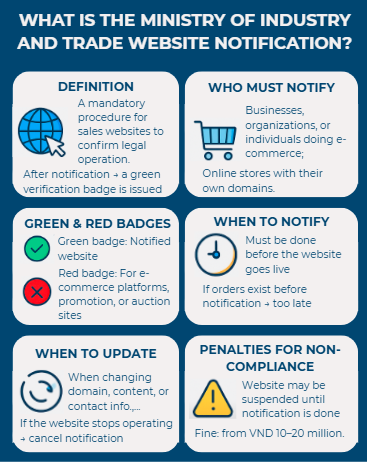
MOIT website notification is a mandatory procedure for businesses, organizations, and individuals who own direct sales websites. It is a formal declaration to the Ministry of Industry and Trade confirming that the website operates legally in e-commerce. This procedure differs from website registration, which applies to platforms hosting third-party sellers. Upon approval, the business receives a verification mark (blue badge)—a symbol of compliance that enhances credibility and reduces administrative penalty risk.
Who Must Notify the MOIT About Their Website
According to Circular 47/2014/TT-BCT, any website that sells goods or services directly on behalf of the business must be notified to the MOIT. Specifically:
- Businesses selling their own products or services online;
- Organizations or individuals conducting e-commerce outside of trading platforms;
- Online retail shops with their own domain names.
Regardless of company size, any website that enables customers to select products, place orders, or make payments must complete notification.
Blue Badge vs. Red Badge Verification
When checking a website on the MOIT portal, you may see two verification types:
- Blue badge: Indicates the website has successfully notified the MOIT—typically for direct sales websites.
- Red badge: Indicates the website has registered—typically for e-commerce platforms, online promotions, or auction sites.
Having a verification badge proves legal operation. For online retailers and service providers, the MOIT blue badge significantly boosts customer trust and conversion rates.
When to Notify Your Website
Businesses must notify the MOIT before the website officially launches. Ideally, this should be done once shopping cart and payment functions are ready. Waiting until after receiving the first order or after an inspection is too late. Websites operating without notification face fines from VND 10–20 million.
When to Update Website Notification
After initial notification, businesses must update their information on the MOIT portal if they:
- Change domain names or add subdomains;
- Modify sales methods or product categories;
- Update contact or ownership information;
- Terminate website operations.
Maintaining accurate information reflects positively during audits and partnerships.
Penalties for Non-Notification
Under Decree 98/2020/NĐ-CP, websites required to notify but failing to do so may face:
- Fines from VND 10–20 million;
- Website suspension until procedures are completed;
- Public warning on the MOIT management system;
- In repeat cases, revocation of e-commerce license.
To remain compliant, businesses should regularly verify notification status, especially when changing domains or business operations.
How to Register a Website with the Ministry of Industry and Trade
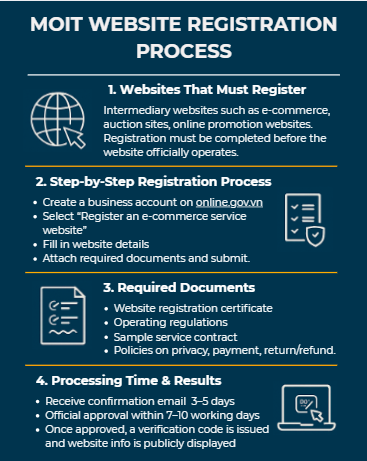
Registering a website with the MOIT is mandatory for e-commerce platforms serving as intermediary marketplaces—such as online trading floors, auction sites, or promotional platforms. This process must be completed before the website officially operates. Unlike simple website notification for direct sales sites, registration requires more comprehensive documentation, stricter review, and formal operational approval from the authority.
Step-by-Step Registration Process
- Visit the official MOIT e-commerce portal: online.gov.vn
- Create an account with your business’s official information;
- Select “Register e-commerce service website”;
- Complete website details: domain name, business model, operation type, target users;
- Attach valid documents (business license, terms of service, privacy policy, etc.);
- Submit the application and expect feedback within 7–10 working days.
Upon approval, the business receives a verification code and may display the official MOIT registration logo on its website.
Required Registration Documents
A complete registration package includes:
- Business Registration Certificate;
- Website Operating Regulations (defining operator and user roles);
- Service contract template (for e-commerce platforms);
- Privacy policy, payment, and return terms;
- Official registration request letter to the MOIT.
All documents must be submitted electronically (PDF or Word format). Documents with signatures or official seals should be scanned from originals to ensure legal validity.
Processing Timeline and Approval
- The MOIT will send a confirmation email within 3–5 working days of submission.
- If additional information is needed, the Ministry will request clarification.
- Complete dossier review typically takes 7–10 working days.
- Upon approval, the website receives a verification code and is publicly listed on online.gov.vn.
- If rejected, the business receives detailed feedback for revision and resubmission.
How to Obtain and Embed the Verification Code
After approval, the MOIT system provides an HTML code snippet that displays the “Registered with MOIT” badge on your website’s footer. When visitors click the logo, they are directed to your registration record on the MOIT portal—serving as official proof of compliance and authenticity.
Submitting Physical Documents (If Required)
While most registrations are processed online, some cases may require physical submission (for verification or local Department involvement):
- Print and sign all documents clearly with official company seals;
- Submit directly or by post to the E-commerce Management Division, MOIT;
- Maintaining hard copies ready can expedite verification if cross-checking is needed.
Tip: Completing registration properly ensures legal compliance, builds credibility, strengthens brand trust, and avoids administrative penalties.
Is MOIT Notification Required for Sales Websites?
Yes. If your website displays products, allows customers to place orders, submit purchase information, or make payments—whether operated by a company or individual—you are required to notify the Ministry of Industry and Trade. This applies to all e-commerce sales websites, regardless of scale or industry. Website notification is distinct from registration, but it is still a legal requirement that must be completed before the site launches, to avoid administrative penalties.
Do Individual Sellers Need to Notify?
Yes. Even individuals or sole proprietors who own personal sales websites must notify the MOIT. You don’t need to be a registered company or have a tax code—if you use a website to sell goods or services (even through simple order forms or messaging), notification is mandatory. This ensures transparency in e-commerce, enables product origin tracing, and prevents tax evasion or fraud. Failure to notify may result in a fine of VND 10–20 million.
Do Mobile Apps Require Notification Like Websites?
Yes. Mobile applications (on Android or iOS) with product listings, booking, ordering, or online payment features are also considered e-commerce platforms and must be notified to the MOIT. Regardless of the platform—website or mobile app—if it facilitates commercial transactions, it falls under MOIT e-commerce regulations. So, if your business operates a sales or booking app, ensure it’s properly notified just like a website.
Do You Need to Notify Again After Website Updates?
Yes. After initial notification, you must update your registration on the MOIT portal if you:
- Change your website design or layout;
- Add ordering or payment features;
- Introduce promotions or discount functions;
- Expand to new product categories.
These updates ensure your information matches actual operations. Failing to update may result in public warnings or fines of VND 5–10 million.
When Is a Website Considered a Sales Website?
According to the MOIT, a website is classified as a sales website if it includes any of the following:
- “Buy Now,” “Order,” or “Add to Cart” buttons;
- Forms for quotes, bookings, or consultation requests;
- Integrated online payment tools or transfer instructions;
- Product listings with descriptions and prices.
You don’t need a full e-commerce payment system—any customer interaction that leads to a sale qualifies your site as a sales website requiring notification.
If the Website Only Promotes Products
If your website only introduces your business or products without pricing, order forms, or sales interactions, notification may not be required. However, the line between “promotion” and “sales” is thin. If your site includes:
- A hotline or contact form for orders;
- “Contact to Buy” buttons;
- Messaging integrations for sales inquiries—
…it will likely be classified as a sales website, and notification is strongly advised. Since the procedure is free and straightforward, notifying early helps you avoid penalties later and ensures full compliance.
Frequently Asked Questions: MOIT Website Registration
When registering or notifying your website with the Ministry of Industry and Trade, businesses often have questions about required documents, deadlines, and post-registration obligations. Below is a summary of the most common FAQs and clear answers to help you avoid mistakes during the process.
1. Does website registration have an expiration date?
No. Once you register or notify your website with the MOIT, there is no expiration period—it remains valid indefinitely. However, you must update your information on the MOIT portal if there are changes in:
- Website ownership;
- Content, functions, or operation scope;
- Domain name;
- Business model.
Failure to update may result in your website being classified as non-compliant, leading to fines or verification code revocation.
2. Do I need to re-register if I transfer the domain?
Yes. Domain transfer means a change in ownership. The new owner must:
- Re-register or re-notify the website under their name;
- Update ownership information on the MOIT portal;
- Reapply the MOIT verification code once approved.
The previous owner should notify the MOIT to deactivate the old record. Not updating ownership can cause legal disputes or data conflicts later.
3. Can I register the website myself or do I need professional help?
You can register it yourself, provided you understand the process and have all required documents correctly prepared. However, since the MOIT system requires specific formats, digital signatures, and embedded verification codes, many businesses prefer to use professional service providers to save time and avoid errors.
These service providers assist you with:
- Preparing valid documentation;
- Submitting registration online;
- Tracking approval progress and responding to feedback;
- Embedding the verification logo on your website.
This is especially valuable for small businesses without in-house legal or IT resources.
4. How long does it take to receive the verification logo?
Normally, after a complete and valid submission, approval and issuance of the MOIT verification code takes 5–7 working days. However, delays may occur if:
- The dossier is incomplete or incorrect;
- The applicant doesn’t respond promptly to requests for clarification;
- There’s a backlog during peak application periods.
Tip: Prepare your documents early and monitor your email regularly for MOIT feedback.
5. How to check if a website is already registered?
You can easily verify your website’s registration or notification status:
- Visit https://online.gov.vn;
- Select the “Lookup” tab;
- Enter your domain name (without “https://”);
- View the status: Registered, Under review, or Not registered.
If your website is not listed, complete the notification or registration process immediately to avoid public warnings or fines. You can also verify legitimacy by clicking the MOIT verification logo on the registered website.
Registering or notifying your website with the MOIT is not just a legal requirement—it is a trust signal to customers and partners. Failure to comply can result in fines from VND 10–30 million, potential suspension, and damage to your brand reputation. If you need help with document preparation, submission, or follow-up, Wacontre’s legal and accounting team can assist you in completing the process quickly, accurately, and in full compliance with regulations.
For assistance, contact Wacontre via Hotline: (028) 3820 1213 or email [email protected]. With a team of experienced professionals, Wacontre is committed to providing prompt and efficient service.
EDITORIAL INFORMATION
Wacontre Accounting & Tax Editorial Team
This article is maintained by the Wacontre editorial team. A named reviewer and review date are shown only after individual sign-off; this article does not yet have that sign-off.
Official references
Update history
- : Added editorial ownership, official references, and update history; no individual expert review is claimed.
- : Originally published.