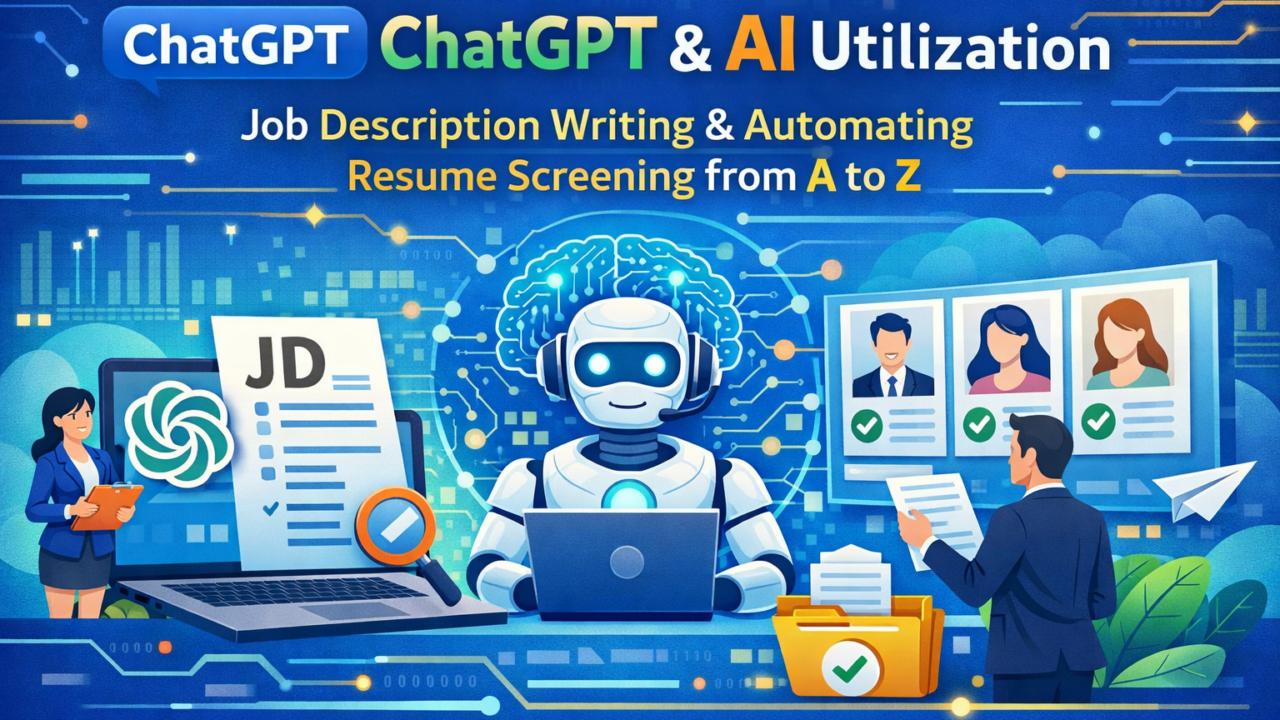
In the digital era, using ChatGPT and AI to write job descriptions and screen resumes is becoming a key HR advantage. Implementing AI in recruitment allows you to create engaging job descriptions and filter candidates with high precision in just a few clicks.
- What is the application of ChatGPT and AI in writing job descriptions and screening resumes?
- Breakthrough benefits of implementing AI in recruitment
- How to apply ChatGPT and AI to write professional and attractive job descriptions
- AI techniques for screening candidates “in an instant”
- Challenges and solutions for AI implementation in Vietnam
- Conclusion
What is the application of ChatGPT and AI in writing job descriptions and screening resumes?
In the era of Industry 4.0, the concept of utilizing ChatGPT and AI for job descriptions and resume screening is no longer a distant trend. It has become a practical tactical tool for modern Human Resources (HR) professionals. ChatGPT is a large language model capable of understanding and generating human-like text based on vast datasets.
When applied to HR, this AI can automatically draft professional job descriptions. It processes key skills and requirements provided by recruiters to create coherent, high-quality text. Furthermore, AI algorithms possess the capability to “read” thousands of candidate resumes to match specific criteria.
This process replaces repetitive manual tasks with intelligent automated workflows. Mastering this technology empowers HR to increase productivity and solidify their strategic position within the enterprise. It is the key to successful and efficient digital transformation for any HR department.
Breakthrough benefits of implementing AI in recruitment
Integrating Artificial Intelligence into the recruitment process brings revolutionary changes. It helps businesses break through in the increasingly fierce race for talent. Here are the core benefits that AI delivers to HR:
1. Maximizing time efficiency in drafting job descriptions
Previously, drafting a complete job description took recruiters 1 to 2 hours. They had to manually conduct market research and synthesize requirements from various technical departments. However, with AI, this time can be reduced to less than 5 minutes for a high-quality draft.
AI can access data from millions of global job description templates to suggest essential skills. You simply provide the job title and a few specific traits, and the AI automatically structures the content. The resulting job description includes everything from duties and requirements to benefits and company culture. This allows HR to focus on more strategic initiatives.
2. Enhancing objectivity and accuracy in candidate screening
One of the main weaknesses of humans in recruitment is fatigue and unconscious bias. When processing a high volume of resumes simultaneously, an HR specialist’s focus often declines significantly. Artificial Intelligence mitigates this by scanning data based on logical algorithms.
AI analyzes keywords, education, and experience to rank suitability impartially. Implementing AI ensures that no potential candidate is overlooked due to human error. Consequently, the quality of the “input” for the interview rounds is significantly elevated and consistent. This helps businesses build a truly high-quality workforce right from the initial screening step.
3. Reducing operational costs for Human Resources (HR)
Recruitment costs often include advertising, HR labor, and management time. By optimizing processes with AI, companies cut labor costs for preliminary screening steps. Instead of requiring a large team, a few specialists skilled in AI can operate the system effectively.
Filling vacant positions faster also minimizes “opportunity costs” for the business. Rapid placement ensures that business operations are not interrupted and productivity is maintained. This is a critical factor for companies expanding their scale in Vietnam. AI is truly a high-return investment for human capital management.
4. Improving candidate experience through rapid feedback
In a competitive labor market, candidate experience is key to attracting top talent. A common complaint is that candidates wait too long for feedback from companies. With AI support, the screening process happens almost instantaneously and can be fully automated.
The system can send notifications to candidates immediately after the algorithm completes its analysis. This transparency creates a professional impression of the employer brand. Even if not selected, candidates feel respected by the structured and prompt workflow. This contributes to a positive company image in the labor market.
How to apply ChatGPT and AI to write professional and attractive job descriptions
Writing a job description is not just about listing tasks; it is an art of promoting the corporate image. AI helps you perform this art scientifically, professionally, and persuasively.
1. A 3-step process to write SEO-standard job descriptions with ChatGPT
To create a perfect job description, you need a smart collaborative process between humans and machines. The first step is providing high-quality “Input,” including the title, level, and specific duties. You should clearly describe the goals the position needs to achieve in the first six months.
The second step is asking ChatGPT to optimize the text according to SEO (Search Engine Optimization) standards. This helps the job description appear easily on Google Jobs or major recruitment sites when candidates search. Finally, perform a manual check to ensure technical terms are accurate. This ensures the job description carries a modern technological feel while retaining the business’s unique identity.
2. Sample prompts to create impressive job descriptions
The key to unlocking the power of AI lies in prompt engineering. Instead of giving short commands, provide the AI with a specific role, such as “HR Expert.” Ask the AI to write an engaging job description for a specific position within a unique working environment.
A good prompt should include: Role, Context, Task, and Format. You can ask the AI to include a “Why Join Us” section with an inspiring tone. Testing various prompt templates will help you find the most effective formula for different industries. Creativity in prompting determines the quality of the final job description.
3. Customizing job description tone for Japanese and Vietnamese corporate cultures
Every corporate culture has its own norms in communication and recruitment documents. Japanese enterprises in Vietnam often value meticulousness, detail, and high discipline. Therefore, the job description needs a formal tone with clear processes and long-term training commitments.
Conversely, Vietnamese startups may prefer a youthful, dynamic, and open style. You can instruct ChatGPT to adjust the writing style according to the specific requirements of each culture. This linguistic adaptability helps businesses break down barriers and connect better with candidates. It ensures your recruitment message meets the expectations of your target audience.
AI techniques for screening candidates “in an instant”
Once a large number of resumes have been collected, the next challenge is selecting potential candidates. This is where AI’s data processing power truly shines.
1. How ChatGPT analyzes and compares resumes with job requirements
AI can perform side-by-side comparisons between job descriptions and resumes with extreme detail. You can upload resume content and ask the AI to score the suitability on a scale of 10. The AI will quickly list similarities and missing skills for that candidate.
This process helps HR eliminate “junk” resumes or those that do not meet minimum requirements in just a few seconds. It is particularly useful for mass recruitment where thousands of resumes arrive simultaneously. Instead of reading every page, you only need to review the AI’s summary evaluation to make a decision.
2. Using specialized AI tools to rank potential candidates
Many Applicant Tracking Systems (ATS) now come with integrated smart AI. These systems use machine learning algorithms to identify success patterns from past high-performing employees. When a resume is submitted, the AI automatically tags and ranks it based on data.
Using specialized tools makes the recruitment process more professional and systematic. You will have a list of candidates sorted by priority. This minimizes errors caused by subjective factors or the recruiter’s emotions. This is a vital step in modernizing human resource management.
3. Eliminating bias in recruitment with AI algorithms
Biases regarding gender, age, or region are often invisible barriers in recruitment. AI can be set to perform “blind hiring,” hiding sensitive personal information. The algorithm will focus solely on professional capacity and practical experience.
When algorithms are trained correctly, they provide absolute fairness in screening. This helps businesses build a diverse and highly capable workforce. It is also a way for businesses to comply with ethical standards in international recruitment. This transparency enhances the company’s reputation in the eyes of potential candidates.
Challenges and solutions for AI implementation in Vietnam
Despite the huge benefits, applying AI in Vietnam still faces certain hurdles. Businesses need to identify these challenges to have appropriate and safe implementation plans.
1. Data security and candidate privacy
Uploading resumes to public AI platforms can pose risks to personal data leakage. In Vietnam, regulations on personal data protection (Decree 13/2023/ND-CP) are becoming stricter. Businesses should prioritize Enterprise AI versions with high security commitments.
Additionally, clear policies on technology-driven data processing must be established for candidates. Ensuring information security helps maintain the recruiter’s reputation and avoids legal risks. Data security must always be a top priority when integrating any AI tool.
2. Linguistic and cultural nuances in Vietnamese resumes
Vietnamese is a nuanced language, which can sometimes challenge Western AI models. Slang or specific local abbreviations in Vietnamese resumes might cause the AI to misunderstand the meaning. To overcome this, businesses should use AI models with strong Vietnamese support that have been fine-tuned.
Building a standard keyword dictionary for each industry in Vietnam is also an effective solution. HR must act as the final gatekeeper to ensure the AI does not misjudge the context. Understanding local culture remains an irreplaceable advantage of HR professionals.
3. Training HR teams to master AI tools rather than depend on them
A common fear is that AI will replace humans and cause HR staff to lose their jobs. However, AI actually only replaces repetitive and mundane tasks. Skills like empathy, negotiation, and relationship building still require the human touch.
Businesses need to invest in training so that HR teams know how to operate AI as a powerful assistant. Instead of fear, they should learn to become smart and agile technology operators. When humans and AI work together, recruitment performance reaches new heights.
Conclusion
Applying ChatGPT and AI to write job descriptions and screen resumes is an inevitable step in the digital age. This technology provides immense power in optimizing time and enhancing accuracy. However, sustainable success still depends on how humans control and apply the technology. Businesses must proactively face challenges to maximize the competitive advantage that AI offers. Start your HR digital transformation journey today to lead the race for talent.
To empower your business in overcoming HR management challenges and staying fully committed to your strategic goals, we provide specialized solutions:
- [RPO Services]: A comprehensive recruitment process outsourcing solution.
- [BPO Services]: Strategic outsourcing to streamline business processes and optimize operational costs.
For any inquiries, contact Wacontre Accounting Services via Hotline: (028) 3820 1213 or email [email protected] for prompt assistance. With a team of experienced professionals, Wacontre is committed to providing dedicated and efficient service. (For Japanese clients, please contact Hotline: (050) 5534 5505).