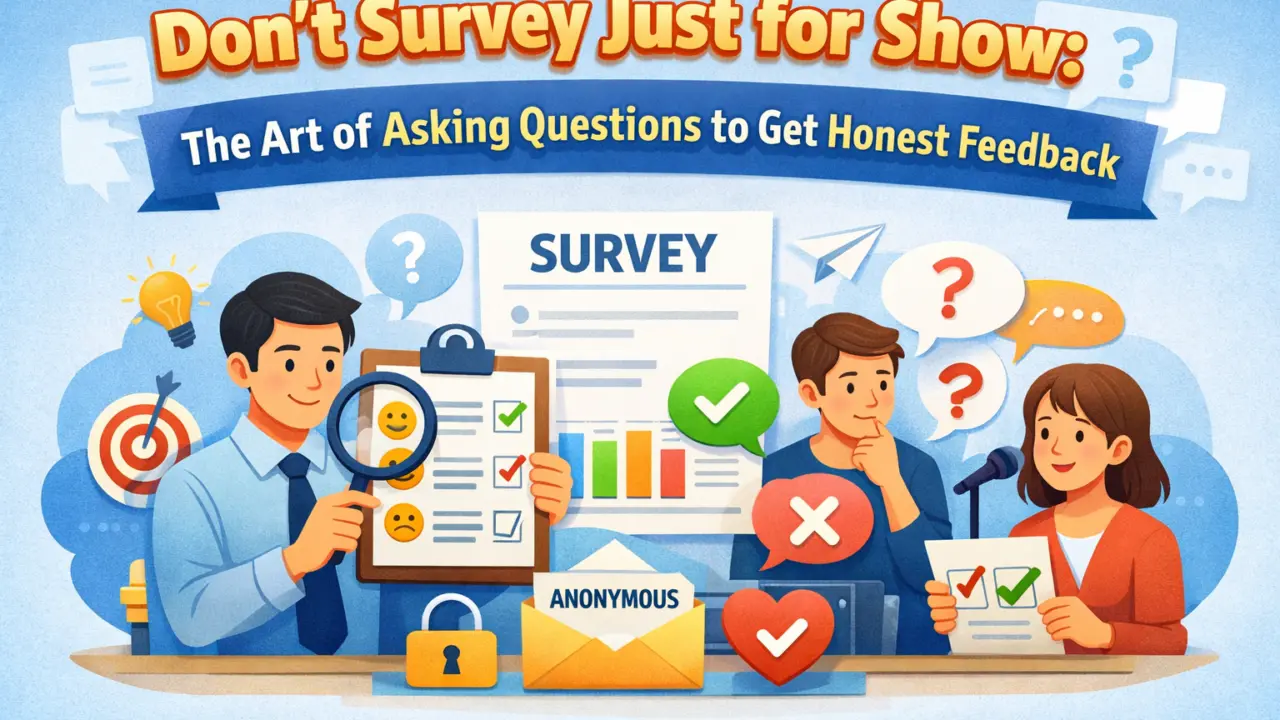
Employee feedback is an indispensable part of modern management. However, a disheartening reality in many businesses today is that surveys often fall into a “perfunctory” trap—yielding polished figures but lacking objective truth. To change this, we must delve deeper into the nature of internal communication and the techniques of inquiry.
What are Perfunctory Surveys?
A “perfunctory survey” or formalistic survey refers to data collection activities that do not provide actual value for decision-making. Typically, these surveys are conducted merely to fulfill HR department KPIs or to beautify reports for leadership. In such cases, questions are often loosely designed, lack focus, and fail to create a safe space for employees to share the “hidden corners” of their work life.
The consequence of perfunctory surveying is a staggering waste of corporate resources. Employees feel their time is not respected, leading to apathy and mechanical responses just to “get it over with.” A genuine survey should be an open dialogue where the business truly wants to listen and the employee truly wants to contribute. If a company cannot commit to taking action based on results, it is better to stop surveying altogether to avoid breeding underlying resentment within the organization.
This concept is also closely linked to transparency in corporate culture. When an organization is stuck in a cycle of formalism, core issues such as engagement, performance, and turnover rates will never be radically resolved. To escape this trap, HR professionals must understand that every question asked is a message to employees about the values the company upholds.
Why Do Businesses Often Receive “Cope-out” Answers?
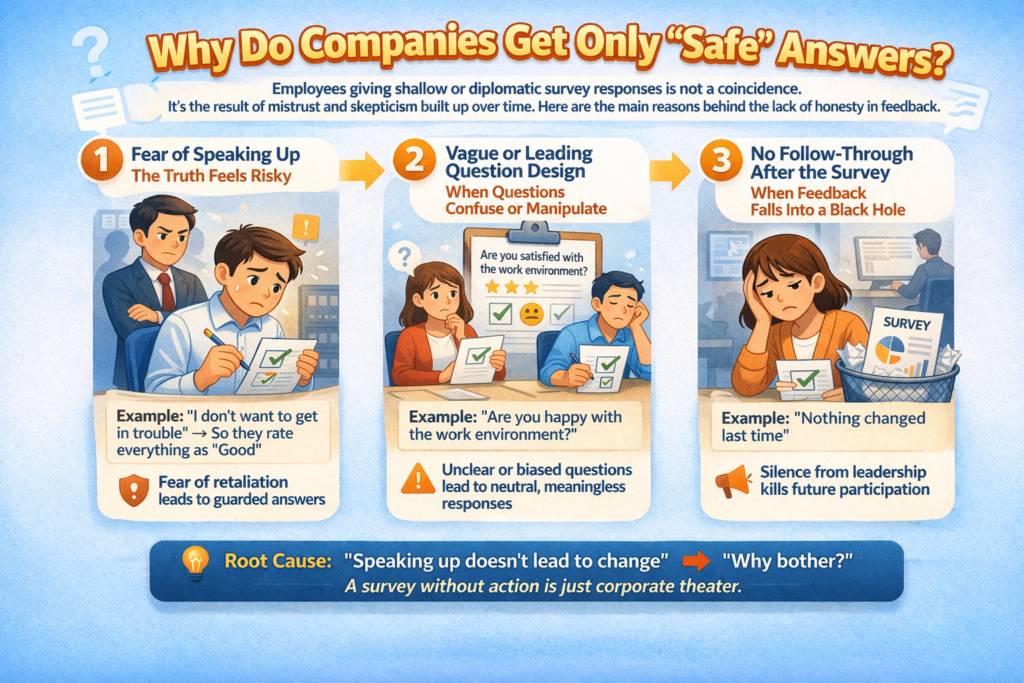
Employees giving dishonest or “coping” answers is not accidental. It is the result of accumulated skepticism and a lack of trust in the existing management system. Below are the primary reasons for dishonesty in HR feedback:
1. Fear of Retaliation
In many businesses, especially those with rigid hierarchical structures, employees live with a constant fear of being victimized or seeing their career path hindered if they provide negative feedback about management or company processes. Even if HR promises confidentiality, if there is a precedent for data leaks or if “truth-tellers” have faced disadvantages in the past, employees will choose the safest route: answering “Good” to everything. This defensive mindset is the biggest barrier to the truth reaching leadership.
2. Overly Vague or Leading Questions
A common error in questionnaires is using ambiguous terms like “Are you satisfied with the working environment?” This is too broad for employees to know where to start, leading them to pick a neutral middle ground for convenience. Furthermore, leading questions such as “Don’t you think the company’s benefits are great?” unintentionally force employees into a pre-set response frame. When a question contains the desired answer, the survey becomes a mere ego-validation tool for managers rather than a search for truth.
3. Lack of Commitment to Post-Survey Action
Employees quickly notice if their opinions are “shelved” after a survey ends. If issues remain stagnant year after year, a sense of discouragement sets in. “Talking won’t change anything” becomes the team’s mantra whenever a new survey link arrives. Silence or perfunctory answers are, in fact, the employees’ way of protesting against leadership indifference. A successful survey does not end with data collection; it only truly begins when improvement actions are implemented.
The Art of Asking to Get Honest Answers
To receive feedback that is “as real as a breath,” HR professionals must be artisans of language. How you structure a question determines the quality of the data you receive.
1. Combine Likert Scales with Open-Ended Questions
Likert scales (1-5 or 1-7) are useful for quantifying sentiment, but they often lack the “soul” of the situation. To fix this, every quantitative question should be followed by an open-ended one asking for the reasoning behind the choice. For example: “If you rated direct management support as a 3, what specific factors prevented you from giving it a 5?” Requiring a specific example forces employees to think seriously rather than mindlessly clicking boxes.
2. Avoid “Trap” or Judgmental Questions
Double-barreled questions like “Are you satisfied with the salary and bonus?” often confuse employees if they like one but not the other. Separate each issue clearly. Additionally, use neutral, non-judgmental language. Instead of “Why don’t you like the new process?”, ask “What challenges does the new process pose to your daily tasks?” This approach reduces confrontation and encourages objective sharing.
3. Use Indirect Questioning to Reduce Pressure
Sometimes, asking directly about an employee’s personal feelings makes them hesitant. Instead, ask about their observations of the team or environment. For example: “In your observation, what is hindering collaboration within the group?” This allows employees to offer critiques without feeling like they are “snitching” or admitting personal fault. This behavioral psychology technique uncovers sensitive issues more subtly, gathering multi-dimensional perspectives on organizational culture.
4. Optimize Frequency and Timing
Do not “terrorize” employees with dozen-page surveys during project peaks or busy month-ends. Overly long questionnaires cause “survey fatigue,” where accuracy drops toward the end. Instead, break content into short “Pulse Surveys” sent monthly or quarterly. Choosing a time when employees are in a relaxed state of mind and have time to reflect will result in much more constructive and profound answers.
Building a Transparent HR Survey System
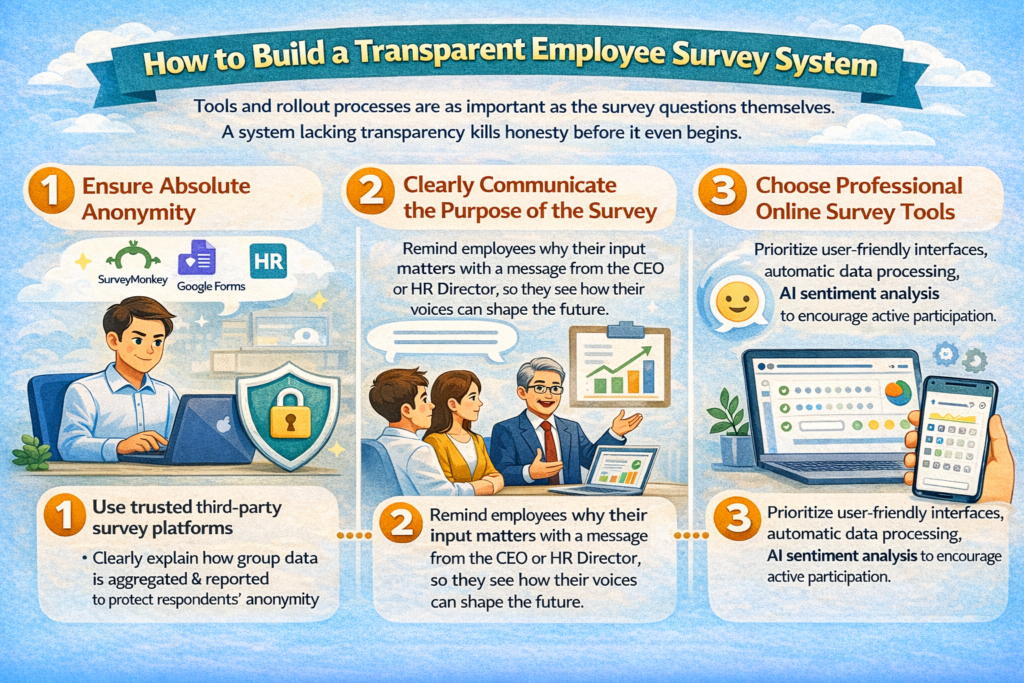
The tools and implementation process are as important as the questions themselves. A non-transparent system kills honesty before it even begins.
1. Ensure Absolute Confidentiality and Anonymity
Businesses must prove that individual responses will never be revealed to direct managers. Using third-party platforms (like SurveyMonkey or specialized HR software) often builds more trust, as employees believe their data is protected by an independent entity. Explain clearly how data is aggregated and reported by group rather than individually to alleviate privacy concerns.
2. Communicate the Purpose Clearly
Never send a dry survey link via email without explanation. Start with a message from the CEO or HR Director, stating why their opinion matters right now. Show them the big picture: how these results will adjust salary policies, improve the environment, or change training processes. When employees understand their voice has the power to change their own future, they take more responsibility for their answers.
3. Choose Professional Online Survey Tools
A user-friendly interface that works on both mobile and desktop encourages active participation. Modern tools also allow for automatic data categorization by department, tenure, or position, giving HR detailed insights while maintaining anonymity. Additionally, AI-driven Sentiment Analysis can help identify negative or positive keywords in open-ended responses, saving time on manual data processing.
Turning Feedback into Concrete Action
The most critical part of a survey is not the result board, but what happens afterward. This is the step that determines if you are conducting a real survey or just “acting.”
1. Analyze Data to Find HR “Hot Spots”
After gathering enough data, HR must conduct a deep dive to find repeating patterns. If a specific department shows a sudden drop in satisfaction, that is a “hot spot” requiring immediate intervention. Do not just look at company-wide averages, as they often mask serious local issues. Pay attention to constructive suggestions in open-ended sections—that is often where the most creative solutions lie.
2. Report Results Back to All Employees
Post-survey silence is poison for engagement. Hold an all-hands meeting or send a summary of the (processed) results to everyone. Bravely acknowledge the shortcomings pointed out by the majority. Publicly sharing results not only shows transparency but proves to employees that leadership has listened to their struggles. This is a vital stepping stone for building trust for future surveys.
3. Establish an Improvement Roadmap Based on Actual Contributions
Select 3 to 5 core issues to solve and announce a concrete roadmap. For example: “Based on your feedback regarding equipment shortages, the company will upgrade the engineering department’s computers next quarter.” When employees see tangible changes stemming from their own suggestions, they feel like a true part of the organization. This is the key to receiving honest answers forever after.
Conclusion
HR surveys are a double-edged sword. If performed sincerely and scientifically, they are a powerful tool for driving engagement and sustainable growth. Conversely, if done “for show,” they erode trust and create a fake culture within the business. Remember, the ultimate goal of asking questions is not to get answers that please the boss, but to find the truth that helps the business get better every day.
To empower your business in overcoming HR management challenges and staying fully committed to your strategic goals, Wacontre provides specialized solutions:
- [RPO Services]: A comprehensive recruitment process outsourcing solution.
- [BPO Services]: Strategic outsourcing to streamline business processes and optimize operational costs.
For any inquiries, contact Wacontre Accounting Services via Hotline: (028) 3820 1213 or email [email protected] for prompt assistance. With a team of experienced professionals, Wacontre is committed to providing dedicated and efficient service. (For Japanese clients, please contact Hotline: (050) 5534 5505).