Understand what tax evasion is and how companies are penalized under Vietnam’s current tax regulations.
Tax evasion is a serious offense that undermines national revenue and market fairness. This article explains what tax evasion is, the most common forms it takes, and the penalties companies may face under Vietnamese law.
- What is Tax Evasion?
- Common Forms of Tax Evasion
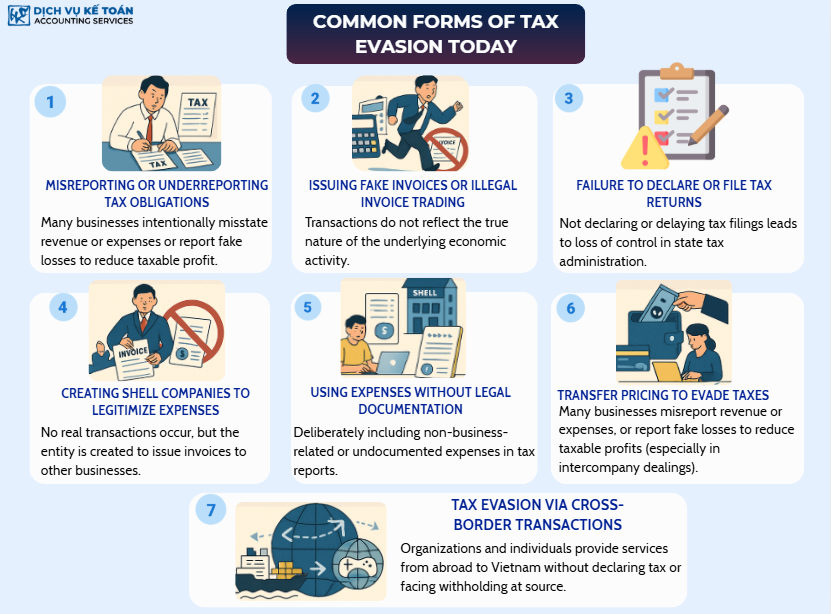
- 1. Misreporting and underreporting tax obligations
- 2. Non-declaration or failure to file tax returns
- 3. Issuing fake invoices or trading invoices illegally
- 4. Setting up shell companies to legitimize expenses
- 5. Claiming undocumented or ineligible expenses
- 6. Transfer pricing abuse
- 7. Cross-border transactions and digital services
- Negative Impacts of Tax Evasion
- Legal Basis and Penalties
What is Tax Evasion?
Tax evasion is the deliberate act of failing to fully comply with tax obligations in order to reduce the amount of tax payable to the state. It is illegal and has a significant negative impact on the national budget and on fair competition in the business environment. With digital transformation and deeper economic integration, methods of tax evasion are becoming increasingly sophisticated and complex.
Common Forms of Tax Evasion
1. Misreporting and underreporting tax obligations
Some businesses intentionally underreport revenue, inflate expenses, or create fictitious losses to reduce taxable income. This is typically done by altering invoices, manipulating bookkeeping records, or fabricating transactions. Gaps in the legal framework and opaque internal accounting can make these practices difficult to detect.
2. Non-declaration or failure to file tax returns
Common among small businesses and irregularly operating enterprises, this tactic delays tax payments and helps avoid audits. Some companies deliberately defer filing to exploit short-term cash flow or evade inspections, which can lead to significant penalties under Decree 125/2020/ND-CP.
3. Issuing fake invoices or trading invoices illegally
One of the most common tactics is using invoices from inactive or fictitious companies to inflate costs and reduce taxable income. These activities often involve organized networks and can result in criminal prosecution.
4. Setting up shell companies to legitimize expenses
Shell companies are entities with no real business operations. They are created solely to issue invoices, allowing other businesses to book fictitious costs and evade taxes. This practice distorts fair market competition and is notoriously difficult to monitor.
5. Claiming undocumented or ineligible expenses
Examples include personal expenses, undocumented receipts, excessive entertainment costs, and fictitious employee payments. Such items are not deductible and are subject to back tax collection and fines.
6. Transfer pricing abuse
Multinational corporations may shift profits to low-tax jurisdictions by manipulating the prices of intra-group transactions. Investigating these arrangements requires complex international cooperation and specialized audits. Despite existing regulations, enforcement in Vietnam remains constrained by limited resources.
7. Cross-border transactions and digital services
E-commerce and cross-border digital services pose significant challenges for tax enforcement. Many foreign providers supplying services to customers in Vietnam avoid tax registration and payment due to gaps in current policy and technical limitations.
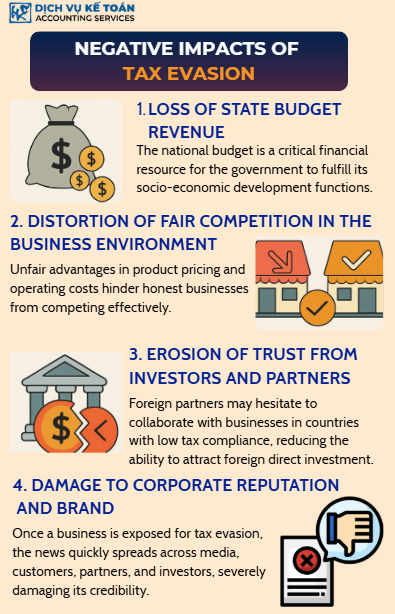
Negative Impacts of Tax Evasion
1. Loss of national revenue
Tax evasion deprives the state of vital financial resources, delaying public infrastructure projects and weakening essential social services such as healthcare and education.
2. Unfair competition
Tax-evading businesses gain artificial cost advantages, undermining law-abiding competitors and distorting market dynamics.
3. Erosion of investor and partner confidence
Frequent tax scandals reduce investor confidence in Vietnam’s transparency and market stability, with knock-on effects on FDI and international cooperation.
Read more: FOREIGN COMPANY SERVICES – Accounting service in HCMC
4. Damage to corporate reputation
Companies caught evading taxes face media scrutiny, loss of customer trust, contract cancellations, and declines in shareholder value.
Legal Basis and Penalties
1. Tax Administration Law and guiding regulations
Vietnam’s Tax Administration Law (2019) and Decree 125/2020/ND-CP provide the legal framework for defining, detecting, and penalizing tax violations.
2. Penal Code 2015 (amended 2017)
Serious tax evasion constitutes a criminal offense under Article 200, with fines of up to VND 4.5 billion and imprisonment of up to 7 years.
3. Administrative penalties for businesses
Fines range from 20% to 300% of the evaded tax amount, in addition to late payment interest. Authorities may also suspend operations or revoke business licenses.
4. Criminal liability for individuals
Responsible individuals, such as legal representatives and chief accountants, may face criminal charges, professional bans, and personal compensation liabilities.
5. Determining evaded tax and time limits
Authorities rely on tax filings, invoices, and third-party data to determine evaded amounts. The statute of limitations is 5 years for administrative penalties and 10 years for criminal prosecution.
Tax evasion is a serious violation that harms national interests and corporate credibility alike. Understanding common evasion practices, the associated penalties, and how to implement preventive measures is essential for legal and sustainable business growth in Vietnam.
For any inquiries, please contact Wacontre Accounting Services via Hotline: (028) 3820 1213 or email [email protected] for prompt assistance. With a team of experienced professionals, Wacontre is committed to delivering dedicated and efficient service. (For Japanese clients, please contact Hotline: (050) 5534 5505).