
Accurately calculating and provisionally paying Corporate Income Tax (CIT) is essential for businesses to stay compliant and proactively manage their tax obligations. This article provides a clear, up-to-date guide to determining and provisionally calculating CIT under Vietnam’s latest 2025 regulations.
What Is Corporate Income Tax (CIT) and Provisional CIT?
Corporate Income Tax (CIT) is a direct tax that businesses must pay to the State based on their taxable income during a given tax period. In practice, companies in Vietnam are required not only to determine the annual CIT payable accurately, but also to make quarterly provisional CIT payments to remain compliant with tax regulations.
Calculating CIT and making provisional CIT payments are key processes that allow businesses to proactively manage their tax obligations. When done properly, they help companies avoid legal risks and optimize their tax position by taking advantage of applicable incentives.
Current Legal Framework for CIT in Vietnam
1. The Latest Corporate Income Tax Law
The legal framework governing CIT currently includes:
- The Corporate Income Tax Law 2008, as amended in 2013 and 2014.
- Implementing decrees and circulars, such as Decree 218/2013/ND-CP and Circular 78/2014/TT-BTC.
- More recent updates, including Decree 126/2020/ND-CP and Circular 80/2021/TT-BTC.
2. Detailed Guidance Documents and Decrees
In addition to the main laws and decrees, businesses should also keep up to date with:
- Circular 96/2015/TT-BTC, which revises the rules on deductible expenses for CIT purposes.
- Official letters and guidance issued by the General Department of Taxation and local tax authorities for specific industries.
How to Calculate CIT Accurately
1. The CIT Calculation Formula
CIT Payable = (Taxable Revenue – Deductible Expenses) x CIT Rate
Where:
- Taxable Revenue: All income from production, business activities, services, and financial operations.
- Deductible Expenses: Reasonable and legitimate expenses related to business activities, supported by valid invoices and documentation.
- CIT Rate: The standard rate is 20%, although some industries may benefit from preferential rates.
2. Deductible vs. Non-Deductible Expenses
Deductible Expenses must:
- Be actually incurred and directly related to business activities.
- Be supported by valid legal invoices and documentation.
- Be paid through non-cash methods for any invoice valued at VND 20 million or more.
Non-Deductible Expenses include:
- Expenses unrelated to business activities.
- Expenses lacking valid invoices or supporting documents.
- Expenses that exceed regulatory caps (for example, advertising expenses exceeding 15% of revenue).
3. CIT Incentives for Enterprises
Some businesses are eligible for CIT incentives, including:
- Newly established companies from investment projects in preferential investment areas.
- Enterprises operating in high-tech sectors or scientific research.
- Innovative startup enterprises.
Quarterly Provisional CIT Payment Process
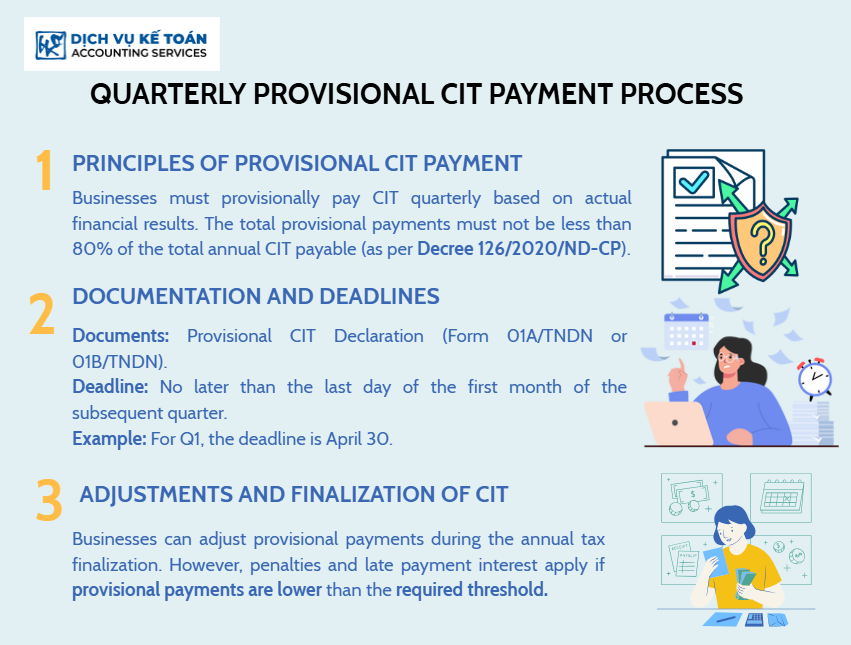
1. Principles of Provisional CIT Payment
Businesses must make quarterly provisional CIT payments based on their actual business results. The total provisional CIT paid during the year must not be less than 80% of the annual CIT payable, as stipulated in Decree 126/2020/ND-CP.
2. Required Documents and Deadlines
- Documents: Provisional CIT declaration forms (Form 01A/TNDN or 01B/TNDN).
- Deadline: No later than the last day of the first month of the following quarter.
For example, the deadline for Q1 provisional CIT payment is April 30.
3. Adjustments and CIT Finalization
If errors occur in provisional payments, businesses may correct them during the annual CIT finalization. However, if total provisional payments fall short of the required threshold, the company will be subject to penalties and late payment interest.
Key Considerations When Calculating and Paying Provisional CIT
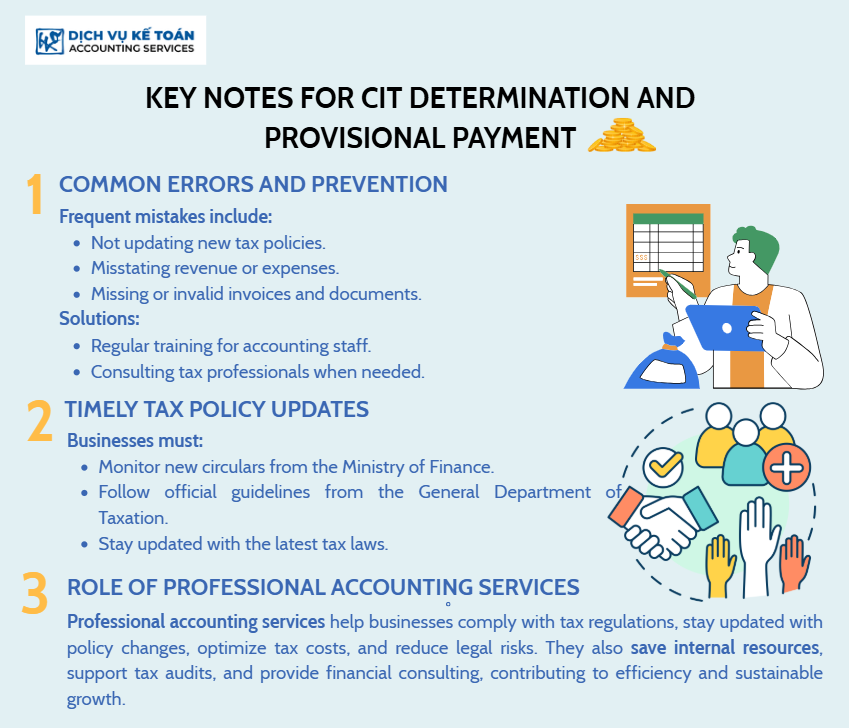
1. Common Mistakes and How to Avoid Them
Common mistakes include:
- Failing to update to the latest tax policies in a timely manner.
- Incorrectly recording revenue and expenses.
- Missing valid invoices or supporting documentation.
To avoid these issues, businesses should:
- Regularly train their accounting staff.
- Consult tax professionals whenever necessary.
2. Keeping Up With Tax Policy Changes
CIT regulations in Vietnam are updated frequently. Businesses should proactively monitor:
- New circulars issued by the Ministry of Finance.
- Official guidance from the General Department of Taxation.
- Newly issued legal documents and regulations.
3. The Role of Professional Accounting Services
Professional accounting services help businesses stay compliant with tax regulations, react quickly to policy changes, and minimize legal risks. They also support companies in optimizing deductible expenses, leveraging tax incentives, saving internal resources, handling audits, and providing strategic financial management advice — all of which contribute to higher operational efficiency and sustainable growth.
Accurately calculating and paying provisional CIT requires precision, ongoing updates, and a deep understanding of Vietnam’s tax laws. Businesses should build a strong internal tax accounting system or partner with a reputable accounting service provider to ensure full compliance and support stable, long-term growth.
For further information, please contact Wacontre Accounting Services via Hotline: (028) 3820 1213 or email [email protected] for prompt assistance. With a team of experienced professionals, Wacontre is committed to delivering dedicated and efficient service. (For Japanese clients, please contact Hotline: (050) 5534 5505.)