
For every business, accurate salary calculation is not just a legal obligation but an essential element for maintaining fairness and transparency in labor relations. With recent changes to the basic salary and regional minimum wage levels effective July 1, 2024, companies must update and adjust their payroll methods to ensure compliance with Vietnamese law and to protect employee rights.
This article explains the latest regulations on the basic salary and regional minimum wage, along with the most commonly used salary calculation methods. We provide detailed guidance on how to calculate fair wages and review popular payment methods that help businesses and employees achieve both fairness and maximum efficiency in the workplace.
1. What is Salary Calculation?
Salary calculation is one of the key factors in determining an employee’s income. The process helps businesses fulfill their obligation to pay wages on time while ensuring fairness and transparency in compensation. When salaries are calculated in line with legal regulations, it protects employee rights and helps prevent unnecessary labor disputes.
Salaries can be calculated using a range of methods, depending on the nature of the work, industry requirements, and the agreement between the company and the employee. Common methods include time-based salary, product-based salary, piece-rate salary, revenue-based salary, and salary based on terms set out in the employment contract.
What is Time-based Salary Calculation?
Time-based salary calculation pays employees according to the actual hours or days worked during a specific period (month, week, or day). It is well suited to jobs with stable working hours and no strict productivity targets. This method makes it easy for businesses to control labor costs and adjust payroll across different periods.
What is Product-based Salary Calculation?
Product-based salary calculation pays employees based on the quantity and quality of goods they produce. It is widely used in manufacturing and service industries where output can be clearly measured. This approach motivates employees to raise both productivity and product quality.
What is Piece-rate Salary Calculation?
Piece-rate salary is a payment model where employees are paid for completing a fixed scope of work within a pre-agreed time frame. Pay is tied to the effectiveness of the work delivered. This method suits jobs with clearly defined workloads and helps boost employee motivation.
What is Revenue-based Salary Calculation?
Revenue-based salary pays employees according to the revenue they generate for the company. It is common in sales teams and any role with direct customer relationships. Compensation is calculated as a percentage of the revenue or profit achieved during a given period.
What is Agreement-based Salary Calculation?
Agreement-based salary calculation is a flexible method defined in the employment contract between the company and the employee. Base salary, allowances, bonuses, and other terms are clearly agreed from the outset. This approach allows businesses to adjust compensation based on job requirements and operating conditions.
2. Basic Salary and Regional Minimum Wage in 2025
The basic salary and the regional minimum wage are key benchmarks for determining fair compensation for employees and ensuring that businesses comply with Vietnamese labor regulations.
What is the Basic Salary?
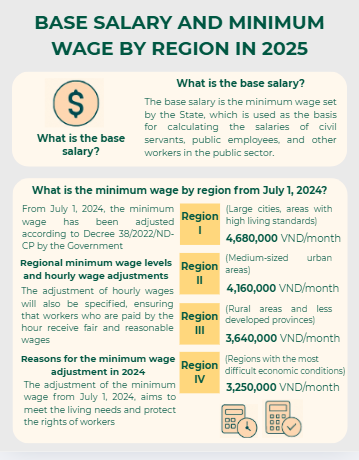
The basic salary is the minimum rate set by the government, used as the basis for calculating wages for state officials, civil servants, public employees, and other workers in the public sector. From July 1, 2024, the basic salary was raised to VND 2,340,000 per month, an increase of VND 540,000 from the previous rate of VND 1,800,000 per month. The adjustment is intended to improve worker incomes and keep pace with rising living costs during Vietnam’s economic recovery.
Regional Minimum Wage Effective July 1, 2024
From July 1, 2024, the regional minimum wage is adjusted under government Decree 38/2022/ND-CP, with the following rates:
- Region I (major cities and high cost-of-living areas such as Hanoi and Ho Chi Minh City): VND 4,680,000/month
- Region II (medium-sized urban areas): VND 4,160,000/month
- Region III (rural areas and less developed provinces): VND 3,640,000/month
- Region IV (areas with the most challenging economic conditions): VND 3,250,000/month
The regional minimum wage effective July 1, 2024, helps protect workers’ rights by ensuring they can cover essential living costs, while promoting fairness across Vietnam’s regional labor markets.
Regional Minimum Wage and Hourly Rate Adjustments
Each region’s minimum wage is adjusted in line with local cost-of-living and economic conditions. Hourly rates are also regulated so that hourly workers are paid fairly and equitably.
Why was the Minimum Wage Adjusted in 2024?
The minimum wage adjustment effective July 1, 2024, is intended to meet workers’ living needs and protect their rights. It also helps businesses comply with the law and ensures fairness in wage payments across regions. These changes reflect Vietnam’s continued economic development and improvements in living standards.
3. Popular Payroll Methods and How to Calculate Salary
Selecting the right payment method for the nature of the job helps businesses optimize personnel costs while motivating employees to perform at their best. Each method has its own strengths and trade-offs, so companies should understand all of them and choose the one that best fits their business goals and HR strategy.
Time-Based Salary
Time-based salary is the most common payment method, especially in companies with stable roles and no strict productivity or output requirements. Employees are paid for the hours or days worked in a given period (month, week, or day). This method is simple, easy to track, and easy to control, but it can offer limited incentive for employees to raise their productivity.
The formula for time-based salary is:
Monthly salary = (Basic salary + Allowances) / Standard working days × Actual working days.
One drawback is that employees who miss working days or take leave will not receive the full fixed amount. This can affect take-home pay and cause dissatisfaction if the rules are not communicated clearly.
Product-Based Salary
Product-based salary pays employees according to the quantity and quality of items they produce. It is commonly used in manufacturing, processing, and any role where results can be clearly measured through the finished product.
Pay can be calculated using a unit rate for each product or task completed. This method encourages employees to improve both efficiency and product quality, but it can also create pressure if the required quantity and quality targets are not set appropriately.
The formula for product-based salary is:
Product salary = Number of products × Price per product.
Task-Based Salary
Task-based salary is a payment model where employees are paid for completing a defined scope of work, as agreed in advance. Pay is tied to the effectiveness and quality of the work delivered. This method increases ownership of results and is typically used for specific projects or roles without fixed working hours.
Task-based pay can be defined by project or by specific goals. It helps companies reduce supervision overhead and gives employees more flexibility in how they manage their time.
The formula for task-based salary is:
Task salary = Agreed salary rate × Work completion rate.
Revenue-Based Salary
Revenue-based salary pays employees a percentage of the revenue or profit they generate for the company. It is commonly used in sales, marketing, and other roles directly tied to revenue generation, such as sales representatives, consultants, and marketers.
Compensation varies with the results delivered, motivating employees to pursue higher sales targets. However, it can create pressure if the targets are set too high or are difficult to achieve.
The formula for revenue-based salary is:
Revenue salary = Individual or team revenue achieved × Revenue-based salary policy.
Agreement-Based Salary
Agreement-based salary is defined in the employment contract between the employer and the employee. The salary amount, payment schedule, allowances, bonuses, and other terms are agreed upon and clearly stated in the contract. This gives both parties flexibility to adjust pay based on job needs and business conditions.
Salary levels and terms may be revised, but any changes must remain compliant with Vietnamese labor law.
4. 2025 Salary Calculation Guide: The Latest Methods
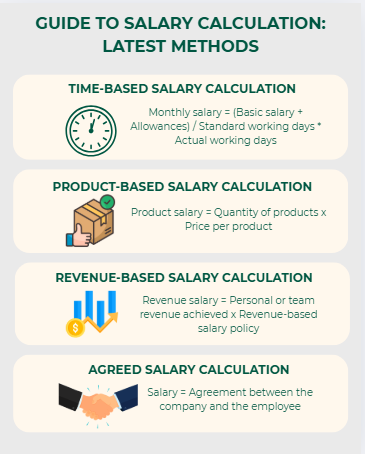
Calculating salaries accurately and reasonably helps businesses comply with the law and motivates employees to perform more effectively. Below are the most common salary calculation methods, with specific formulas you can apply in your company.
Time-Based Salary Calculation
Time-based salary calculation is the most common and straightforward method, particularly in companies with stable, predictable roles. Employees’ salaries are calculated based on standard working days or actual hours worked in a month.
Formula:
Monthly salary = (Basic salary + Allowances) / Standard working days × Actual working days.
It is easy to calculate and manage, but offers limited incentive to boost productivity.
Product-Based Salary Calculation
Product-based salary is one of the most effective methods in manufacturing. Pay is calculated based on the number of products completed or the quality of work delivered, encouraging higher productivity and better product quality.
Formula:
Product salary = Number of products × Price per product.
Revenue-Based Salary Calculation
Revenue-based salary is used to incentivize sales staff and other employees directly involved in revenue generation. Pay depends on the percentage of revenue achieved.
Formula:
Revenue salary = Individual or team revenue achieved × Revenue-based salary policy.
Agreement-Based Salary Calculation
This method is determined by the employment contract between the employer and the employee. Salary, bonuses, and allowances are agreed before the contract is signed.
Formula:
Salary = Agreement between the employer and the employee.
Important Notes on Salary Calculation
When calculating salaries, businesses must comply with regulations on insurance, taxes, and allowances. These factors affect not only employee benefits but also the company’s legal compliance.
Accurately calculating salaries and following the rules on basic salary and regional minimum wage is essential for both employers and employees. It protects employee rights, ensures fairness, and maintains transparency in the workplace. Companies should also keep up with the latest regulations to avoid any legal violations.
Choosing the right payment method for the job helps businesses optimize personnel costs and keep employees motivated. Applying flexible and accurate salary calculation methods will improve overall efficiency and bring greater stability to the company.
For any inquiries, contact Wacontre Accounting Services via Hotline: (028) 3820 1213 or email [email protected] for prompt assistance. With a team of experienced professionals, Wacontre is committed to providing dedicated and efficient service. (For Japanese clients, please contact Hotline: (050) 5534 5505).