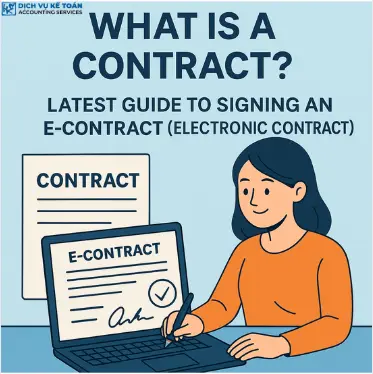
In the digital era, signing contracts through electronic platforms is becoming increasingly common. Alongside traditional paper contracts, electronic contracts offer a modern alternative that helps businesses cut costs, accelerate processing, and improve management efficiency. However, many companies remain uncertain about their legal validity and the proper signing process. The article below provides a comprehensive overview of contracts, with a focus on electronic contracts, under the latest Vietnamese laws.
What Is a Contract? What Types of Contracts Exist?
Definition of a Contract Under the Civil Code
Under Article 385 of the 2015 Civil Code, a contract is an agreement between parties to establish, modify, or terminate civil rights and obligations. A contract may be expressed orally, in writing, through specific actions, or via electronic means with an electronic signature.
Signing a contract provides an essential legal basis for clearly defining the rights and obligations of each party across various fields, including labor, commerce, construction, services, and civil matters.
Common Contract Classifications
Contracts can be grouped under different categories based on legal criteria or intended use, including:
- By form: written contract, oral contract, electronic contract.
- By field: labor contract, civil contract, economic contract, sale of goods contract.
- By party structure: bilateral contract, unilateral contract.
- By enforceability: standard-form contract, negotiated contract.
In today’s digital economy, electronic contracts are growing in popularity due to their convenience and effectiveness, particularly in e-commerce and logistics.
Legal Significance of Contracts
A contract serves as legal evidence that clearly defines the rights and obligations of each party. It helps to:
- Reduce the risk of disputes.
- Provide a basis for resolution in the event of a breach of obligations.
- Serve as a mandatory document when dealing with regulatory authorities, auditors, and banks.
The clearer and more complete a contract is, the more binding it becomes and the better it protects the interests of every party involved.
Essential Elements of a Valid Contract
Under Article 117 of the Civil Code, a valid contract must meet the following conditions:
- The parties must have full legal capacity and civil act capacity.
- The parties must enter into the contract voluntarily.
- The purpose and content must not violate legal prohibitions or social ethics.
- The contract form must comply with legal requirements (for example, certain contracts must be in writing).
For electronic contracts, authentication and security elements such as digital signatures and digital certificates are essential to ensure legal validity.
Latest Updates on Contracts
Under the 2023 Law on Electronic Transactions (effective from July 1, 2024):
- An electronic contract has the same legal value as a paper contract, provided it meets identification and electronic signature requirements.
- The electronic contract storage system must be able to verify the origin, signing time, and integrity of the content.
- The signing process may be carried out entirely through digital platforms, as long as security and authentication requirements are met.
These updates create a clear legal framework that encourages businesses to transition from traditional contracts to more efficient electronic contracts.
What Is an Electronic Contract? Is It Legally Valid?
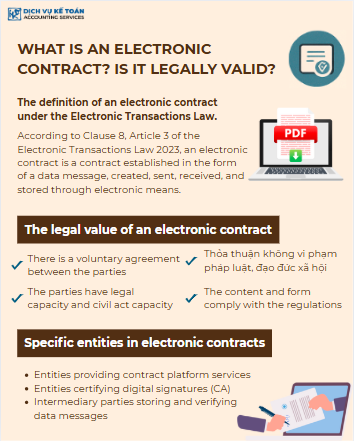
Definition Under the Law on Electronic Transactions
Under Clause 8, Article 3 of the 2023 Law on Electronic Transactions, an electronic contract is a contract created in the form of a data message that is generated, sent, received, and stored by electronic means. It is signed using digital signatures, electronic signatures, or other authentication methods recognized by law.
An electronic contract can fully replace a traditional paper contract in most civil and commercial transactions today, provided it meets all legal requirements.
Legal Value of Electronic Contracts
Current law clearly states that an electronic contract has the same legal value as a written contract if it meets the following conditions:
- There is mutual agreement among all parties involved.
- The parties have full legal capacity and civil act capacity.
- The agreement does not violate the law or social ethics.
- The content and format comply with legal regulations and allow verification of the signature, time, and content.
In other words, an electronic contract can be used as evidence in legal disputes, audits, or tax filings if it is signed in accordance with the proper standards.
Differences Between Electronic and Paper Contracts
| Criteria | Paper Contract | Electronic Contract |
| Form | Printed or handwritten | PDF or XML files with electronic signatures |
| Signing | Ink pen and official stamp | Digital signature, OTP, or identification code |
| Storage | Physical files | Cloud storage or server |
| Processing Speed | Slow and manual | Fast, with remote signing available |
| Application Scope | All fields | Rapidly expanding in e-commerce, logistics, finance, and more |
Special Parties in Electronic Contracts
In addition to the principal signing parties, an electronic contract may involve several specialized participants, such as:
- Organizations providing the contract conclusion platform (for example, VNPT, FPT.eContract, TrustSign).
- Certification authorities (CAs) issuing digital signatures.
- Intermediaries that store and verify data messages.
These parties play a vital role in ensuring the security, integrity, and verification of an electronic contract’s legal validity when disputes arise.
Legal Regulations Governing Electronic Contracts
Key legal documents regulating electronic contracts in Vietnam include:
- The 2023 Law on Electronic Transactions;
- The 2015 Civil Code;
- Decree No. 130/2018/ND-CP on digital signatures;
- Circular No. 01/2021/TT-BTP guiding the conclusion of electronic contracts in civil matters;
- Internal contract management policies of agencies, organizations, and enterprises.
Companies should follow the appropriate legal framework when selecting the contracting method that fits the nature of their operations and regulatory obligations.
The Standard Process for Signing an Electronic Contract
Agreeing on Terms and Creating the Contract on a Digital Platform
The first step is drafting the contract content and agreeing on the terms between the parties. This can be done through email, office software, or directly on an electronic contract platform such as FPT.eContract or VNPT eContract.
Once the parties reach an agreement, the contract initiator will:
- Upload the contract to the system,
- Provide the details of the parties involved,
- Set the signing order and deadline.
The content of the electronic contract must include all standard provisions found in a paper contract: party information, rights and obligations, payment terms, termination clauses, and so on.
Signing With Electronic or Digital Signatures
The contract is signed electronically through one of the following methods:
- Digital signatures issued by a certification authority (CA);
- Electronic signatures using OTP, QR code, or identity authentication codes;
- Other electronic authentication methods recognized under the Law on Electronic Transactions.
The contract becomes valid only once the electronic signature is attached to the document and its identity and signing time can be authenticated.
Storage and Verification of Contract Information
After signing, the contract is stored in the system in a digital format such as PDF, XML, or encrypted files.
Businesses must ensure that:
- Data is stored where it can be reviewed and retrieved at any time;
- There is a mechanism to verify the origin, signing time, and content of the contract;
- Content integrity is maintained and protected from tampering.
The standard retention period for electronic contracts is generally at least 10 years, particularly in the finance, accounting, and tax sectors.
Authentication and Data Security Mechanisms
To strengthen legal validity and reduce legal risks, businesses should use:
- Contract authentication services from trusted platforms;
- Data encryption and multi-layer authentication (OTP, eKYC, and similar);
- Tiered access permissions with logging of access history and actions.
Some providers also offer timestamping services that help verify the time of signing and reinforce legal validity.
Handling Rejected or Canceled Contracts
If a party refuses to sign or wishes to amend the contract:
- The platform records the rejection or postponement status;
- The initiator can withdraw, edit, or resend the contract;
- Any cancellation or rejection is logged in the system and can be used as evidence in case of dispute.
The entire electronic contract signing process is carried out on the platform, ensuring transparency and clarity at every step of the transaction.
Advantages and Risks of Using Electronic Contracts
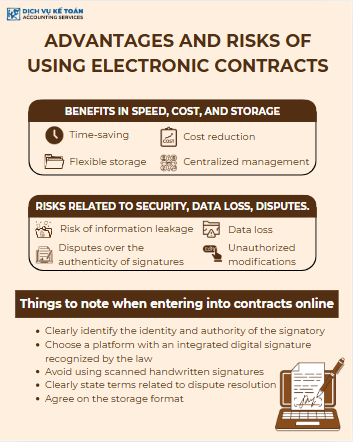
Benefits in Speed, Cost, and Storage
Compared to traditional paper contracts, electronic contracts offer clear advantages:
- Time savings: Contracts can be signed in minutes with no need for face-to-face meetings.
- Cost reduction: There are no expenses for printing, mailing, or courier delivery.
- Flexible storage: Contracts are stored on digital platforms, making them easy to search, retrieve, and synchronize with document management software.
- Centralized management: It is simple to monitor the signing process, track each party’s status, and integrate automated reporting.
These benefits are particularly valuable in fast-paced business environments such as e-commerce, logistics, and finance, where multi-location transactions are common.
Risks Related to Security, Data Loss, and Disputes
Despite their convenience, electronic contracts carry potential risks if businesses do not follow sound security practices:
- Information leakage if the storage system does not encrypt data.
- Data loss caused by system failures and the lack of regular backups.
- Disputes over signature authenticity when scanned images are used instead of proper digital signatures.
- Unauthorized modifications when there is no timestamping mechanism or change log.
These risks can compromise the legal validity of an electronic contract and may lead to a court dismissing it in the event of a dispute.
Role of Third Parties and Certification Entities
A valid electronic contract typically involves:
- Contract platform providers such as TrustSign, FPT.eContract, and VNPT;
- Digital signature certification authorities (CAs) such as Bkav, Viettel-CA, and FPT-CA;
- Third-party storage intermediaries that handle data backup, security, timestamping, and clear legal evidence.
These entities ensure transparency, security, and legal compliance throughout the electronic contract signing process.
Considerations When Concluding Contracts Online
When using electronic contracts, businesses should:
- Clearly verify the identity and authority of each signatory;
- Choose platforms that integrate legally recognized digital signatures;
- Avoid using scanned handwritten signatures, since they have no legal value unless properly verified;
- Clearly state the provisions for dispute resolution conducted electronically;
- Agree on storage formats (PDF, XML, JSON) that support content integrity checks.
How to Mitigate Risks When Signing Electronic Contracts
Recommended measures to reduce risks when using electronic contracts include:
- Use digital signatures issued by reputable CAs;
- Store contracts in systems with multi-layer backup that prevent unauthorized alterations;
- Log every signing activity (access logs, IP addresses, timestamps);
- Use timestamping services;
- Train legal and accounting staff to manage electronic contracts effectively.
For any inquiries, contact Wacontre Accounting Services via Hotline: (028) 3820 1213 or email [email protected] for prompt assistance. With a team of experienced professionals, Wacontre is committed to providing dedicated and efficient service. (For Japanese clients, please contact Hotline: (050) 5534 5505).