
When a business begins using its fixed assets, registering depreciation is a critical step in accounting and tax finalization. Failure to comply with the regulations may result in depreciation expenses being disallowed as deductible costs for Corporate Income Tax (CIT) purposes. Understanding the procedures, timing, and required documents for fixed asset depreciation helps businesses protect their tax benefits and ensure full legal compliance. This article provides a step-by-step guide on how to register fixed asset depreciation in line with the latest legal requirements in Vietnam.
What Is Depreciation Registration?
Definition
Depreciation registration is a mandatory accounting procedure that businesses must complete when putting fixed assets into use for production or business activities. Under current regulations, companies are required to notify the tax authority of the depreciation method chosen for each fixed asset so that depreciation expenses can be recognized as deductible when calculating Corporate Income Tax (CIT). This process ensures transparency in accounting and directly affects both taxable profit and the amount of CIT payable. Depreciation of fixed assets allows a business to gradually allocate the cost of its investment over the asset’s useful life, accurately reflecting wear and tear in the accounting records. Failure to register depreciation correctly and on time may result in the entire depreciation expense being disallowed, leading to higher tax liabilities and potential legal risks during audits or inspections.
The Concept of Fixed Asset Depreciation
Fixed asset depreciation is the process of allocating the initial or book value of an asset as an expense over a defined period — typically annually or per accounting cycle. Depreciation reflects the actual use and deterioration of an asset, supporting the accuracy and reliability of a company’s financial statements.
There are three common depreciation methods allowed by law:
- Straight-line method
- Declining balance method
- Units-of-production method
Each method suits different types of assets and industries. The chosen method must reflect the actual nature of asset usage and must be registered with the tax authority before implementation.
The Importance of Fixed Asset Depreciation
Depreciation plays a key role in corporate financial management by:
- Recording reasonable business expenses and determining taxable income;
- Allocating the value of asset investments into periodic operating costs;
- Supporting maintenance and replacement planning;
- Serving as a key input for financial reporting, loan applications, and shareholder presentations.
Proper depreciation also reflects the true condition of a company’s assets in the accounting records, thereby increasing reliability during audits and tax reviews.
When Must Depreciation Be Registered?
According to Circular 45/2013/TT-BTC and Circular 96/2015/TT-BTC, all fixed assets used for business purposes must be registered for depreciation with the tax authority.
Specifically, enterprises must:
- Notify the tax office of their chosen depreciation method before starting depreciation;
- Prepare a detailed list of the fixed assets to be depreciated;
- Maintain consistency in the registered method throughout the depreciation period, unless a justified change is approved.
If a company changes its method without approval or fails to register, the related depreciation expense will not be recognized as deductible for CIT purposes.
Depreciation and Its Impact on Corporate Income Tax (CIT)
Depreciation expenses are considered deductible for CIT only when the following conditions are met:
- The asset is used for business operations;
- Valid invoices, contracts, and supporting documents are in place;
- The depreciation method was registered before depreciation began;
- The asset meets the legal definition of a fixed asset under current regulations.
Failing to meet these conditions may lead to partial or full disallowance of depreciation expenses, resulting in higher tax obligations and increased audit risk. Registering fixed asset depreciation is therefore a critical step in accounting and corporate tax management.
When Should Fixed Asset Depreciation Be Registered?
Determining the correct timing for registering fixed asset depreciation is essential to ensure that depreciation expenses are legally recognized during the tax period. In practice, many businesses have had their depreciation expenses disallowed by the tax authority simply because they failed to register on time or did not submit a proper written notice. Accurately identifying the registration timeline and strictly following the required procedures is the only way to ensure that depreciation expenses are accepted as deductible costs during CIT finalization.
Should Depreciation Be Registered Before or After the Asset Is Put into Use?
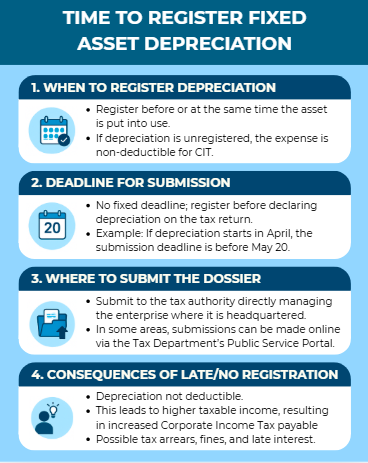
Under current regulations, businesses must register depreciation before depreciation begins or, at the latest, within the first tax declaration period in which depreciation expenses arise. In other words, registration must be completed before or at the same time the asset is officially put into use. If a business begins using an asset without registering the depreciation method, all depreciation expenses from that point onward will be disallowed as deductible costs for CIT purposes. It is therefore best to register depreciation immediately after recording the fixed asset in the accounting books to avoid missing the deadline.
Deadline for Submitting the Depreciation Dossier
There is no fixed statutory deadline for submitting a depreciation registration dossier.
However, the general rule is that it must be submitted before depreciation expenses are declared on the tax return. For example, if depreciation begins in April, registration must be completed before filing the tax return for that month or quarter (typically by the 20th of the following month). If errors are discovered after submission, businesses may still make corrections, but they must provide a written explanation and are subject to review by the tax authority.
Tax Authority Receiving the Registration
The depreciation registration dossier must be submitted to the local tax office that directly manages the enterprise’s head office. Many provinces and cities now allow online submission via the General Department of Taxation’s public service portal, enabling businesses to file electronically instead of in person. Companies should retain electronic receipts or submission confirmations as legal proof in case of future inspections or disputes.
Consequences of Late or Missing Registration
If a business fails to properly register depreciation on time, the tax authority has the right to disallow all related depreciation expenses when determining taxable income for CIT. This will increase taxable profit and, consequently, raise the amount of tax payable. In addition, if the tax authority discovers unregistered depreciation across multiple periods, the business may face tax arrears, late-payment interest, and administrative penalties.
Registering depreciation on time and in line with the regulations is therefore not only an accounting obligation but also a key safeguard against future financial and legal risks.
What Are the Methods of Fixed Asset Depreciation?
After registering fixed asset depreciation, businesses must determine the appropriate depreciation method for each type of asset. The chosen method affects not only periodic expenses but also the company’s profit and tax obligations. The selected method must comply with Circular No. 45/2013/TT-BTC and cannot be changed arbitrarily during use unless there is a valid reason.
1. Straight-Line Method
This is the simplest and most common depreciation method used in accounting. Under this method, depreciation expenses are allocated evenly over the asset’s useful life. Monthly depreciation is calculated by dividing the original cost by the number of years of useful life prescribed by the Ministry of Finance. This method is preferred by most businesses because of its stability, ease of accounting, and suitability for assets with consistent usage over time.
2. Declining Balance Method
This method allows higher depreciation in the early years and gradually lower amounts in later years. It is suitable for assets that wear out quickly in the initial period of use, such as technology equipment or specialized machinery. Not all assets qualify for this method, however. Businesses must prepare full documentation and register clearly with the tax authority when applying the declining balance method to avoid having depreciation expenses rejected during tax finalization.
3. Units-of-Production Method
This method applies to assets whose wear and tear depends on production output, such as machinery used in processing or mass production. Under this approach, depreciation expenses are allocated based on the number of units produced during each period, using the ratio of actual output to estimated total output. Businesses must maintain clear and transparent production records to justify this method to the tax authority.
4. Rules for Changing the Depreciation Method
Once a depreciation method has been registered, it must be applied consistently throughout the asset’s useful life.
Changes are only permitted for legitimate reasons, such as:
- a change in how the asset is used;
- a shift in production scale; or
- new official guidance from the authorities.
If a business changes methods without re-registration or without valid grounds, all related depreciation expenses may be disallowed for tax purposes. Businesses should therefore carefully evaluate and select the appropriate method before registration to avoid future tax and accounting risks.
Note: Each method has its own advantages and limitations and is suitable for specific asset types. Businesses should consult their chief accountant or a professional accounting service before registering depreciation to ensure compliance and minimize risk.
What Does a Fixed Asset Depreciation Registration Dossier Include?
To properly register fixed asset depreciation, businesses must prepare a complete set of documents in line with Circular No. 45/2013/TT-BTC and Circular No. 96/2015/TT-BTC. Preparing the dossier accurately from the start saves time, prevents rejection by the tax authority, and ensures that depreciation expenses are accepted as deductible when calculating CIT. Below are the essential components of a fixed asset depreciation registration dossier.
Depreciation Registration Notice
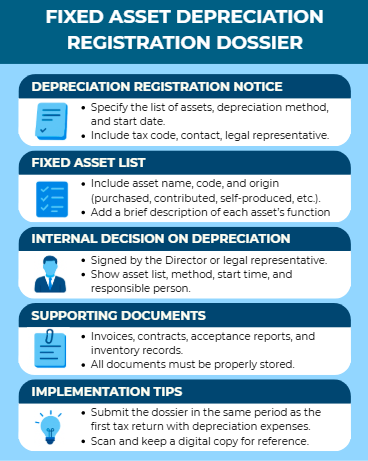
This is the main and mandatory document in the registration dossier. It must clearly include:
- The list of fixed assets to be depreciated;
- The depreciation method to be applied (straight-line, declining balance, or units-of-production);
- The start date of depreciation;
- The reason for the chosen method when the straight-line method is not used.
The notice must also state the company’s tax identification number (TIN), contact information, and legal representative so that the tax authority can easily request additional clarification or documents if needed.
List of Fixed Assets
This list summarizes detailed information about each fixed asset to be depreciated, including:
- Asset name;
- Code or serial number and origin (purchased, capital contribution, self-produced, etc.);
- Original cost, date placed in service, and estimated depreciation period;
- The department or unit using the asset and its location.
It is advisable to attach a brief description of each asset’s function to demonstrate that it serves production or business activities. This helps the tax authority assess the validity and reasonableness of the depreciation claim.
Internal Decision on Depreciation
The business must issue an internal decision signed by the Director or legal representative, clearly stating:
- Approval of the fixed assets to be depreciated;
- The depreciation method applied to each asset;
- The start date of depreciation;
- The department or individual responsible for overseeing the depreciation process.
This internal document strengthens transparency and confirms that the depreciation registration is a deliberate and well-organized process.
Supporting Forms and Documents
In addition to the above, businesses should prepare the following supporting materials:
- Purchase invoices, sales contracts, or handover minutes;
- Acceptance records or commissioning reports;
- Inventory or valuation reports (for contributed or transferred assets);
- Technical documents where applicable — such as operation manuals or production capacity data (for the units-of-production method).
All documents must be kept on file and presented on request by the tax authority during inspections.
Recommendation: It is best to submit the depreciation registration dossier together with the first tax declaration period in which depreciation expenses arise. Businesses should also scan and store digital copies in their internal system for easy reference and verification during future tax audits.
Are Depreciation Expenses Deductible for Tax Purposes?
Depreciation of fixed assets is one of the key expenses used to determine a company’s taxable income. However, not all depreciation expenses are deductible. Only when a business registers depreciation properly and applies it according to the approved method and timeframe will the expense be recognized by the tax authority as deductible for CIT purposes. Understanding and complying with these conditions helps businesses optimize costs and avoid tax penalties or back payments.
Conditions for Depreciation to Be Deductible
For fixed asset depreciation to be accepted as a deductible expense when determining taxable income, businesses must meet the following requirements:
- The asset is used for production or business purposes;
- The asset has valid invoices and documents proving ownership, value, and origin;
- The asset is recorded in the accounting books in line with the regulations;
- The depreciation method is properly registered with the tax authority at the correct time;
- The depreciation period complies with the framework prescribed by the Ministry of Finance (neither shorter nor longer without valid justification).
Failure to meet any of these conditions may result in the depreciation expense being disallowed, increasing taxable income and CIT payable.
Non-Deductible Depreciation Cases
Certain types of asset depreciation are not considered deductible, including:
- Assets that do not meet the definition of a fixed asset (e.g., value under VND 30 million);
- Assets not used for business purposes (e.g., vehicles used for personal matters);
- Assets that have been fully depreciated but are still being depreciated further;
- Depreciation applied without proper registration or following unauthorized method changes;
- Assets acquired through grants, aid, or free allocation, unless otherwise permitted by law.
Businesses should periodically review their fixed asset lists and depreciation schedules to prevent miscalculations that could affect financial statements and tax reports.
Key Points When Recording Depreciation
When accounting for depreciation expenses, accountants must ensure:
- Accurate timing and asset classification;
- Proper allocation of depreciation to the correct departments;
- Recognition of depreciation under the correct cost accounts (e.g., accounts 627, 641, or 642);
- A reasonable allocation method for assets used across multiple functions;
- That the accounting software accurately reflects the depreciation period, method, and asset cost.
Incorrect accounting can result in disallowed expenses or tax reassessment during audits or inspections.
How to Verify That the Tax Authority Has Acknowledged Depreciation
After registering depreciation, businesses should keep the submission receipt (either a hard copy or an electronic one if filed online). They can also contact their managing tax officer to confirm that the depreciation registration has been recorded. In some cases, the registration status can be tracked via e-tax software or the tax authority’s online portal. If there is any doubt that the registration has been processed, the business should send an official confirmation letter to ensure that depreciation expenses are not later disallowed during tax finalization.
Registering fixed asset depreciation on time, with the correct method and documentation, is not only a legal requirement but also a key step in protecting deductible business expenses and optimizing tax obligations. Complying with the depreciation rules enhances financial transparency, reduces tax risk, and accurately reflects the company’s asset value. If you need assistance in registering or preparing depreciation documentation properly, contact a professional accounting team for fast, accurate, and compliant support.
For any inquiries, contact Wacontre Accounting Services via Hotline: (028) 3820 1213 or email [email protected] for prompt assistance. With a team of experienced professionals, Wacontre is committed to providing dedicated and efficient service. (For Japanese clients, please contact Hotline: (050) 5534 5505).

EDITORIAL INFORMATION
Wacontre Accounting & Tax Editorial Team
This article is maintained by the Wacontre editorial team. A named reviewer and review date are shown only after individual sign-off; this article does not yet have that sign-off.
Official references
Update history
- : Added editorial ownership, official references, and update history; no individual expert review is claimed.
- : Originally published.