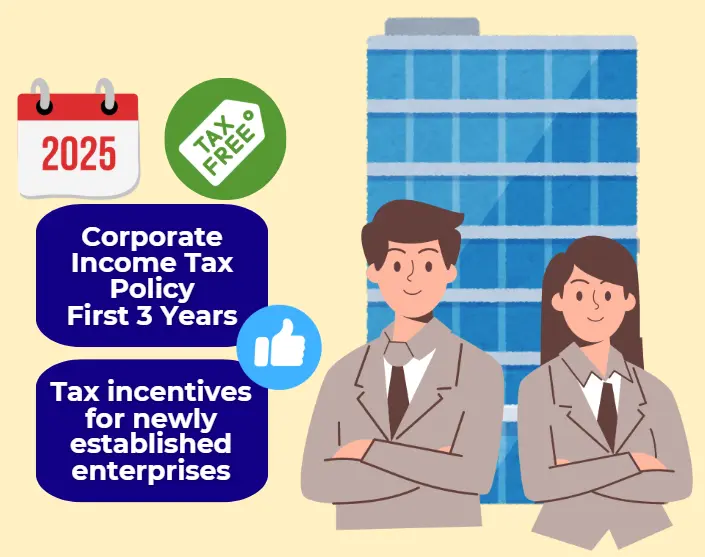
From 2025, newly established companies in Vietnam will be exempt from corporate income tax (CIT) for their first three years of operation. These preferential policies help businesses launch smoothly and grow sustainably. The 2025 policy of exempting CIT for the first three years opens up significant opportunities for young companies. With incentives such as the 2025 CIT exemption and tax benefits for newly established companies, this provides strong momentum for successful start-ups.
From 2025: Corporate Income Tax Exemption for the First 3 Years for Newly Established Companies
Under Resolution 68-NQ/TW, Section III, Sub-section 2.1, issued on May 4, 2025: business license fees are abolished, and small and medium-sized enterprises (SMEs) are exempt from corporate income tax for the first three years after establishment.
As a result, the three-year CIT exemption policy applies to newly established SMEs. The main beneficiaries are enterprises registering for business for the first time and that have never operated before (including sole proprietorships, limited liability companies, joint stock companies, and legally registered cooperatives).
In particular, the policy focuses on sectors that the government encourages, such as high technology, agricultural technology, creative services, and clean, environmentally friendly production. Innovative start-ups also qualify for this incentive, providing a solid foundation for new projects. In addition, some businesses converting from household businesses to companies may also be considered for tax exemption if they meet the conditions set by the tax authority.
Conditions for Applying the Corporate Income Tax Exemption
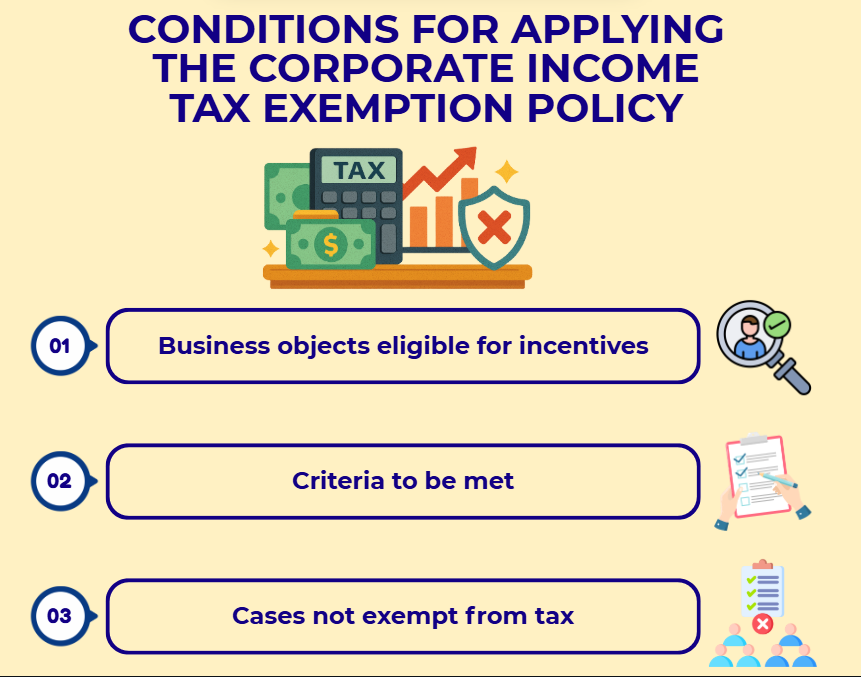
1. Enterprises Eligible for the Incentive
Under the Law on Support for Small and Medium Enterprises 2017, Article 4 — Criteria for Identifying SMEs:
SMEs include micro, small, and medium-sized enterprises with an average annual headcount participating in social insurance of no more than 200 employees, and that meet one of the following two criteria:
a) Total capital does not exceed VND 100 billion;
b) Total revenue of the previous year does not exceed VND 300 billion.
Under Decree 80/2021/ND-CP, Article 5 — detailed criteria by enterprise size and sector:
Micro enterprises:
– Industry, construction, agriculture, forestry, and fishery: up to 10 employees, revenue up to VND 3 billion, or capital up to VND 3 billion.
– Trade and services: up to 10 employees, revenue up to VND 10 billion, or capital up to VND 3 billion.
Small enterprises:
– Industry, construction, agriculture, forestry, and fishery: up to 100 employees, revenue up to VND 50 billion, or capital up to VND 20 billion.
– Trade and services: up to 50 employees, revenue up to VND 100 billion, or capital up to VND 50 billion.
Medium enterprises:
– Industry, construction, agriculture, forestry, and fishery: up to 200 employees, revenue up to VND 200 billion, or capital up to VND 100 billion.
– Trade and services: up to 100 employees, revenue up to VND 300 billion, or capital up to VND 100 billion.
2. Criteria to Qualify for the Tax Exemption
To benefit from the three-year CIT exemption, enterprises must meet the following criteria:
– Legal registration: the enterprise must hold a business registration certificate issued by the competent business registration authority.
– Actual operations: the enterprise must carry out genuine production and business activities, maintain transparent accounting records, and demonstrate valid revenue and expenses.
– No legal violations: the enterprise must not seriously breach tax, environmental, or labor regulations during the exemption period.
– Eligible business lines: the enterprise must operate in sectors encouraged by the state and not appear on the list of restricted or prohibited industries.
3. Cases Not Eligible for the Tax Exemption
Not every new enterprise qualifies for the tax exemption. The following cases are excluded to ensure fairness, prevent abuse of the policy, and support businesses that genuinely contribute to economic development:
– Newly established businesses that are in fact spin-offs, mergers, or consolidations of existing businesses.
– Businesses that change their name and legal representative while maintaining the same production facilities.
– Businesses operating in industries with negative impacts on the environment or public health.
– Organizations whose capital sources are not transparent or that show signs of exploiting the policy to evade taxes.
Benefits of the First 3-Year Corporate Income Tax Exemption
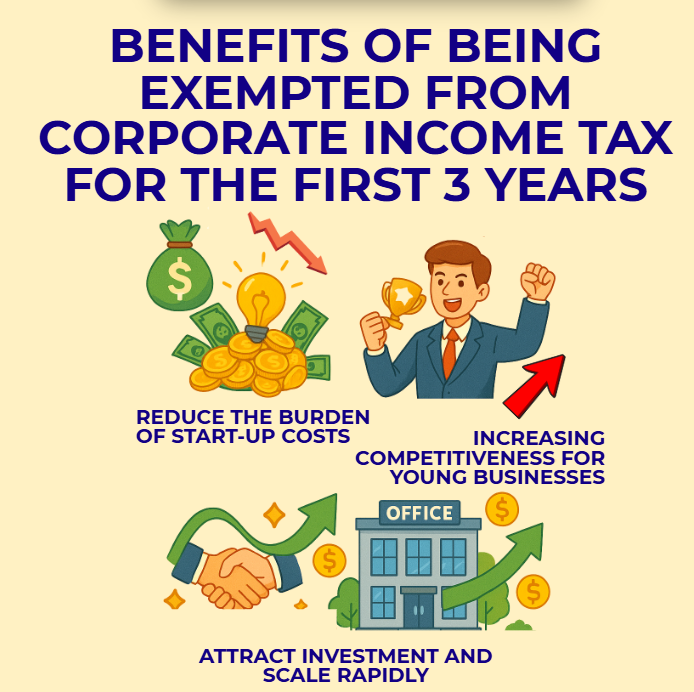
1. Reducing the Burden of Start-up Costs
In the early stages, businesses often face challenges with capital, operating costs, and competitive pressure. The three-year CIT exemption significantly reduces the financial burden, enabling businesses to focus resources on production, marketing, and market expansion.
Not paying CIT for the first three years means cash flow is retained and quickly reinvested in essential activities. This is particularly meaningful for start-ups with limited capital.
2. Increasing Competitiveness for Young Businesses
The tax exemption allows young businesses to offer more competitive prices than their rivals. Without the additional tax cost, they can deliver better pricing and strengthen their ability to capture market share.
In addition, the exemption creates a cash-flow advantage, giving businesses more flexibility to develop products, expand distribution channels, and improve service quality.
3. Attracting Investment and Expanding Quickly
A new business that enjoys tax incentives can more easily attract investment capital from funds and partners. Investors typically prioritize businesses with a clear legal foundation and government support.
During the three-year exemption period, businesses can use retained profits to expand operations, hire additional staff, and invest in technology, building a sustainable competitive advantage.
The three-year CIT exemption for newly established companies from 2025 is an important milestone in supporting young businesses. It not only relieves financial pressure during the start-up phase, but also helps create a fair business environment that encourages innovation and long-term investment.
Businesses should proactively seize this opportunity by preparing transparent documentation and clear development plans to fully benefit from the policy.
For any inquiries, please contact Wacontre Accounting Services via Hotline: (028) 3820 1213 or email [email protected] for prompt assistance. With a team of experienced professionals, Wacontre is committed to providing dedicated and efficient service. (For Japanese clients, please contact Hotline: (050) 5534 5505).