

A complete overview of Decree 70/2025 in Vietnam, covering the major changes to invoices, social insurance (SI), cash payments, and salaries, along with practical compliance solutions.
Decree 70/2025 is now in effect and is fundamentally reshaping Vietnam’s business landscape. This guide walks through the new rules on e-invoices, mandatory social insurance for business owners, non-cash payments, and salary transparency.
Since taking effect, Decree 70/2025 has profoundly reshaped Vietnam’s business environment. No longer a draft or a future proposal, the new regulations on invoices, social insurance, cash payments, and salary management are now the reality every business must face. This article provides a complete overview, an A-to-Z analysis of the core changes, and strategic solutions to help businesses not only comply but also turn these challenges into a competitive advantage.
What Is Decree 70/2025 and Why Should Businesses Care?
Decree 70/2025/ND-CP (hereinafter referred to as Decree 70/2025) is a pivotal legal document that marks a decisive step by the Government to modernize tax administration and establish a transparent business environment. It is not a routine update but a systematic reform whose core objective is to apply technology comprehensively to every economic transaction, closing loopholes that cause budget revenue loss and eliminating fraudulent practices.
With Decree 70/2025 now fully implemented, every business must pay close attention because it affects four vital pillars of any enterprise: cash flow, costs, operational processes, and risk management. Ignoring or delaying adaptation will not only lead to heavy administrative penalties but can also disrupt operations and erode competitiveness. The Decree leaves no one behind; from large corporations to micro-enterprises, each provision carries deep management implications and demands a shift in leadership mindset. Understanding Decree 70/2025 is no longer optional—it is a mandatory requirement for survival and growth.
A Detailed Analysis of the 4 Core Changes in Decree 70/2025
Decree 70/2025 centers on four main areas, each introducing transformative regulations that require immediate adjustments from businesses.
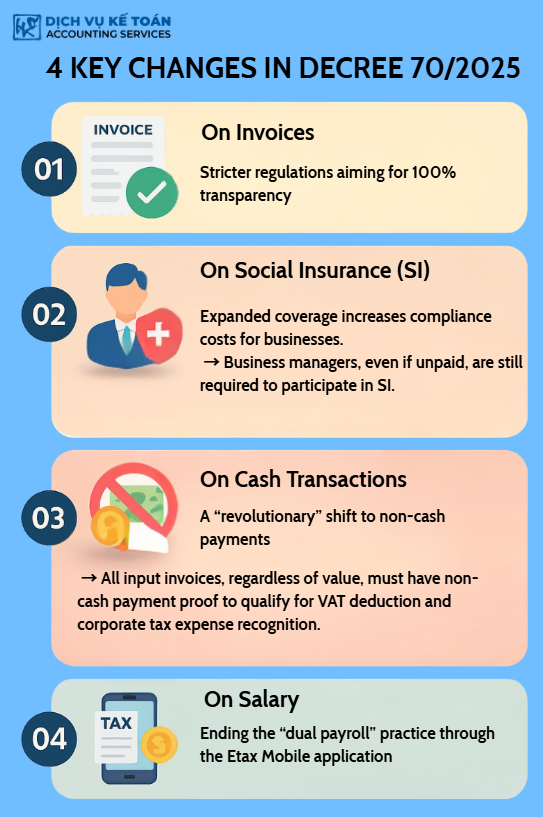
1. Invoices: Tighter Regulations Aimed at 100% Transparency
First, the information requirements for retail invoices have been tightened. For businesses selling directly to consumers—such as supermarkets, restaurants, and convenience stores—issuing invoices without buyer information or pooling multiple transactions into one is no longer compliant. The new rule requires recording the buyer’s full identification details upon request, preventing the sale of fraudulent invoices and protecting consumer rights. This creates significant challenges at checkout, requiring staff retraining and more flexible POS systems.
Second, the scope of mandatory use of cash registers connected to the tax authority’s data system has been expanded. Service industries with high cash transaction volumes—such as transportation, F&B, hospitality, and retail—must now transmit all revenue to the tax authority’s system in real time. This is not merely an equipment investment but a fundamental shift in revenue management, leaving no room for unrecorded income.
Third, and most critically, the process for handling errors has become far stricter. The concept of “canceling an invoice” has been virtually eliminated. Any error discovered after an invoice has been sent to the buyer must be corrected by issuing an adjusted or replacement invoice, accompanied by a clear explanation via Form 04/SS-HDDT. This creates an indelible audit trail and demands near-perfect accuracy from accountants from the very first issuance.
2. Social Insurance (SI): Expanded Coverage and Higher Compliance Costs
- The owner of a private enterprise.
- The Director or General Director of a single-member Limited Liability Company (owned by an individual).
- The owner of a business household (applicable to registered business households).
Previously, owners of these enterprise types commonly kept themselves off the payroll to optimize costs, since they received after-tax profits instead of a salary. The new regulation completely closes this “grey area.” The law aims to ensure long-term social security benefits—such as pensions, sickness, and maternity leave—for business owners and leaders themselves, while also ensuring fairness with other employees.
Direct impact on businesses:
- Higher fixed costs: Businesses must contribute monthly SI for the subjects above, based on an SI contribution base set by law (typically no lower than the regional minimum wage). This is an additional mandatory expense that must be built into the financial plan.
- Declaration and monitoring obligations: Accounting and HR teams must immediately complete registration procedures, report the increase in labor, and declare and pay monthly SI contributions for these subjects to avoid back-payments and high-interest late penalties.
This mandatory regulation requires business owners to rethink their cost management approach and view SI contributions as an investment in their own future.
3. Cash: A Revolutionary Rule on Non-Cash Payments
All input invoices, regardless of value, must have non-cash payment proof to qualify for input VAT deduction and to be counted as a deductible expense for Corporate Income Tax (CIT) purposes.
This regulation completely removes the previous VND 20 million threshold, meaning cash payments in business-to-business transactions now have virtually no tax value. The Government’s objective is clear: eliminate cash transactions in the business sector, monitor 100% of financial flows, and prevent the legitimization of expenses through fake invoices that lack real transactions. For businesses, this is a major operational challenge. Companies must fully overhaul their payment policies, abolish petty cash for small purchases, and require all departments to use bank transfers, even for minor expenses.
4. Salary: Ending the “Two-Payroll” System via the eTax Mobile App
Now, any employee can easily log in and verify the official salary their company is declaring on their behalf. This makes the “two-payroll” practice—a low salary on paper to reduce SI and tax contributions, with the remainder paid in cash—extremely risky. If employees discover discrepancies, they can file complaints, and the business will face back-collection of Personal Income Tax (PIT) and SI, plus related penalties, on the entire actual salary. This rule forces businesses to confront their true labor costs, including taxes and insurance on total income, marking a major shift in cost structure.
The Impact of Decree 70/2025 on Business Structure and Operations
- Financial: Compliance costs have surged. Businesses must invest in technology (software, cash registers), personnel costs (fully declared salaries and SI), and advisory services. Cash flow is also affected by the inability to flexibly use cash.
- Operational: Internal processes must be standardized and tightened. Sales, procurement, advance payments, settlements, and payroll must all be redesigned to ensure 100% compliance, with no room for ad hoc or “experience-based” practices.
- Technological: Businesses are forced into digital transformation. Maintaining separate, unintegrated software systems will be a critical weakness. Technology has become a mandatory factor for survival.
- Strategic: The “grey areas” in business have been significantly narrowed. Business models built on cost optimization through informal methods are no longer sustainable. Companies must now compete on core competencies, product quality, and genuine management efficiency.
Comprehensive Solutions to Comply with Decree 70/2025
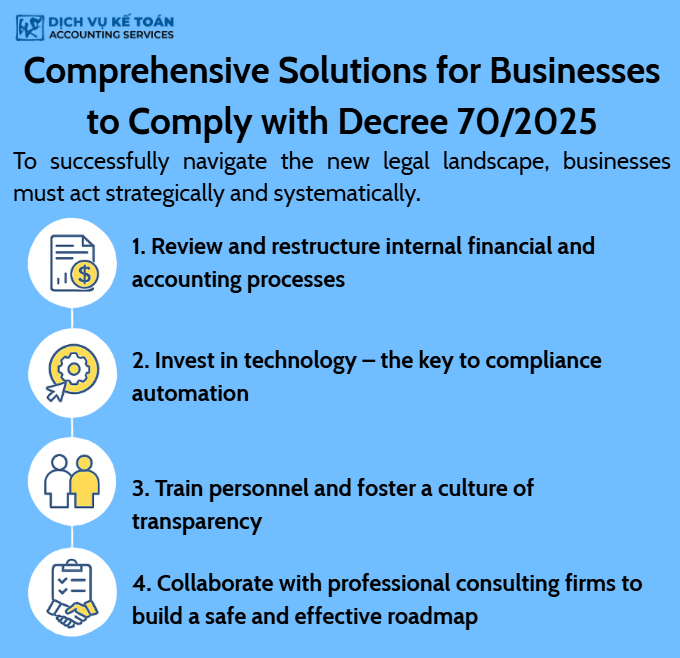
1. Review and Restructure Internal Finance and Accounting Processes
2. Invest in Technology: The Key to Automating Compliance
3. Train Personnel and Build a Culture of Transparency
4. Partner with Professional Advisory Firms for a Safe Roadmap
Decree 70/2025 is truly a revolution in Vietnam’s tax administration. While the new regulations may create significant challenges and cost pressures in the initial phase, over the long term they will build a more transparent, fair, and modern business environment. Businesses that take a long-term view—proactively adapting, treating compliance as a cornerstone of corporate culture, and systematically investing in technology and people—will not only overcome the challenges but also unlock opportunities to break through, strengthen their position, and achieve sustainable growth in the new era.
For any inquiries, contact Wacontre Accounting Services via Hotline: (028) 3820 1213 or email [email protected] for prompt assistance. With a team of experienced professionals, Wacontre is committed to providing dedicated and efficient service. (For Japanese clients, please contact Hotline: (050) 5534 5505).