
Effective HR management requires a professional offboarding process. This guide covers how to terminate employees gracefully and legally to ensure a smooth transition for both sides.
What Is a Graceful Employee Termination?
A graceful termination is more than just the clerical act of ending an employment contract on paper. It is a human-centric HR process where the enterprise executes a dismissal based on respect, empathy, and strict adherence to legal regulations. When an employee is no longer a fit for the organization, instead of creating negative pressure, managers utilize sophisticated communication skills to help them depart in the most positive mindset possible.
Essentially, this is the “art of dismissal,” where the worker’s dignity is protected and the company’s reputation is upheld. This process requires meticulous preparation, ranging from legal and financial aspects to the dialogue script itself. A civilized parting will not leave behind bitterness, “exposure” posts on social media, or lawsuits filed with authorities. Instead, it opens the door for both parties to begin a better new journey.
The Importance of Professional Employee Offboarding
1. Protecting Corporate Reputation and Employer Branding
In the digital age, Employer Branding is an invaluable asset. How you treat someone about to depart is observed by those remaining and the external community alike. If the offboarding process is unprofessional, malicious rumors can spread rapidly, making talented candidates hesitant to apply to the company.
A business with a culture of graceful departures will be regarded as a decent and trustworthy workplace. Even when they are no longer part of the team, former employees can become indirect “ambassadors,” recommending customers or new talent if they felt respected until their final minute. Protecting reputation is not just about avoiding scandal; it is about building sustainable core values for the organization.
2. Mitigating Legal Risks and Labor Disputes
Labor disputes in Vietnam often stem from businesses unilaterally terminating contracts without following the correct process or lacking sufficient grounds. Prolonged litigation not only causes significant financial damage through compensation but also consumes the leadership’s time and energy. Implementing a professional termination ensures all procedures align perfectly with the Labor Code.
When employees feel satisfied with the support terms and the company’s conduct, they are less likely to resort to extreme legal actions. Transparency in explaining reasons and goodwill in severance payments act as the best “shield” for the business. Risk management starting right from the face-to-face dialogue is the key to keeping the organization operating steadily within a safe legal corridor.
3. Maintaining Stability for the Remaining Workforce
Whenever a staff member leaves, those staying behind often develop anxiety, wondering: “Am I next?” If the firing process is ruthless or abrupt, the productivity of the entire team can drop sharply due to confusion and loss of trust in leadership. Unprofessional offboarding can trigger a wave of mass resignations from key personnel.
Conversely, seeing a colleague supported through a dignified and kind departure reassures the remaining employees about the company culture. They understand that the organization behaves appropriately even in the most difficult situations. This strengthens loyalty and maintains a positive working atmosphere, helping the business navigate personnel transitions smoothly.
Preparation Process Before Terminating an Employment Contract
1. Reviewing Legal Grounds Under Current Labor Laws
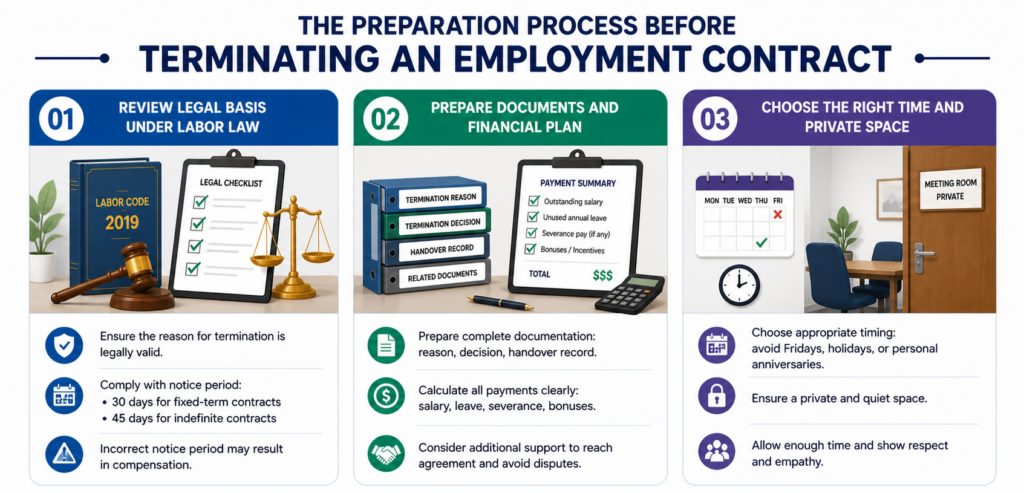
Before making any decision, the HR department and managers must carefully cross-reference the provisions of the 2019 Labor Code. The business needs to clearly determine if the reason for dismissal falls under the categories allowed for unilateral termination—for example, an employee repeatedly failing to complete tasks or due to organizational restructuring. A lack of solid legal grounds is the leading cause of failures in labor courts.
Furthermore, pay attention to the notice period required by the type of contract (30 days for fixed-term contracts and 45 days for indefinite-term contracts). Any error regarding the notice period can lead to compensation equivalent to the salary for the unnotified days. Thorough legal preparation allows the business to be more confident and decisive during the discussion.
2. Preparing Full Documentation and Financial Support Plans
The termination file includes documents proving the reason for dismissal, the draft termination decision, and the job handover minutes. Businesses should prepare a detailed calculation of payments: earned salary, unused annual leave, severance pay (if applicable), and performance bonuses. Clarity regarding numbers helps reduce stress and unnecessary inquiries from the employee.
Besides mandatory statutory payments, businesses should consider additional financial support to “soften” the departure. A severance package higher than the legal minimum can be a worthwhile investment to gain the employee’s consensus and a commitment not to dispute. When financial interests are secured, workers find it easier to accept reality and focus on seeking new opportunities rather than resisting.
3. Selecting the Appropriate Time and Space for the Discussion
The timing of a termination notice plays a vital role in psychological mitigation. Avoid giving notice on Friday afternoons, right before holidays, or on an employee’s personal anniversaries if possible. The beginning of the week is usually better, allowing the employee time to process the information and start new plans immediately. The discussion space must ensure absolute privacy, away from the prying eyes of other colleagues.
A closed meeting room with a neutral atmosphere helps the exchange stay focused and serious. Managers should set aside a sufficient amount of time, uninterrupted by phone calls or other meetings, to show respect for the employee. Meticulous preparation of the setting demonstrates that the business values human dignity and is conducting this process with deep empathy.
The Art of Communication During the Termination Meeting
1. Delivering the News Directly but Respectfully
In the dialogue, frankness is necessary but must be accompanied by a polite attitude. Managers should get straight to the point within the first five minutes to avoid creating unnecessary suspense. Use objective language, focusing on work and performance rather than personal attacks. For example, instead of saying “You performed poorly,” say “Current work results have not met the department’s expectations and general goals during this period.”
Maintaining a calm tone, direct eye contact, and open body language keeps the conversation from becoming hostile. Prepare specific evidence or data if the employee asks for further explanation, but never get caught up in arguing who is right or wrong. The purpose of this meeting is to announce the decision and agree on the departure plan, not to hold a stressful criticism or disciplinary session.
2. Listening to Feedback and Resolving Employee Concerns
After delivering the notice, allow space for the employee to express their feelings and ask questions. Being heard helps them relieve some of the shock or disappointment. Managers should show empathy by acknowledging their contributions to the company over the past period. Sometimes, a sincere thank you for past efforts is enough to diffuse much of the tension in the room.
For inquiries about benefits or subsequent procedures, answer patiently and accurately. If there are issues that cannot be decided immediately, take note and commit to responding within a specific timeframe. Thoroughly resolving small concerns from the start prevents them from escalating into major conflicts later. Empathy in communication is the bridge to maintaining a professional relationship.
3. Supporting the Employee During the Transition
Instead of asking an employee to leave immediately (except in special cases involving security), work with them to establish a reasonable handover plan. This helps the employee feel they still have value and responsibility to the organization until the last day. The business can provide support such as: letters of recommendation, advice on polishing their CV, or connecting them with other recruitment networks.
Assisting in the search for a new job is the highest testament to a company’s professionalism. Some large corporations now provide “Outplacement” services to help employees quickly reintegrate into the labor market. When workers see that the company truly cares about their future after leaving, voluntary cooperation and job handovers occur very smoothly and effectively.
Measures to Prevent Post-Termination Conflicts and Lawsuits
1. Implementing Confidentiality and Non-Compete Commitments
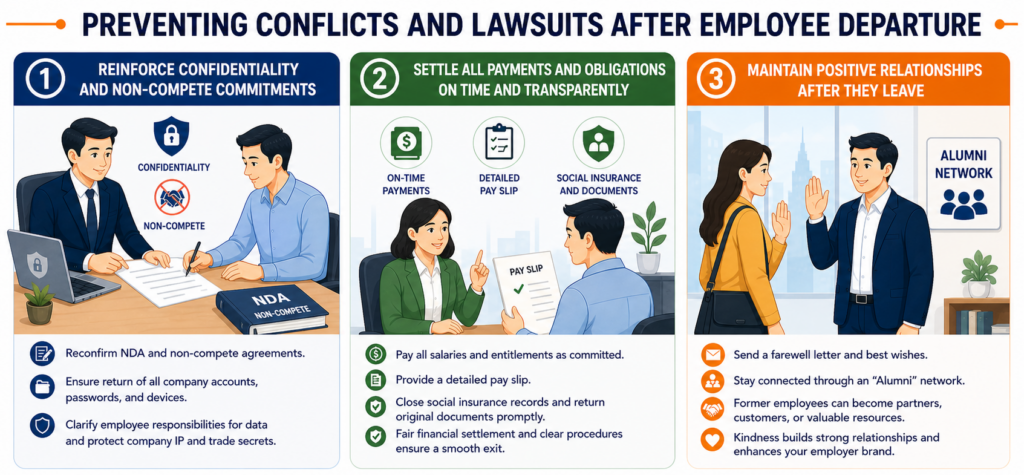
During the finalization of procedures, re-signing or reminding employees of Non-Disclosure Agreements (NDA) and Non-Compete clauses is crucial. This protects the business’s intellectual property and trade secrets when the employee moves to a new unit. However, these terms must be built on a voluntary basis and include reasonable compensation to ensure legal validity in Vietnam.
The business should clearly explain the employee’s rights and responsibilities regarding the data they once held. The full handover of accounts, passwords, and company devices should also be recorded in a clear minute. Transparency at this stage helps prevent disputes over trade secret infringement or customer poaching—conflicts that are often very difficult to resolve through sentiment alone.
2. Completing Payment Obligations Timely and Transparently
One of the most common causes of labor litigation is the delay or omission in paying wages and allowances. The business must ensure that all funds are transferred to the employee’s account exactly as committed in the termination decision. Attaching a detailed pay slip explaining each item of income and deduction helps the employee easily verify and maintain absolute trust.
Additionally, closing the Social Insurance book and returning original documents to the employee must be done as quickly as possible. In Vietnam, the process of closing the SI book can be time-consuming; therefore, HR should proactively update the former employee on the progress so they do not feel abandoned or harrassed. Fairness in finances and procedures is the fastest way to close a career chapter in peace.
3. Maintaining a Good Relationship After the Employee Departs
Do not cut off contact entirely the moment the employee walks out of the office. Sending a farewell letter or well-wishes from the direct manager can leave a lasting positive impression. Many large enterprises today build “Alumni” networks to stay connected and create future collaboration opportunities. Former employees can absolutely become partners, customers, or sources of high-quality talent referrals.
Treat the person leaving like an old friend rather than a stranger. This kindness costs nothing but brings immense value in terms of morale and brand image. When the community sees that a business always appreciates those who have contributed, regardless of their position, trust in the organization is more firmly consolidated than ever.
Terminating an employee has never been an easy task for any manager. However, by applying a graceful offboarding process and the art of professional dismissal, a business not only protects itself from legal risks but also asserts its status in HR management culture. Investing in a kind parting is a long-term investment in the reputation and sustainable development of the organization. Always remember: “How you end a relationship is just as important as how you started it.”
To empower your business in overcoming HR management challenges and staying fully committed to your strategic goals, we provide specialized solutions:
- [RPO Services]: A comprehensive recruitment process outsourcing solution.
- [BPO Services]: Strategic outsourcing to streamline business processes and optimize operational costs.
For any inquiries, contact Wacontre Accounting Services via Hotline: (028) 3820 1213 or email [email protected] for prompt assistance. With a team of experienced professionals, Wacontre is committed to providing dedicated and efficient service. (For Japanese clients, please contact Hotline: (050) 5534 5505).