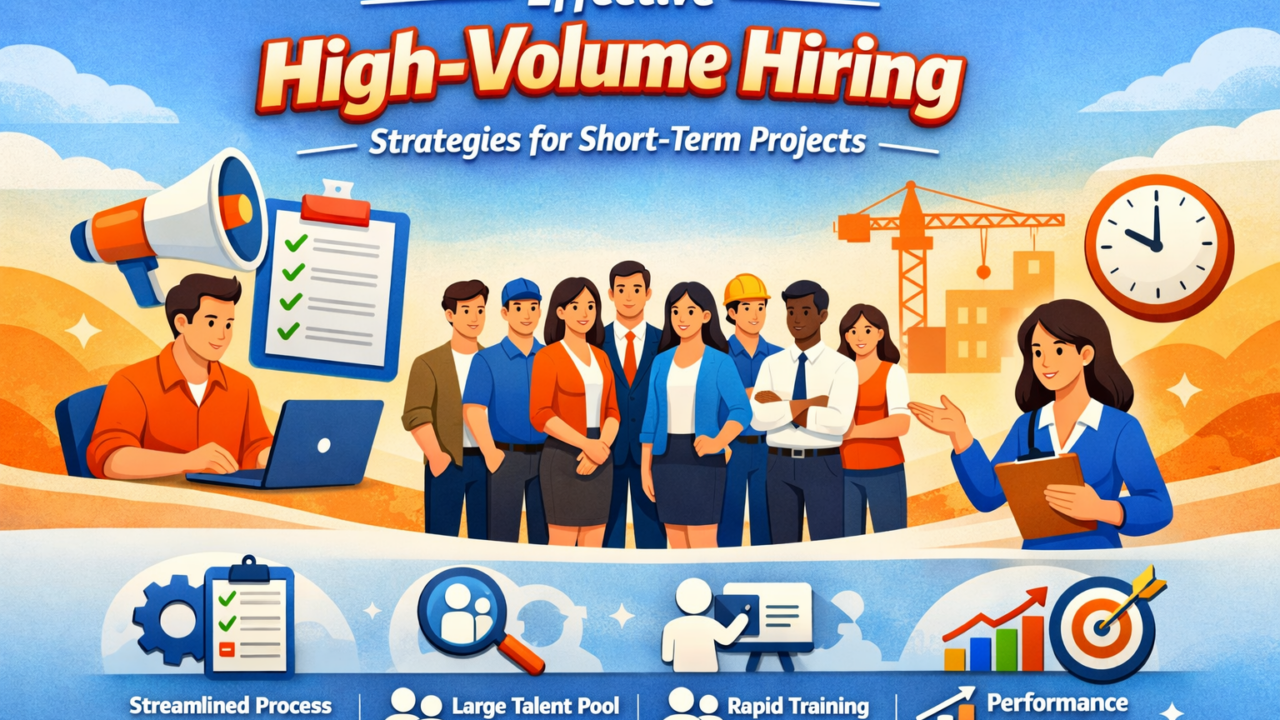
To succeed in mass hiring for short-term projects, businesses must integrate an efficient recruitment process and fast hiring solutions to manage seasonal labor effectively.
What is Mass Hiring for Short-term Projects?
Mass Hiring for Short-term Projects is the process of attracting and onboarding a large volume of personnel within an extremely compressed timeframe to meet immediate production or business demands. Typically, these projects last from 1 to 6 months, focusing on peak periods such as festive seasons, product launches, or short-term outsourcing contracts.
Unlike permanent recruitment, Mass Hiring prioritizes speed and scalability. Instead of deep-diving into individual long-term potential, businesses must establish a system capable of screening thousands of applications weekly. The objective is to identify candidates with core skills and a “can-do” attitude who are ready to start immediately.
In the Vietnamese market, this model is prevalent in sectors such as E-commerce (Mega Sales), Logistics, F&B Manufacturing, and Event Management. A robust strategy not only ensures smooth project execution but also minimizes the risk of mid-project attrition—a primary concern for any project manager.
The Strategic Importance of Mass Hiring for Short-term Projects
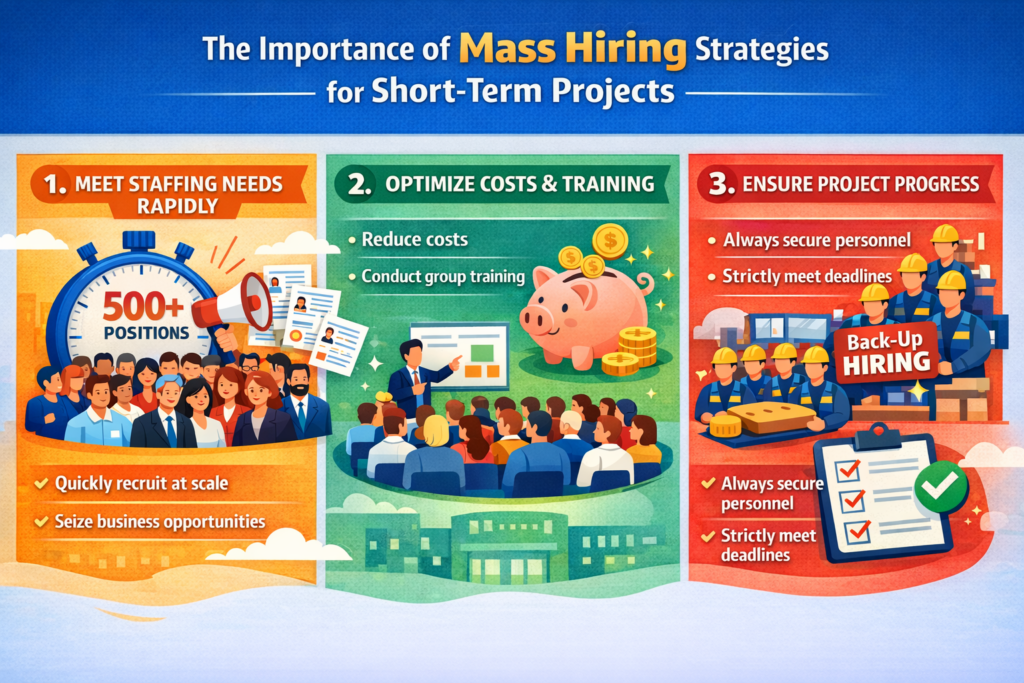
1. Meeting Personnel Demands in Minimal Time
In short-term projects, time is the most critical asset. A business cannot afford to spend 1-2 months filling 500 positions for a project that only lasts one quarter. A mass hiring strategy enables a powerful media blitz, attracting a massive talent pool within the first few days of the campaign.
Possessing a rapid response process allows businesses to seize market opportunities in real-time. For instance, when a partner suddenly requests a production surge, the ability to mobilize 200 seasonal workers within a single week becomes a core competitive advantage, maintaining the company’s reputation and market position.
Furthermore, rapid recruitment relieves pressure on the management team. When personnel are added promptly, operations remain seamless, preventing existing staff from overworking, which leads to burnout and operational errors.
2. Optimizing Operational and Training Costs
Despite the large scale of recruitment, a well-structured strategy can significantly reduce the cost-per-hire. Instead of allocating fragmented budgets for individual roles, businesses concentrate resources on a single, high-intensity campaign. This optimizes advertising and media spend across social platforms and job boards.
Regarding training, Mass Hiring allows for Group Training sessions. Rather than instructing individuals separately, businesses organize workshops to guide hundreds of people simultaneously. This saves internal trainer hours and ensures consistency in how tasks are executed.
Additionally, utilizing seasonal labor provides flexibility in payroll management. You only pay for manpower during the actual project duration, avoiding the waste of maintaining surplus staff when the market enters a low season.
3. Ensuring Project Deadlines and Delivery
Meeting deadlines is the lifeblood of short-term contracts. Even a minor personnel shortage in one department can stall the entire production line or service flow. Mass Hiring ensures that every role in the operational chart is filled at the right time.
This strategy often incorporates Back-up Hiring. Businesses typically recruit a surplus of 10-15% to immediately replace any “no-shows” or early resignations. This ensures the project remains fully staffed and operational progress is never interrupted.
Ultimately, a numerically strong team instills confidence in project managers. When human resources are guaranteed, departments can focus entirely on quality control and performance optimization instead of struggling to fill gaps.
Effective Implementation of a Mass Hiring Strategy
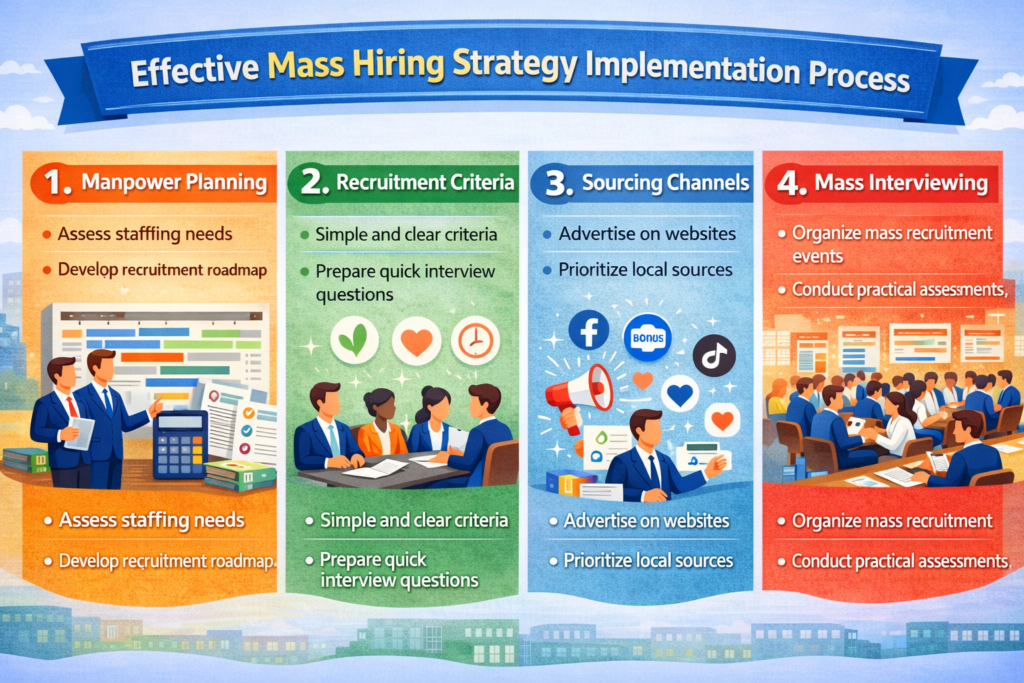
1. Manpower Planning and Demand Analysis
The first step is to accurately quantify personnel needs. Businesses must calculate the required man-hours based on expected volume to determine the exact headcount. This requires close coordination between HR and Operations to avoid discrepancies.
Manpower planning is not just about total numbers; it is about the Phasing of personnel growth. For example, week one might require 50 people for setup, while week two requires 200 more for full operation. A clear manpower chart helps the recruitment department know exactly when to “hit the gas” on sourcing.
Additionally, a detailed recruitment budget must be defined. This includes posting fees, headhunt service fees (if applicable), costs for Career Days, and attraction incentives such as “Joining Bonuses” to stimulate labor supply.
2. Developing Lean and Realistic Selection Criteria
In mass hiring, complex criteria are the biggest barriers. Businesses should strip away non-essential requirements and keep only 2-3 “Must-have” standards. Usually, for short-term projects, attitude, health, and time commitment are far more important than advanced degrees or deep experience.
Simplifying the Job Description (JD) is also vital. The JD should focus on the information seasonal workers care about most: Net salary, shift patterns, location, and allowances. The language should be accessible and clear, allowing candidates to make immediate applications.
Furthermore, prepare a set of Quick-scan questions. These help screen candidates within a 5-10 minute interview, focusing on verifying practical skills and cultural fit for a high-pressure environment.
3. Diversifying Sourcing Channels
To attract thousands of candidates in weeks, businesses cannot rely on a single channel. An omni-channel strategy is essential. Beyond professional job boards, social media platforms like Facebook (Job Groups), TikTok (Recruitment Videos), and Zalo are highly effective for reaching general labor and students.
Local relationships should not be overlooked. Partnering with universities, vocational centers, or local authorities helps access stable labor sources. In Vietnam, recruitment banners at industrial parks or local loudspeaker announcements still yield surprising results for large-scale needs.
Another sustainable channel is the Employee Referral Program. Encourage current staff to refer friends by offering small bonuses. These candidates often have higher engagement rates as they have acquaintances at work, reducing the likelihood of mid-project quitting.
4. Mass Interviewing and Assessment Process
Instead of individual interviews, organize Mass Recruitment Days. Here, the process—from reception and testing to interviewing—is executed like a production line. Candidates can often know the results on the same day, which is crucial for retaining them before they find other work.
Leveraging technology in assessment is key. Online registration forms (Google Forms, Typeform) automate data collection. Quick attitude or basic IQ tests on mobile phones help filter out unsuitable candidates at the “front gate,” saving time for interviewers.
During the interview, focus on practical scenarios. For warehouse staff, have them demonstrate sorting boxes on-site. For event staff, observe their communication and problem-solving in a mock situation. Real-world observation evaluates capability more accurately than any certificate.
Challenges and Solutions in the Vietnamese Market
1. High Ghosting Rates and Mitigation Tactics
“Ghosting” (candidates registering but not showing up) is the biggest challenge in Vietnam during mass hiring. This wastes resources and skews manpower plans.
The solution is continuous Candidate Care. Immediately after a candidate registers, send an SMS or call to confirm. One day before the interview, a reminder call or text is mandatory. Professional engagement from the employer increases the candidate’s sense of responsibility.
Additionally, adopt Over-recruitment. If you need 100 people and the ghosting rate is 20%, invite 120-130 people to join. Maintaining a Waitlist also provides an immediate replacement source if someone quits at the last minute.
2. Managing Quality During Rapid Expansion
When the pressure of numbers is overwhelming, HR departments may lower standards, leading to poor quality intake. Employees with low skills or bad attitudes negatively impact productivity and morale.
To resolve this, implement an Accelerated Probation system within the first 1-3 days. This is the most realistic screening stage. Those who do not meet discipline or performance minimums are replaced immediately by the backup pool. This protects the overall quality of the team.
Furthermore, hierarchical structuring is important. Identify more experienced personnel to act as Group Leaders managing small teams of 10-15. These leaders serve as HR’s “eyes and ears” on the ground, controlling quality and supporting new hires in real-time.
3. Leveraging AI and Automation in Mass Hiring
In the digital age, manual CV processing is unfeasible. Vietnamese businesses should invest in Applicant Tracking Systems (ATS). AI can automatically scan for keywords, reducing screening time from days to minutes.
Recruitment Chatbots are another smart solution. They can answer FAQs about salary and location 24/7 and assist in automated interview scheduling. This ensures no potential candidate is missed, even if they apply late at night.
Finally, digitizing HR records and using E-contracts is essential. Instead of managing stacks of paperwork for 1,000 people, all information is stored on the Cloud. This is not only professional but also simplifies searching, payroll, and data management later on.
Post-Recruitment Management for Short-term Projects
1. Accelerated Onboarding for Seasonal Staff
Project personnel must hit the ground running. Onboarding should be lean, lasting a maximum of half a day. Content should focus on: Safety regulations, Actual workflow, Support tools, and Points of contact.
Use visual learning materials like short videos or infographics. Instead of long lectures, let employees watch clips of actual task execution. This helps them visualize and retain information better in a hectic environment.
Ensuring all equipment (uniforms, badges, system accounts) is ready on day one is critical. Readiness from the employer makes new hires feel welcomed and responsible for contributing immediately.
2. Performance Tracking and Engagement
In mass hiring projects, employees often feel like “cogs in a machine.” Establish Daily Performance Tracking. Publicly displaying a Leaderboard and offering small weekly rewards for top individuals or groups creates immense motivation.
Engagement in short-term projects is not about grand Galas but meaningful actions. Afternoon tea, snacks, or a sincere “thank you” from the project manager carries significant weight. Make employees feel that even though the project is short, they are a vital part of the collective.
Don’t forget to establish a fast feedback channel. A suggestion box or a Zalo group for reporting on-ground difficulties helps management adjust processes promptly, preventing frustrations from leading to mass resignations.
3. Building a Talent Pool for Future Projects
A common mistake is “end of project, end of contact.” Personnel who performed well are your most valuable resources for the next project. Build a detailed Database of high-performers to proactively invite them back for future opportunities.
Maintaining an Alumni Community via social media groups can save businesses up to 70% in recruitment costs for subsequent rounds. When a new project arises, a simple notification to “old friends” results in high acceptance rates because they already understand the company culture.
Finally, conclude the project professionally. A thank-you letter, a Certificate of Participation, or a small farewell gathering leaves a lasting positive impression. These individuals will become brand ambassadors for your company in the labor market.
Conclusion
Mass hiring for short-term projects is the art of coordinating resources under time pressure. In a dynamic market like Vietnam, success comes not just from having a large budget, but from understanding worker psychology and having a scientific, flexible operational process.
By applying these steps—from planning to post-recruitment management—businesses will not only solve immediate personnel puzzles but also build a sustainable labor ecosystem, ready for any future business challenge.
To empower your business in overcoming HR management challenges and staying fully committed to your strategic goals, Wacontre provides specialized solutions:
- [RPO Services]: A comprehensive recruitment process outsourcing solution.
- [BPO Services]: Strategic outsourcing to streamline business processes and optimize operational costs.
For any inquiries, contact Wacontre Accounting Services via Hotline: (028) 3820 1213 or email [email protected] for prompt assistance. With a team of experienced professionals, Wacontre is committed to providing dedicated and efficient service. (For Japanese clients, please contact Hotline: (050) 5534 5505).