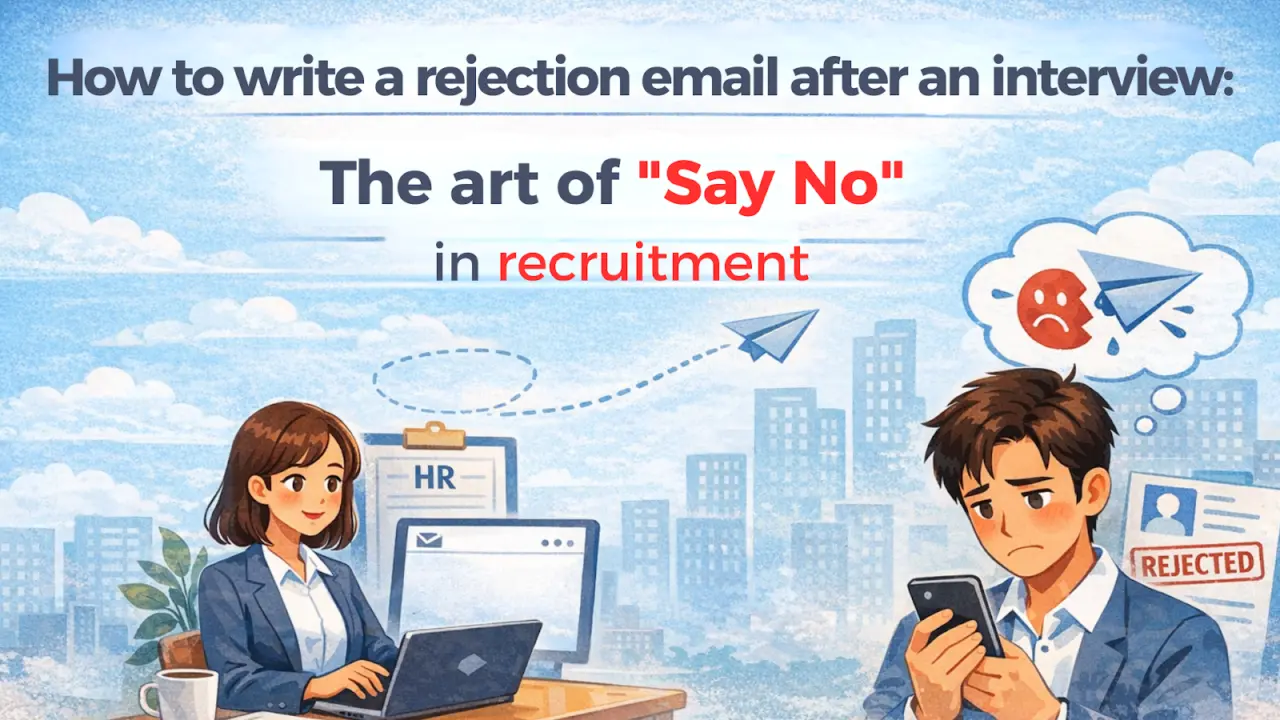
Sending a professional rejection email after an interview is a critical HR task that impacts your employer brand and candidate experience. This guide provides rejection email templates and strategies to decline candidates respectfully while maintaining positive relationships.
- What is a Post-Interview Rejection Email?
- Conclusion
- Conclusion
- Common Rejection Email Mistakes to Avoid
- Conclusion
- Common Rejection Email Mistakes to Avoid
- Conclusion
- Common Rejection Email Mistakes to Avoid
- Conclusion
- Common Rejection Email Mistakes to Avoid
- Conclusion
- Common Rejection Email Mistakes to Avoid
- Conclusion
- Common Rejection Email Mistakes to Avoid
- Conclusion
- Common Rejection Email Mistakes to Avoid
- Conclusion
- Common Rejection Email Mistakes to Avoid
- Conclusion
- Common Rejection Email Mistakes to Avoid
- Conclusion
- Common Rejection Email Mistakes to Avoid
- Conclusion
- Common Rejection Email Mistakes to Avoid
- Conclusion
- Common Rejection Email Mistakes to Avoid
- Conclusion
- Common Rejection Email Mistakes to Avoid
- Conclusion
- Common Rejection Email Mistakes to Avoid
- Conclusion
- Common Rejection Email Mistakes to Avoid
- Conclusion
- Common Rejection Email Mistakes to Avoid
- Conclusion
- Common Rejection Email Mistakes to Avoid
- Conclusion
- Common Rejection Email Mistakes to Avoid
- Conclusion
- Common Rejection Email Mistakes to Avoid
- Conclusion
- Common Rejection Email Mistakes to Avoid
- Conclusion
- Common Rejection Email Mistakes to Avoid
- Conclusion
- Common Rejection Email Mistakes to Avoid
- Conclusion
- Common Rejection Email Mistakes to Avoid
- Conclusion
- Common Rejection Email Mistakes to Avoid
- Conclusion
- Common Rejection Email Mistakes to Avoid
- Conclusion
- Common Rejection Email Mistakes to Avoid
- Conclusion
- Common Rejection Email Mistakes to Avoid
- Conclusion
- Common Rejection Email Mistakes to Avoid
- Conclusion
- Common Rejection Email Mistakes to Avoid
- Conclusion
- Common Rejection Email Mistakes to Avoid
- Conclusion
- Common Rejection Email Mistakes to Avoid
- Conclusion
- Rejection Email Templates by Stage
- Common Rejection Email Mistakes to Avoid
- Conclusion
- Rejection Email Templates by Stage
- Common Rejection Email Mistakes to Avoid
- Conclusion
- Rejection Email Templates by Stage
- Common Rejection Email Mistakes to Avoid
- Conclusion
- Rejection Email Templates by Stage
- Common Rejection Email Mistakes to Avoid
- Conclusion
- Rejection Email Templates by Stage
- Common Rejection Email Mistakes to Avoid
- Conclusion
- Rejection Email Templates by Stage
- Common Rejection Email Mistakes to Avoid
- Conclusion
- Rejection Email Templates by Stage
- Common Rejection Email Mistakes to Avoid
- Conclusion
- Rejection Email Templates by Stage
- Common Rejection Email Mistakes to Avoid
- Conclusion
- Rejection Email Templates by Stage
- Common Rejection Email Mistakes to Avoid
- Conclusion
- Rejection Email Templates by Stage
- Common Rejection Email Mistakes to Avoid
- Conclusion
- Structure of a Professional Rejection Email
- Rejection Email Templates by Stage
- Common Rejection Email Mistakes to Avoid
- Conclusion
- Structure of a Professional Rejection Email
- Rejection Email Templates by Stage
- Common Rejection Email Mistakes to Avoid
- Conclusion
- Structure of a Professional Rejection Email
- Rejection Email Templates by Stage
- Common Rejection Email Mistakes to Avoid
- Conclusion
- Structure of a Professional Rejection Email
- Rejection Email Templates by Stage
- Common Rejection Email Mistakes to Avoid
- Conclusion
- Structure of a Professional Rejection Email
- Rejection Email Templates by Stage
- Common Rejection Email Mistakes to Avoid
- Conclusion
- Structure of a Professional Rejection Email
- Rejection Email Templates by Stage
- Common Rejection Email Mistakes to Avoid
- Conclusion
- Structure of a Professional Rejection Email
- Rejection Email Templates by Stage
- Common Rejection Email Mistakes to Avoid
- Conclusion
- Structure of a Professional Rejection Email
- Rejection Email Templates by Stage
- Common Rejection Email Mistakes to Avoid
- Conclusion
- Structure of a Professional Rejection Email
- Rejection Email Templates by Stage
- Common Rejection Email Mistakes to Avoid
- Conclusion
- Structure of a Professional Rejection Email
- Rejection Email Templates by Stage
- Common Rejection Email Mistakes to Avoid
- Conclusion
- Why Professional Rejection Emails Matter
- Structure of a Professional Rejection Email
- Rejection Email Templates by Stage
- Common Rejection Email Mistakes to Avoid
- Conclusion
- Why Professional Rejection Emails Matter
- Structure of a Professional Rejection Email
- Rejection Email Templates by Stage
- Common Rejection Email Mistakes to Avoid
- Conclusion
- Why Professional Rejection Emails Matter
- Structure of a Professional Rejection Email
- Rejection Email Templates by Stage
- Common Rejection Email Mistakes to Avoid
- Conclusion
What is a Post-Interview Rejection Email?
Recruitment is more than finding talent—it is about building relationships. Professional rejection emails plant seeds of goodwill that benefit your organization long-term. Even in disappointment, thoughtful communication elevates your employer brand and contributes to a more respectful job market.
For assistance with recruitment strategy, employer branding, and HR management in Vietnam, contact Wacontre Accounting Services. Hotline: (028) 3820 1213 or email [email protected]. For Japanese clients, call (050) 5534 5505.
Conclusion
Recruitment is more than finding talent—it is about building relationships. Professional rejection emails plant seeds of goodwill that benefit your organization long-term. Even in disappointment, thoughtful communication elevates your employer brand and contributes to a more respectful job market.
For assistance with recruitment strategy, employer branding, and HR management in Vietnam, contact Wacontre Accounting Services. Hotline: (028) 3820 1213 or email [email protected]. For Japanese clients, call (050) 5534 5505.
Conclusion
Recruitment is more than finding talent—it is about building relationships. Professional rejection emails plant seeds of goodwill that benefit your organization long-term. Even in disappointment, thoughtful communication elevates your employer brand and contributes to a more respectful job market.
For assistance with recruitment strategy, employer branding, and HR management in Vietnam, contact Wacontre Accounting Services. Hotline: (028) 3820 1213 or email [email protected]. For Japanese clients, call (050) 5534 5505.
Common Rejection Email Mistakes to Avoid
- Ghosting: Silence is the worst response. Send rejections within 1-2 weeks of the interview date.
- Cold, Robotic Tone: Avoid clichéd phrases. Add a personal touch to show genuine respect for the candidate.
- Harsh Criticism: Never criticize personal competence harshly. Focus on “not fitting current requirements” instead of “poor skills.”
- Information Errors: Using the wrong name or position is unacceptable. Proofread carefully before sending.
Conclusion
Recruitment is more than finding talent—it is about building relationships. Professional rejection emails plant seeds of goodwill that benefit your organization long-term. Even in disappointment, thoughtful communication elevates your employer brand and contributes to a more respectful job market.
For assistance with recruitment strategy, employer branding, and HR management in Vietnam, contact Wacontre Accounting Services. Hotline: (028) 3820 1213 or email [email protected]. For Japanese clients, call (050) 5534 5505.
Download our rejection email templates here.
Common Rejection Email Mistakes to Avoid
- Ghosting: Silence is the worst response. Send rejections within 1-2 weeks of the interview date.
- Cold, Robotic Tone: Avoid clichéd phrases. Add a personal touch to show genuine respect for the candidate.
- Harsh Criticism: Never criticize personal competence harshly. Focus on “not fitting current requirements” instead of “poor skills.”
- Information Errors: Using the wrong name or position is unacceptable. Proofread carefully before sending.
Conclusion
Recruitment is more than finding talent—it is about building relationships. Professional rejection emails plant seeds of goodwill that benefit your organization long-term. Even in disappointment, thoughtful communication elevates your employer brand and contributes to a more respectful job market.
For assistance with recruitment strategy, employer branding, and HR management in Vietnam, contact Wacontre Accounting Services. Hotline: (028) 3820 1213 or email [email protected]. For Japanese clients, call (050) 5534 5505.
Warm regards,
[Signature]
Download our rejection email templates here.
Common Rejection Email Mistakes to Avoid
- Ghosting: Silence is the worst response. Send rejections within 1-2 weeks of the interview date.
- Cold, Robotic Tone: Avoid clichéd phrases. Add a personal touch to show genuine respect for the candidate.
- Harsh Criticism: Never criticize personal competence harshly. Focus on “not fitting current requirements” instead of “poor skills.”
- Information Errors: Using the wrong name or position is unacceptable. Proofread carefully before sending.
Conclusion
Recruitment is more than finding talent—it is about building relationships. Professional rejection emails plant seeds of goodwill that benefit your organization long-term. Even in disappointment, thoughtful communication elevates your employer brand and contributes to a more respectful job market.
For assistance with recruitment strategy, employer branding, and HR management in Vietnam, contact Wacontre Accounting Services. Hotline: (028) 3820 1213 or email [email protected]. For Japanese clients, call (050) 5534 5505.
Thank you, and we look forward to future collaboration.
Warm regards,
[Signature]
Download our rejection email templates here.
Common Rejection Email Mistakes to Avoid
- Ghosting: Silence is the worst response. Send rejections within 1-2 weeks of the interview date.
- Cold, Robotic Tone: Avoid clichéd phrases. Add a personal touch to show genuine respect for the candidate.
- Harsh Criticism: Never criticize personal competence harshly. Focus on “not fitting current requirements” instead of “poor skills.”
- Information Errors: Using the wrong name or position is unacceptable. Proofread carefully before sending.
Conclusion
Recruitment is more than finding talent—it is about building relationships. Professional rejection emails plant seeds of goodwill that benefit your organization long-term. Even in disappointment, thoughtful communication elevates your employer brand and contributes to a more respectful job market.
For assistance with recruitment strategy, employer branding, and HR management in Vietnam, contact Wacontre Accounting Services. Hotline: (028) 3820 1213 or email [email protected]. For Japanese clients, call (050) 5534 5505.
If you agree, we would like to add you to our “Priority Candidates” list. When an equivalent position opens, you will be contacted before we conduct public recruitment.
Thank you, and we look forward to future collaboration.
Warm regards,
[Signature]
Download our rejection email templates here.
Common Rejection Email Mistakes to Avoid
- Ghosting: Silence is the worst response. Send rejections within 1-2 weeks of the interview date.
- Cold, Robotic Tone: Avoid clichéd phrases. Add a personal touch to show genuine respect for the candidate.
- Harsh Criticism: Never criticize personal competence harshly. Focus on “not fitting current requirements” instead of “poor skills.”
- Information Errors: Using the wrong name or position is unacceptable. Proofread carefully before sending.
Conclusion
Recruitment is more than finding talent—it is about building relationships. Professional rejection emails plant seeds of goodwill that benefit your organization long-term. Even in disappointment, thoughtful communication elevates your employer brand and contributes to a more respectful job market.
For assistance with recruitment strategy, employer branding, and HR management in Vietnam, contact Wacontre Accounting Services. Hotline: (028) 3820 1213 or email [email protected]. For Japanese clients, call (050) 5534 5505.
Although we cannot extend an offer at this moment due to [objective reason: budget constraints/position filled], we believe you would be an excellent cultural fit at [Company Name].
If you agree, we would like to add you to our “Priority Candidates” list. When an equivalent position opens, you will be contacted before we conduct public recruitment.
Thank you, and we look forward to future collaboration.
Warm regards,
[Signature]
Download our rejection email templates here.
Common Rejection Email Mistakes to Avoid
- Ghosting: Silence is the worst response. Send rejections within 1-2 weeks of the interview date.
- Cold, Robotic Tone: Avoid clichéd phrases. Add a personal touch to show genuine respect for the candidate.
- Harsh Criticism: Never criticize personal competence harshly. Focus on “not fitting current requirements” instead of “poor skills.”
- Information Errors: Using the wrong name or position is unacceptable. Proofread carefully before sending.
Conclusion
Recruitment is more than finding talent—it is about building relationships. Professional rejection emails plant seeds of goodwill that benefit your organization long-term. Even in disappointment, thoughtful communication elevates your employer brand and contributes to a more respectful job market.
For assistance with recruitment strategy, employer branding, and HR management in Vietnam, contact Wacontre Accounting Services. Hotline: (028) 3820 1213 or email [email protected]. For Japanese clients, call (050) 5534 5505.
Thank you for your outstanding performance in our recent interviews. Our management team genuinely values your professional capabilities.
Although we cannot extend an offer at this moment due to [objective reason: budget constraints/position filled], we believe you would be an excellent cultural fit at [Company Name].
If you agree, we would like to add you to our “Priority Candidates” list. When an equivalent position opens, you will be contacted before we conduct public recruitment.
Thank you, and we look forward to future collaboration.
Warm regards,
[Signature]
Download our rejection email templates here.
Common Rejection Email Mistakes to Avoid
- Ghosting: Silence is the worst response. Send rejections within 1-2 weeks of the interview date.
- Cold, Robotic Tone: Avoid clichéd phrases. Add a personal touch to show genuine respect for the candidate.
- Harsh Criticism: Never criticize personal competence harshly. Focus on “not fitting current requirements” instead of “poor skills.”
- Information Errors: Using the wrong name or position is unacceptable. Proofread carefully before sending.
Conclusion
Recruitment is more than finding talent—it is about building relationships. Professional rejection emails plant seeds of goodwill that benefit your organization long-term. Even in disappointment, thoughtful communication elevates your employer brand and contributes to a more respectful job market.
For assistance with recruitment strategy, employer branding, and HR management in Vietnam, contact Wacontre Accounting Services. Hotline: (028) 3820 1213 or email [email protected]. For Japanese clients, call (050) 5534 5505.
Dear [Candidate Name],
Thank you for your outstanding performance in our recent interviews. Our management team genuinely values your professional capabilities.
Although we cannot extend an offer at this moment due to [objective reason: budget constraints/position filled], we believe you would be an excellent cultural fit at [Company Name].
If you agree, we would like to add you to our “Priority Candidates” list. When an equivalent position opens, you will be contacted before we conduct public recruitment.
Thank you, and we look forward to future collaboration.
Warm regards,
[Signature]
Download our rejection email templates here.
Common Rejection Email Mistakes to Avoid
- Ghosting: Silence is the worst response. Send rejections within 1-2 weeks of the interview date.
- Cold, Robotic Tone: Avoid clichéd phrases. Add a personal touch to show genuine respect for the candidate.
- Harsh Criticism: Never criticize personal competence harshly. Focus on “not fitting current requirements” instead of “poor skills.”
- Information Errors: Using the wrong name or position is unacceptable. Proofread carefully before sending.
Conclusion
Recruitment is more than finding talent—it is about building relationships. Professional rejection emails plant seeds of goodwill that benefit your organization long-term. Even in disappointment, thoughtful communication elevates your employer brand and contributes to a more respectful job market.
For assistance with recruitment strategy, employer branding, and HR management in Vietnam, contact Wacontre Accounting Services. Hotline: (028) 3820 1213 or email [email protected]. For Japanese clients, call (050) 5534 5505.
Subject Line: Thank You – [Candidate Name], We’d Like to Stay in Touch
Dear [Candidate Name],
Thank you for your outstanding performance in our recent interviews. Our management team genuinely values your professional capabilities.
Although we cannot extend an offer at this moment due to [objective reason: budget constraints/position filled], we believe you would be an excellent cultural fit at [Company Name].
If you agree, we would like to add you to our “Priority Candidates” list. When an equivalent position opens, you will be contacted before we conduct public recruitment.
Thank you, and we look forward to future collaboration.
Warm regards,
[Signature]
Download our rejection email templates here.
Common Rejection Email Mistakes to Avoid
- Ghosting: Silence is the worst response. Send rejections within 1-2 weeks of the interview date.
- Cold, Robotic Tone: Avoid clichéd phrases. Add a personal touch to show genuine respect for the candidate.
- Harsh Criticism: Never criticize personal competence harshly. Focus on “not fitting current requirements” instead of “poor skills.”
- Information Errors: Using the wrong name or position is unacceptable. Proofread carefully before sending.
Conclusion
Recruitment is more than finding talent—it is about building relationships. Professional rejection emails plant seeds of goodwill that benefit your organization long-term. Even in disappointment, thoughtful communication elevates your employer brand and contributes to a more respectful job market.
For assistance with recruitment strategy, employer branding, and HR management in Vietnam, contact Wacontre Accounting Services. Hotline: (028) 3820 1213 or email [email protected]. For Japanese clients, call (050) 5534 5505.
Template 4: Talent Pool Rejection (High-Potential Candidates)
Subject Line: Thank You – [Candidate Name], We’d Like to Stay in Touch
Dear [Candidate Name],
Thank you for your outstanding performance in our recent interviews. Our management team genuinely values your professional capabilities.
Although we cannot extend an offer at this moment due to [objective reason: budget constraints/position filled], we believe you would be an excellent cultural fit at [Company Name].
If you agree, we would like to add you to our “Priority Candidates” list. When an equivalent position opens, you will be contacted before we conduct public recruitment.
Thank you, and we look forward to future collaboration.
Warm regards,
[Signature]
Download our rejection email templates here.
Common Rejection Email Mistakes to Avoid
- Ghosting: Silence is the worst response. Send rejections within 1-2 weeks of the interview date.
- Cold, Robotic Tone: Avoid clichéd phrases. Add a personal touch to show genuine respect for the candidate.
- Harsh Criticism: Never criticize personal competence harshly. Focus on “not fitting current requirements” instead of “poor skills.”
- Information Errors: Using the wrong name or position is unacceptable. Proofread carefully before sending.
Conclusion
Recruitment is more than finding talent—it is about building relationships. Professional rejection emails plant seeds of goodwill that benefit your organization long-term. Even in disappointment, thoughtful communication elevates your employer brand and contributes to a more respectful job market.
For assistance with recruitment strategy, employer branding, and HR management in Vietnam, contact Wacontre Accounting Services. Hotline: (028) 3820 1213 or email [email protected]. For Japanese clients, call (050) 5534 5505.
Sincerely,
[Hiring Manager Signature]
Template 4: Talent Pool Rejection (High-Potential Candidates)
Subject Line: Thank You – [Candidate Name], We’d Like to Stay in Touch
Dear [Candidate Name],
Thank you for your outstanding performance in our recent interviews. Our management team genuinely values your professional capabilities.
Although we cannot extend an offer at this moment due to [objective reason: budget constraints/position filled], we believe you would be an excellent cultural fit at [Company Name].
If you agree, we would like to add you to our “Priority Candidates” list. When an equivalent position opens, you will be contacted before we conduct public recruitment.
Thank you, and we look forward to future collaboration.
Warm regards,
[Signature]
Download our rejection email templates here.
Common Rejection Email Mistakes to Avoid
- Ghosting: Silence is the worst response. Send rejections within 1-2 weeks of the interview date.
- Cold, Robotic Tone: Avoid clichéd phrases. Add a personal touch to show genuine respect for the candidate.
- Harsh Criticism: Never criticize personal competence harshly. Focus on “not fitting current requirements” instead of “poor skills.”
- Information Errors: Using the wrong name or position is unacceptable. Proofread carefully before sending.
Conclusion
Recruitment is more than finding talent—it is about building relationships. Professional rejection emails plant seeds of goodwill that benefit your organization long-term. Even in disappointment, thoughtful communication elevates your employer brand and contributes to a more respectful job market.
For assistance with recruitment strategy, employer branding, and HR management in Vietnam, contact Wacontre Accounting Services. Hotline: (028) 3820 1213 or email [email protected]. For Japanese clients, call (050) 5534 5505.
We believe your skills will lead to great success, and we would welcome staying connected on LinkedIn. We may reach out about future opportunities that match your expertise.
Sincerely,
[Hiring Manager Signature]
Template 4: Talent Pool Rejection (High-Potential Candidates)
Subject Line: Thank You – [Candidate Name], We’d Like to Stay in Touch
Dear [Candidate Name],
Thank you for your outstanding performance in our recent interviews. Our management team genuinely values your professional capabilities.
Although we cannot extend an offer at this moment due to [objective reason: budget constraints/position filled], we believe you would be an excellent cultural fit at [Company Name].
If you agree, we would like to add you to our “Priority Candidates” list. When an equivalent position opens, you will be contacted before we conduct public recruitment.
Thank you, and we look forward to future collaboration.
Warm regards,
[Signature]
Download our rejection email templates here.
Common Rejection Email Mistakes to Avoid
- Ghosting: Silence is the worst response. Send rejections within 1-2 weeks of the interview date.
- Cold, Robotic Tone: Avoid clichéd phrases. Add a personal touch to show genuine respect for the candidate.
- Harsh Criticism: Never criticize personal competence harshly. Focus on “not fitting current requirements” instead of “poor skills.”
- Information Errors: Using the wrong name or position is unacceptable. Proofread carefully before sending.
Conclusion
Recruitment is more than finding talent—it is about building relationships. Professional rejection emails plant seeds of goodwill that benefit your organization long-term. Even in disappointment, thoughtful communication elevates your employer brand and contributes to a more respectful job market.
For assistance with recruitment strategy, employer branding, and HR management in Vietnam, contact Wacontre Accounting Services. Hotline: (028) 3820 1213 or email [email protected]. For Japanese clients, call (050) 5534 5505.
This recruitment cycle was highly competitive. After careful consideration of all candidates, we selected someone whose background more closely aligned with [specific requirement: hands-on experience in X/cultural fit]. This decision reflects the strength of our candidate pool, not a deficiency in your qualifications.
We believe your skills will lead to great success, and we would welcome staying connected on LinkedIn. We may reach out about future opportunities that match your expertise.
Sincerely,
[Hiring Manager Signature]
Template 4: Talent Pool Rejection (High-Potential Candidates)
Subject Line: Thank You – [Candidate Name], We’d Like to Stay in Touch
Dear [Candidate Name],
Thank you for your outstanding performance in our recent interviews. Our management team genuinely values your professional capabilities.
Although we cannot extend an offer at this moment due to [objective reason: budget constraints/position filled], we believe you would be an excellent cultural fit at [Company Name].
If you agree, we would like to add you to our “Priority Candidates” list. When an equivalent position opens, you will be contacted before we conduct public recruitment.
Thank you, and we look forward to future collaboration.
Warm regards,
[Signature]
Download our rejection email templates here.
Common Rejection Email Mistakes to Avoid
- Ghosting: Silence is the worst response. Send rejections within 1-2 weeks of the interview date.
- Cold, Robotic Tone: Avoid clichéd phrases. Add a personal touch to show genuine respect for the candidate.
- Harsh Criticism: Never criticize personal competence harshly. Focus on “not fitting current requirements” instead of “poor skills.”
- Information Errors: Using the wrong name or position is unacceptable. Proofread carefully before sending.
Conclusion
Recruitment is more than finding talent—it is about building relationships. Professional rejection emails plant seeds of goodwill that benefit your organization long-term. Even in disappointment, thoughtful communication elevates your employer brand and contributes to a more respectful job market.
For assistance with recruitment strategy, employer branding, and HR management in Vietnam, contact Wacontre Accounting Services. Hotline: (028) 3820 1213 or email [email protected]. For Japanese clients, call (050) 5534 5505.
First, I want to thank you for visiting our office and taking the time to meet with our team on [Date]. We were genuinely impressed by your [specific strength: strategic thinking/presentation skills].
This recruitment cycle was highly competitive. After careful consideration of all candidates, we selected someone whose background more closely aligned with [specific requirement: hands-on experience in X/cultural fit]. This decision reflects the strength of our candidate pool, not a deficiency in your qualifications.
We believe your skills will lead to great success, and we would welcome staying connected on LinkedIn. We may reach out about future opportunities that match your expertise.
Sincerely,
[Hiring Manager Signature]
Template 4: Talent Pool Rejection (High-Potential Candidates)
Subject Line: Thank You – [Candidate Name], We’d Like to Stay in Touch
Dear [Candidate Name],
Thank you for your outstanding performance in our recent interviews. Our management team genuinely values your professional capabilities.
Although we cannot extend an offer at this moment due to [objective reason: budget constraints/position filled], we believe you would be an excellent cultural fit at [Company Name].
If you agree, we would like to add you to our “Priority Candidates” list. When an equivalent position opens, you will be contacted before we conduct public recruitment.
Thank you, and we look forward to future collaboration.
Warm regards,
[Signature]
Download our rejection email templates here.
Common Rejection Email Mistakes to Avoid
- Ghosting: Silence is the worst response. Send rejections within 1-2 weeks of the interview date.
- Cold, Robotic Tone: Avoid clichéd phrases. Add a personal touch to show genuine respect for the candidate.
- Harsh Criticism: Never criticize personal competence harshly. Focus on “not fitting current requirements” instead of “poor skills.”
- Information Errors: Using the wrong name or position is unacceptable. Proofread carefully before sending.
Conclusion
Recruitment is more than finding talent—it is about building relationships. Professional rejection emails plant seeds of goodwill that benefit your organization long-term. Even in disappointment, thoughtful communication elevates your employer brand and contributes to a more respectful job market.
For assistance with recruitment strategy, employer branding, and HR management in Vietnam, contact Wacontre Accounting Services. Hotline: (028) 3820 1213 or email [email protected]. For Japanese clients, call (050) 5534 5505.
Dear [Candidate Name],
First, I want to thank you for visiting our office and taking the time to meet with our team on [Date]. We were genuinely impressed by your [specific strength: strategic thinking/presentation skills].
This recruitment cycle was highly competitive. After careful consideration of all candidates, we selected someone whose background more closely aligned with [specific requirement: hands-on experience in X/cultural fit]. This decision reflects the strength of our candidate pool, not a deficiency in your qualifications.
We believe your skills will lead to great success, and we would welcome staying connected on LinkedIn. We may reach out about future opportunities that match your expertise.
Sincerely,
[Hiring Manager Signature]
Template 4: Talent Pool Rejection (High-Potential Candidates)
Subject Line: Thank You – [Candidate Name], We’d Like to Stay in Touch
Dear [Candidate Name],
Thank you for your outstanding performance in our recent interviews. Our management team genuinely values your professional capabilities.
Although we cannot extend an offer at this moment due to [objective reason: budget constraints/position filled], we believe you would be an excellent cultural fit at [Company Name].
If you agree, we would like to add you to our “Priority Candidates” list. When an equivalent position opens, you will be contacted before we conduct public recruitment.
Thank you, and we look forward to future collaboration.
Warm regards,
[Signature]
Download our rejection email templates here.
Common Rejection Email Mistakes to Avoid
- Ghosting: Silence is the worst response. Send rejections within 1-2 weeks of the interview date.
- Cold, Robotic Tone: Avoid clichéd phrases. Add a personal touch to show genuine respect for the candidate.
- Harsh Criticism: Never criticize personal competence harshly. Focus on “not fitting current requirements” instead of “poor skills.”
- Information Errors: Using the wrong name or position is unacceptable. Proofread carefully before sending.
Conclusion
Recruitment is more than finding talent—it is about building relationships. Professional rejection emails plant seeds of goodwill that benefit your organization long-term. Even in disappointment, thoughtful communication elevates your employer brand and contributes to a more respectful job market.
For assistance with recruitment strategy, employer branding, and HR management in Vietnam, contact Wacontre Accounting Services. Hotline: (028) 3820 1213 or email [email protected]. For Japanese clients, call (050) 5534 5505.
Subject Line: [Company Name] – Interview Result for [Position Name]
Dear [Candidate Name],
First, I want to thank you for visiting our office and taking the time to meet with our team on [Date]. We were genuinely impressed by your [specific strength: strategic thinking/presentation skills].
This recruitment cycle was highly competitive. After careful consideration of all candidates, we selected someone whose background more closely aligned with [specific requirement: hands-on experience in X/cultural fit]. This decision reflects the strength of our candidate pool, not a deficiency in your qualifications.
We believe your skills will lead to great success, and we would welcome staying connected on LinkedIn. We may reach out about future opportunities that match your expertise.
Sincerely,
[Hiring Manager Signature]
Template 4: Talent Pool Rejection (High-Potential Candidates)
Subject Line: Thank You – [Candidate Name], We’d Like to Stay in Touch
Dear [Candidate Name],
Thank you for your outstanding performance in our recent interviews. Our management team genuinely values your professional capabilities.
Although we cannot extend an offer at this moment due to [objective reason: budget constraints/position filled], we believe you would be an excellent cultural fit at [Company Name].
If you agree, we would like to add you to our “Priority Candidates” list. When an equivalent position opens, you will be contacted before we conduct public recruitment.
Thank you, and we look forward to future collaboration.
Warm regards,
[Signature]
Download our rejection email templates here.
Common Rejection Email Mistakes to Avoid
- Ghosting: Silence is the worst response. Send rejections within 1-2 weeks of the interview date.
- Cold, Robotic Tone: Avoid clichéd phrases. Add a personal touch to show genuine respect for the candidate.
- Harsh Criticism: Never criticize personal competence harshly. Focus on “not fitting current requirements” instead of “poor skills.”
- Information Errors: Using the wrong name or position is unacceptable. Proofread carefully before sending.
Conclusion
Recruitment is more than finding talent—it is about building relationships. Professional rejection emails plant seeds of goodwill that benefit your organization long-term. Even in disappointment, thoughtful communication elevates your employer brand and contributes to a more respectful job market.
For assistance with recruitment strategy, employer branding, and HR management in Vietnam, contact Wacontre Accounting Services. Hotline: (028) 3820 1213 or email [email protected]. For Japanese clients, call (050) 5534 5505.
Template 3: In-Person Interview Rejection (Final Round)
Subject Line: [Company Name] – Interview Result for [Position Name]
Dear [Candidate Name],
First, I want to thank you for visiting our office and taking the time to meet with our team on [Date]. We were genuinely impressed by your [specific strength: strategic thinking/presentation skills].
This recruitment cycle was highly competitive. After careful consideration of all candidates, we selected someone whose background more closely aligned with [specific requirement: hands-on experience in X/cultural fit]. This decision reflects the strength of our candidate pool, not a deficiency in your qualifications.
We believe your skills will lead to great success, and we would welcome staying connected on LinkedIn. We may reach out about future opportunities that match your expertise.
Sincerely,
[Hiring Manager Signature]
Template 4: Talent Pool Rejection (High-Potential Candidates)
Subject Line: Thank You – [Candidate Name], We’d Like to Stay in Touch
Dear [Candidate Name],
Thank you for your outstanding performance in our recent interviews. Our management team genuinely values your professional capabilities.
Although we cannot extend an offer at this moment due to [objective reason: budget constraints/position filled], we believe you would be an excellent cultural fit at [Company Name].
If you agree, we would like to add you to our “Priority Candidates” list. When an equivalent position opens, you will be contacted before we conduct public recruitment.
Thank you, and we look forward to future collaboration.
Warm regards,
[Signature]
Download our rejection email templates here.
Common Rejection Email Mistakes to Avoid
- Ghosting: Silence is the worst response. Send rejections within 1-2 weeks of the interview date.
- Cold, Robotic Tone: Avoid clichéd phrases. Add a personal touch to show genuine respect for the candidate.
- Harsh Criticism: Never criticize personal competence harshly. Focus on “not fitting current requirements” instead of “poor skills.”
- Information Errors: Using the wrong name or position is unacceptable. Proofread carefully before sending.
Conclusion
Recruitment is more than finding talent—it is about building relationships. Professional rejection emails plant seeds of goodwill that benefit your organization long-term. Even in disappointment, thoughtful communication elevates your employer brand and contributes to a more respectful job market.
For assistance with recruitment strategy, employer branding, and HR management in Vietnam, contact Wacontre Accounting Services. Hotline: (028) 3820 1213 or email [email protected]. For Japanese clients, call (050) 5534 5505.
Sincerely,
[Your Name/HR Title]
Template 3: In-Person Interview Rejection (Final Round)
Subject Line: [Company Name] – Interview Result for [Position Name]
Dear [Candidate Name],
First, I want to thank you for visiting our office and taking the time to meet with our team on [Date]. We were genuinely impressed by your [specific strength: strategic thinking/presentation skills].
This recruitment cycle was highly competitive. After careful consideration of all candidates, we selected someone whose background more closely aligned with [specific requirement: hands-on experience in X/cultural fit]. This decision reflects the strength of our candidate pool, not a deficiency in your qualifications.
We believe your skills will lead to great success, and we would welcome staying connected on LinkedIn. We may reach out about future opportunities that match your expertise.
Sincerely,
[Hiring Manager Signature]
Template 4: Talent Pool Rejection (High-Potential Candidates)
Subject Line: Thank You – [Candidate Name], We’d Like to Stay in Touch
Dear [Candidate Name],
Thank you for your outstanding performance in our recent interviews. Our management team genuinely values your professional capabilities.
Although we cannot extend an offer at this moment due to [objective reason: budget constraints/position filled], we believe you would be an excellent cultural fit at [Company Name].
If you agree, we would like to add you to our “Priority Candidates” list. When an equivalent position opens, you will be contacted before we conduct public recruitment.
Thank you, and we look forward to future collaboration.
Warm regards,
[Signature]
Download our rejection email templates here.
Common Rejection Email Mistakes to Avoid
- Ghosting: Silence is the worst response. Send rejections within 1-2 weeks of the interview date.
- Cold, Robotic Tone: Avoid clichéd phrases. Add a personal touch to show genuine respect for the candidate.
- Harsh Criticism: Never criticize personal competence harshly. Focus on “not fitting current requirements” instead of “poor skills.”
- Information Errors: Using the wrong name or position is unacceptable. Proofread carefully before sending.
Conclusion
Recruitment is more than finding talent—it is about building relationships. Professional rejection emails plant seeds of goodwill that benefit your organization long-term. Even in disappointment, thoughtful communication elevates your employer brand and contributes to a more respectful job market.
For assistance with recruitment strategy, employer branding, and HR management in Vietnam, contact Wacontre Accounting Services. Hotline: (028) 3820 1213 or email [email protected]. For Japanese clients, call (050) 5534 5505.
We hope to collaborate with you on future opportunities and wish you the best.
Sincerely,
[Your Name/HR Title]
Template 3: In-Person Interview Rejection (Final Round)
Subject Line: [Company Name] – Interview Result for [Position Name]
Dear [Candidate Name],
First, I want to thank you for visiting our office and taking the time to meet with our team on [Date]. We were genuinely impressed by your [specific strength: strategic thinking/presentation skills].
This recruitment cycle was highly competitive. After careful consideration of all candidates, we selected someone whose background more closely aligned with [specific requirement: hands-on experience in X/cultural fit]. This decision reflects the strength of our candidate pool, not a deficiency in your qualifications.
We believe your skills will lead to great success, and we would welcome staying connected on LinkedIn. We may reach out about future opportunities that match your expertise.
Sincerely,
[Hiring Manager Signature]
Template 4: Talent Pool Rejection (High-Potential Candidates)
Subject Line: Thank You – [Candidate Name], We’d Like to Stay in Touch
Dear [Candidate Name],
Thank you for your outstanding performance in our recent interviews. Our management team genuinely values your professional capabilities.
Although we cannot extend an offer at this moment due to [objective reason: budget constraints/position filled], we believe you would be an excellent cultural fit at [Company Name].
If you agree, we would like to add you to our “Priority Candidates” list. When an equivalent position opens, you will be contacted before we conduct public recruitment.
Thank you, and we look forward to future collaboration.
Warm regards,
[Signature]
Download our rejection email templates here.
Common Rejection Email Mistakes to Avoid
- Ghosting: Silence is the worst response. Send rejections within 1-2 weeks of the interview date.
- Cold, Robotic Tone: Avoid clichéd phrases. Add a personal touch to show genuine respect for the candidate.
- Harsh Criticism: Never criticize personal competence harshly. Focus on “not fitting current requirements” instead of “poor skills.”
- Information Errors: Using the wrong name or position is unacceptable. Proofread carefully before sending.
Conclusion
Recruitment is more than finding talent—it is about building relationships. Professional rejection emails plant seeds of goodwill that benefit your organization long-term. Even in disappointment, thoughtful communication elevates your employer brand and contributes to a more respectful job market.
For assistance with recruitment strategy, employer branding, and HR management in Vietnam, contact Wacontre Accounting Services. Hotline: (028) 3820 1213 or email [email protected]. For Japanese clients, call (050) 5534 5505.
After internal discussion, we have decided not to advance your application to the next round. The primary reason is that we are seeking candidates with more specialized experience in [specific skill] to meet our immediate project timeline.
We hope to collaborate with you on future opportunities and wish you the best.
Sincerely,
[Your Name/HR Title]
Template 3: In-Person Interview Rejection (Final Round)
Subject Line: [Company Name] – Interview Result for [Position Name]
Dear [Candidate Name],
First, I want to thank you for visiting our office and taking the time to meet with our team on [Date]. We were genuinely impressed by your [specific strength: strategic thinking/presentation skills].
This recruitment cycle was highly competitive. After careful consideration of all candidates, we selected someone whose background more closely aligned with [specific requirement: hands-on experience in X/cultural fit]. This decision reflects the strength of our candidate pool, not a deficiency in your qualifications.
We believe your skills will lead to great success, and we would welcome staying connected on LinkedIn. We may reach out about future opportunities that match your expertise.
Sincerely,
[Hiring Manager Signature]
Template 4: Talent Pool Rejection (High-Potential Candidates)
Subject Line: Thank You – [Candidate Name], We’d Like to Stay in Touch
Dear [Candidate Name],
Thank you for your outstanding performance in our recent interviews. Our management team genuinely values your professional capabilities.
Although we cannot extend an offer at this moment due to [objective reason: budget constraints/position filled], we believe you would be an excellent cultural fit at [Company Name].
If you agree, we would like to add you to our “Priority Candidates” list. When an equivalent position opens, you will be contacted before we conduct public recruitment.
Thank you, and we look forward to future collaboration.
Warm regards,
[Signature]
Download our rejection email templates here.
Common Rejection Email Mistakes to Avoid
- Ghosting: Silence is the worst response. Send rejections within 1-2 weeks of the interview date.
- Cold, Robotic Tone: Avoid clichéd phrases. Add a personal touch to show genuine respect for the candidate.
- Harsh Criticism: Never criticize personal competence harshly. Focus on “not fitting current requirements” instead of “poor skills.”
- Information Errors: Using the wrong name or position is unacceptable. Proofread carefully before sending.
Conclusion
Recruitment is more than finding talent—it is about building relationships. Professional rejection emails plant seeds of goodwill that benefit your organization long-term. Even in disappointment, thoughtful communication elevates your employer brand and contributes to a more respectful job market.
For assistance with recruitment strategy, employer branding, and HR management in Vietnam, contact Wacontre Accounting Services. Hotline: (028) 3820 1213 or email [email protected]. For Japanese clients, call (050) 5534 5505.
Thank you for our conversation on [Date/Day]. I appreciated your enthusiasm and insights regarding [relevant topic].
After internal discussion, we have decided not to advance your application to the next round. The primary reason is that we are seeking candidates with more specialized experience in [specific skill] to meet our immediate project timeline.
We hope to collaborate with you on future opportunities and wish you the best.
Sincerely,
[Your Name/HR Title]
Template 3: In-Person Interview Rejection (Final Round)
Subject Line: [Company Name] – Interview Result for [Position Name]
Dear [Candidate Name],
First, I want to thank you for visiting our office and taking the time to meet with our team on [Date]. We were genuinely impressed by your [specific strength: strategic thinking/presentation skills].
This recruitment cycle was highly competitive. After careful consideration of all candidates, we selected someone whose background more closely aligned with [specific requirement: hands-on experience in X/cultural fit]. This decision reflects the strength of our candidate pool, not a deficiency in your qualifications.
We believe your skills will lead to great success, and we would welcome staying connected on LinkedIn. We may reach out about future opportunities that match your expertise.
Sincerely,
[Hiring Manager Signature]
Template 4: Talent Pool Rejection (High-Potential Candidates)
Subject Line: Thank You – [Candidate Name], We’d Like to Stay in Touch
Dear [Candidate Name],
Thank you for your outstanding performance in our recent interviews. Our management team genuinely values your professional capabilities.
Although we cannot extend an offer at this moment due to [objective reason: budget constraints/position filled], we believe you would be an excellent cultural fit at [Company Name].
If you agree, we would like to add you to our “Priority Candidates” list. When an equivalent position opens, you will be contacted before we conduct public recruitment.
Thank you, and we look forward to future collaboration.
Warm regards,
[Signature]
Download our rejection email templates here.
Common Rejection Email Mistakes to Avoid
- Ghosting: Silence is the worst response. Send rejections within 1-2 weeks of the interview date.
- Cold, Robotic Tone: Avoid clichéd phrases. Add a personal touch to show genuine respect for the candidate.
- Harsh Criticism: Never criticize personal competence harshly. Focus on “not fitting current requirements” instead of “poor skills.”
- Information Errors: Using the wrong name or position is unacceptable. Proofread carefully before sending.
Conclusion
Recruitment is more than finding talent—it is about building relationships. Professional rejection emails plant seeds of goodwill that benefit your organization long-term. Even in disappointment, thoughtful communication elevates your employer brand and contributes to a more respectful job market.
For assistance with recruitment strategy, employer branding, and HR management in Vietnam, contact Wacontre Accounting Services. Hotline: (028) 3820 1213 or email [email protected]. For Japanese clients, call (050) 5534 5505.
Dear [Candidate Name],
Thank you for our conversation on [Date/Day]. I appreciated your enthusiasm and insights regarding [relevant topic].
After internal discussion, we have decided not to advance your application to the next round. The primary reason is that we are seeking candidates with more specialized experience in [specific skill] to meet our immediate project timeline.
We hope to collaborate with you on future opportunities and wish you the best.
Sincerely,
[Your Name/HR Title]
Template 3: In-Person Interview Rejection (Final Round)
Subject Line: [Company Name] – Interview Result for [Position Name]
Dear [Candidate Name],
First, I want to thank you for visiting our office and taking the time to meet with our team on [Date]. We were genuinely impressed by your [specific strength: strategic thinking/presentation skills].
This recruitment cycle was highly competitive. After careful consideration of all candidates, we selected someone whose background more closely aligned with [specific requirement: hands-on experience in X/cultural fit]. This decision reflects the strength of our candidate pool, not a deficiency in your qualifications.
We believe your skills will lead to great success, and we would welcome staying connected on LinkedIn. We may reach out about future opportunities that match your expertise.
Sincerely,
[Hiring Manager Signature]
Template 4: Talent Pool Rejection (High-Potential Candidates)
Subject Line: Thank You – [Candidate Name], We’d Like to Stay in Touch
Dear [Candidate Name],
Thank you for your outstanding performance in our recent interviews. Our management team genuinely values your professional capabilities.
Although we cannot extend an offer at this moment due to [objective reason: budget constraints/position filled], we believe you would be an excellent cultural fit at [Company Name].
If you agree, we would like to add you to our “Priority Candidates” list. When an equivalent position opens, you will be contacted before we conduct public recruitment.
Thank you, and we look forward to future collaboration.
Warm regards,
[Signature]
Download our rejection email templates here.
Common Rejection Email Mistakes to Avoid
- Ghosting: Silence is the worst response. Send rejections within 1-2 weeks of the interview date.
- Cold, Robotic Tone: Avoid clichéd phrases. Add a personal touch to show genuine respect for the candidate.
- Harsh Criticism: Never criticize personal competence harshly. Focus on “not fitting current requirements” instead of “poor skills.”
- Information Errors: Using the wrong name or position is unacceptable. Proofread carefully before sending.
Conclusion
Recruitment is more than finding talent—it is about building relationships. Professional rejection emails plant seeds of goodwill that benefit your organization long-term. Even in disappointment, thoughtful communication elevates your employer brand and contributes to a more respectful job market.
For assistance with recruitment strategy, employer branding, and HR management in Vietnam, contact Wacontre Accounting Services. Hotline: (028) 3820 1213 or email [email protected]. For Japanese clients, call (050) 5534 5505.
Subject Line: Thank You for Your Interest – Interview Update
Dear [Candidate Name],
Thank you for our conversation on [Date/Day]. I appreciated your enthusiasm and insights regarding [relevant topic].
After internal discussion, we have decided not to advance your application to the next round. The primary reason is that we are seeking candidates with more specialized experience in [specific skill] to meet our immediate project timeline.
We hope to collaborate with you on future opportunities and wish you the best.
Sincerely,
[Your Name/HR Title]
Template 3: In-Person Interview Rejection (Final Round)
Subject Line: [Company Name] – Interview Result for [Position Name]
Dear [Candidate Name],
First, I want to thank you for visiting our office and taking the time to meet with our team on [Date]. We were genuinely impressed by your [specific strength: strategic thinking/presentation skills].
This recruitment cycle was highly competitive. After careful consideration of all candidates, we selected someone whose background more closely aligned with [specific requirement: hands-on experience in X/cultural fit]. This decision reflects the strength of our candidate pool, not a deficiency in your qualifications.
We believe your skills will lead to great success, and we would welcome staying connected on LinkedIn. We may reach out about future opportunities that match your expertise.
Sincerely,
[Hiring Manager Signature]
Template 4: Talent Pool Rejection (High-Potential Candidates)
Subject Line: Thank You – [Candidate Name], We’d Like to Stay in Touch
Dear [Candidate Name],
Thank you for your outstanding performance in our recent interviews. Our management team genuinely values your professional capabilities.
Although we cannot extend an offer at this moment due to [objective reason: budget constraints/position filled], we believe you would be an excellent cultural fit at [Company Name].
If you agree, we would like to add you to our “Priority Candidates” list. When an equivalent position opens, you will be contacted before we conduct public recruitment.
Thank you, and we look forward to future collaboration.
Warm regards,
[Signature]
Download our rejection email templates here.
Common Rejection Email Mistakes to Avoid
- Ghosting: Silence is the worst response. Send rejections within 1-2 weeks of the interview date.
- Cold, Robotic Tone: Avoid clichéd phrases. Add a personal touch to show genuine respect for the candidate.
- Harsh Criticism: Never criticize personal competence harshly. Focus on “not fitting current requirements” instead of “poor skills.”
- Information Errors: Using the wrong name or position is unacceptable. Proofread carefully before sending.
Conclusion
Recruitment is more than finding talent—it is about building relationships. Professional rejection emails plant seeds of goodwill that benefit your organization long-term. Even in disappointment, thoughtful communication elevates your employer brand and contributes to a more respectful job market.
For assistance with recruitment strategy, employer branding, and HR management in Vietnam, contact Wacontre Accounting Services. Hotline: (028) 3820 1213 or email [email protected]. For Japanese clients, call (050) 5534 5505.
Template 2: Phone or Screening Interview Rejection
Subject Line: Thank You for Your Interest – Interview Update
Dear [Candidate Name],
Thank you for our conversation on [Date/Day]. I appreciated your enthusiasm and insights regarding [relevant topic].
After internal discussion, we have decided not to advance your application to the next round. The primary reason is that we are seeking candidates with more specialized experience in [specific skill] to meet our immediate project timeline.
We hope to collaborate with you on future opportunities and wish you the best.
Sincerely,
[Your Name/HR Title]
Template 3: In-Person Interview Rejection (Final Round)
Subject Line: [Company Name] – Interview Result for [Position Name]
Dear [Candidate Name],
First, I want to thank you for visiting our office and taking the time to meet with our team on [Date]. We were genuinely impressed by your [specific strength: strategic thinking/presentation skills].
This recruitment cycle was highly competitive. After careful consideration of all candidates, we selected someone whose background more closely aligned with [specific requirement: hands-on experience in X/cultural fit]. This decision reflects the strength of our candidate pool, not a deficiency in your qualifications.
We believe your skills will lead to great success, and we would welcome staying connected on LinkedIn. We may reach out about future opportunities that match your expertise.
Sincerely,
[Hiring Manager Signature]
Template 4: Talent Pool Rejection (High-Potential Candidates)
Subject Line: Thank You – [Candidate Name], We’d Like to Stay in Touch
Dear [Candidate Name],
Thank you for your outstanding performance in our recent interviews. Our management team genuinely values your professional capabilities.
Although we cannot extend an offer at this moment due to [objective reason: budget constraints/position filled], we believe you would be an excellent cultural fit at [Company Name].
If you agree, we would like to add you to our “Priority Candidates” list. When an equivalent position opens, you will be contacted before we conduct public recruitment.
Thank you, and we look forward to future collaboration.
Warm regards,
[Signature]
Download our rejection email templates here.
Common Rejection Email Mistakes to Avoid
- Ghosting: Silence is the worst response. Send rejections within 1-2 weeks of the interview date.
- Cold, Robotic Tone: Avoid clichéd phrases. Add a personal touch to show genuine respect for the candidate.
- Harsh Criticism: Never criticize personal competence harshly. Focus on “not fitting current requirements” instead of “poor skills.”
- Information Errors: Using the wrong name or position is unacceptable. Proofread carefully before sending.
Conclusion
Recruitment is more than finding talent—it is about building relationships. Professional rejection emails plant seeds of goodwill that benefit your organization long-term. Even in disappointment, thoughtful communication elevates your employer brand and contributes to a more respectful job market.
For assistance with recruitment strategy, employer branding, and HR management in Vietnam, contact Wacontre Accounting Services. Hotline: (028) 3820 1213 or email [email protected]. For Japanese clients, call (050) 5534 5505.
Best regards,
[Recruitment Team – Company Name]
Template 2: Phone or Screening Interview Rejection
Subject Line: Thank You for Your Interest – Interview Update
Dear [Candidate Name],
Thank you for our conversation on [Date/Day]. I appreciated your enthusiasm and insights regarding [relevant topic].
After internal discussion, we have decided not to advance your application to the next round. The primary reason is that we are seeking candidates with more specialized experience in [specific skill] to meet our immediate project timeline.
We hope to collaborate with you on future opportunities and wish you the best.
Sincerely,
[Your Name/HR Title]
Template 3: In-Person Interview Rejection (Final Round)
Subject Line: [Company Name] – Interview Result for [Position Name]
Dear [Candidate Name],
First, I want to thank you for visiting our office and taking the time to meet with our team on [Date]. We were genuinely impressed by your [specific strength: strategic thinking/presentation skills].
This recruitment cycle was highly competitive. After careful consideration of all candidates, we selected someone whose background more closely aligned with [specific requirement: hands-on experience in X/cultural fit]. This decision reflects the strength of our candidate pool, not a deficiency in your qualifications.
We believe your skills will lead to great success, and we would welcome staying connected on LinkedIn. We may reach out about future opportunities that match your expertise.
Sincerely,
[Hiring Manager Signature]
Template 4: Talent Pool Rejection (High-Potential Candidates)
Subject Line: Thank You – [Candidate Name], We’d Like to Stay in Touch
Dear [Candidate Name],
Thank you for your outstanding performance in our recent interviews. Our management team genuinely values your professional capabilities.
Although we cannot extend an offer at this moment due to [objective reason: budget constraints/position filled], we believe you would be an excellent cultural fit at [Company Name].
If you agree, we would like to add you to our “Priority Candidates” list. When an equivalent position opens, you will be contacted before we conduct public recruitment.
Thank you, and we look forward to future collaboration.
Warm regards,
[Signature]
Download our rejection email templates here.
Common Rejection Email Mistakes to Avoid
- Ghosting: Silence is the worst response. Send rejections within 1-2 weeks of the interview date.
- Cold, Robotic Tone: Avoid clichéd phrases. Add a personal touch to show genuine respect for the candidate.
- Harsh Criticism: Never criticize personal competence harshly. Focus on “not fitting current requirements” instead of “poor skills.”
- Information Errors: Using the wrong name or position is unacceptable. Proofread carefully before sending.
Conclusion
Recruitment is more than finding talent—it is about building relationships. Professional rejection emails plant seeds of goodwill that benefit your organization long-term. Even in disappointment, thoughtful communication elevates your employer brand and contributes to a more respectful job market.
For assistance with recruitment strategy, employer branding, and HR management in Vietnam, contact Wacontre Accounting Services. Hotline: (028) 3820 1213 or email [email protected]. For Japanese clients, call (050) 5534 5505.
We wish you success in your job search and hope to connect in the future.
Best regards,
[Recruitment Team – Company Name]
Template 2: Phone or Screening Interview Rejection
Subject Line: Thank You for Your Interest – Interview Update
Dear [Candidate Name],
Thank you for our conversation on [Date/Day]. I appreciated your enthusiasm and insights regarding [relevant topic].
After internal discussion, we have decided not to advance your application to the next round. The primary reason is that we are seeking candidates with more specialized experience in [specific skill] to meet our immediate project timeline.
We hope to collaborate with you on future opportunities and wish you the best.
Sincerely,
[Your Name/HR Title]
Template 3: In-Person Interview Rejection (Final Round)
Subject Line: [Company Name] – Interview Result for [Position Name]
Dear [Candidate Name],
First, I want to thank you for visiting our office and taking the time to meet with our team on [Date]. We were genuinely impressed by your [specific strength: strategic thinking/presentation skills].
This recruitment cycle was highly competitive. After careful consideration of all candidates, we selected someone whose background more closely aligned with [specific requirement: hands-on experience in X/cultural fit]. This decision reflects the strength of our candidate pool, not a deficiency in your qualifications.
We believe your skills will lead to great success, and we would welcome staying connected on LinkedIn. We may reach out about future opportunities that match your expertise.
Sincerely,
[Hiring Manager Signature]
Template 4: Talent Pool Rejection (High-Potential Candidates)
Subject Line: Thank You – [Candidate Name], We’d Like to Stay in Touch
Dear [Candidate Name],
Thank you for your outstanding performance in our recent interviews. Our management team genuinely values your professional capabilities.
Although we cannot extend an offer at this moment due to [objective reason: budget constraints/position filled], we believe you would be an excellent cultural fit at [Company Name].
If you agree, we would like to add you to our “Priority Candidates” list. When an equivalent position opens, you will be contacted before we conduct public recruitment.
Thank you, and we look forward to future collaboration.
Warm regards,
[Signature]
Download our rejection email templates here.
Common Rejection Email Mistakes to Avoid
- Ghosting: Silence is the worst response. Send rejections within 1-2 weeks of the interview date.
- Cold, Robotic Tone: Avoid clichéd phrases. Add a personal touch to show genuine respect for the candidate.
- Harsh Criticism: Never criticize personal competence harshly. Focus on “not fitting current requirements” instead of “poor skills.”
- Information Errors: Using the wrong name or position is unacceptable. Proofread carefully before sending.
Conclusion
Recruitment is more than finding talent—it is about building relationships. Professional rejection emails plant seeds of goodwill that benefit your organization long-term. Even in disappointment, thoughtful communication elevates your employer brand and contributes to a more respectful job market.
For assistance with recruitment strategy, employer branding, and HR management in Vietnam, contact Wacontre Accounting Services. Hotline: (028) 3820 1213 or email [email protected]. For Japanese clients, call (050) 5534 5505.
We have carefully reviewed your resume. At this time, your experience does not align with the priority requirements for this position. However, we would like to keep your profile in our candidate database and will contact you if a more suitable role becomes available.
We wish you success in your job search and hope to connect in the future.
Best regards,
[Recruitment Team – Company Name]
Template 2: Phone or Screening Interview Rejection
Subject Line: Thank You for Your Interest – Interview Update
Dear [Candidate Name],
Thank you for our conversation on [Date/Day]. I appreciated your enthusiasm and insights regarding [relevant topic].
After internal discussion, we have decided not to advance your application to the next round. The primary reason is that we are seeking candidates with more specialized experience in [specific skill] to meet our immediate project timeline.
We hope to collaborate with you on future opportunities and wish you the best.
Sincerely,
[Your Name/HR Title]
Template 3: In-Person Interview Rejection (Final Round)
Subject Line: [Company Name] – Interview Result for [Position Name]
Dear [Candidate Name],
First, I want to thank you for visiting our office and taking the time to meet with our team on [Date]. We were genuinely impressed by your [specific strength: strategic thinking/presentation skills].
This recruitment cycle was highly competitive. After careful consideration of all candidates, we selected someone whose background more closely aligned with [specific requirement: hands-on experience in X/cultural fit]. This decision reflects the strength of our candidate pool, not a deficiency in your qualifications.
We believe your skills will lead to great success, and we would welcome staying connected on LinkedIn. We may reach out about future opportunities that match your expertise.
Sincerely,
[Hiring Manager Signature]
Template 4: Talent Pool Rejection (High-Potential Candidates)
Subject Line: Thank You – [Candidate Name], We’d Like to Stay in Touch
Dear [Candidate Name],
Thank you for your outstanding performance in our recent interviews. Our management team genuinely values your professional capabilities.
Although we cannot extend an offer at this moment due to [objective reason: budget constraints/position filled], we believe you would be an excellent cultural fit at [Company Name].
If you agree, we would like to add you to our “Priority Candidates” list. When an equivalent position opens, you will be contacted before we conduct public recruitment.
Thank you, and we look forward to future collaboration.
Warm regards,
[Signature]
Download our rejection email templates here.
Common Rejection Email Mistakes to Avoid
- Ghosting: Silence is the worst response. Send rejections within 1-2 weeks of the interview date.
- Cold, Robotic Tone: Avoid clichéd phrases. Add a personal touch to show genuine respect for the candidate.
- Harsh Criticism: Never criticize personal competence harshly. Focus on “not fitting current requirements” instead of “poor skills.”
- Information Errors: Using the wrong name or position is unacceptable. Proofread carefully before sending.
Conclusion
Recruitment is more than finding talent—it is about building relationships. Professional rejection emails plant seeds of goodwill that benefit your organization long-term. Even in disappointment, thoughtful communication elevates your employer brand and contributes to a more respectful job market.
For assistance with recruitment strategy, employer branding, and HR management in Vietnam, contact Wacontre Accounting Services. Hotline: (028) 3820 1213 or email [email protected]. For Japanese clients, call (050) 5534 5505.
Thank you for applying to the [Position Name] role at [Company Name]. We appreciate your interest and the time you invested in your application.
We have carefully reviewed your resume. At this time, your experience does not align with the priority requirements for this position. However, we would like to keep your profile in our candidate database and will contact you if a more suitable role becomes available.
We wish you success in your job search and hope to connect in the future.
Best regards,
[Recruitment Team – Company Name]
Template 2: Phone or Screening Interview Rejection
Subject Line: Thank You for Your Interest – Interview Update
Dear [Candidate Name],
Thank you for our conversation on [Date/Day]. I appreciated your enthusiasm and insights regarding [relevant topic].
After internal discussion, we have decided not to advance your application to the next round. The primary reason is that we are seeking candidates with more specialized experience in [specific skill] to meet our immediate project timeline.
We hope to collaborate with you on future opportunities and wish you the best.
Sincerely,
[Your Name/HR Title]
Template 3: In-Person Interview Rejection (Final Round)
Subject Line: [Company Name] – Interview Result for [Position Name]
Dear [Candidate Name],
First, I want to thank you for visiting our office and taking the time to meet with our team on [Date]. We were genuinely impressed by your [specific strength: strategic thinking/presentation skills].
This recruitment cycle was highly competitive. After careful consideration of all candidates, we selected someone whose background more closely aligned with [specific requirement: hands-on experience in X/cultural fit]. This decision reflects the strength of our candidate pool, not a deficiency in your qualifications.
We believe your skills will lead to great success, and we would welcome staying connected on LinkedIn. We may reach out about future opportunities that match your expertise.
Sincerely,
[Hiring Manager Signature]
Template 4: Talent Pool Rejection (High-Potential Candidates)
Subject Line: Thank You – [Candidate Name], We’d Like to Stay in Touch
Dear [Candidate Name],
Thank you for your outstanding performance in our recent interviews. Our management team genuinely values your professional capabilities.
Although we cannot extend an offer at this moment due to [objective reason: budget constraints/position filled], we believe you would be an excellent cultural fit at [Company Name].
If you agree, we would like to add you to our “Priority Candidates” list. When an equivalent position opens, you will be contacted before we conduct public recruitment.
Thank you, and we look forward to future collaboration.
Warm regards,
[Signature]
Download our rejection email templates here.
Common Rejection Email Mistakes to Avoid
- Ghosting: Silence is the worst response. Send rejections within 1-2 weeks of the interview date.
- Cold, Robotic Tone: Avoid clichéd phrases. Add a personal touch to show genuine respect for the candidate.
- Harsh Criticism: Never criticize personal competence harshly. Focus on “not fitting current requirements” instead of “poor skills.”
- Information Errors: Using the wrong name or position is unacceptable. Proofread carefully before sending.
Conclusion
Recruitment is more than finding talent—it is about building relationships. Professional rejection emails plant seeds of goodwill that benefit your organization long-term. Even in disappointment, thoughtful communication elevates your employer brand and contributes to a more respectful job market.
For assistance with recruitment strategy, employer branding, and HR management in Vietnam, contact Wacontre Accounting Services. Hotline: (028) 3820 1213 or email [email protected]. For Japanese clients, call (050) 5534 5505.
Dear [Candidate Name],
Thank you for applying to the [Position Name] role at [Company Name]. We appreciate your interest and the time you invested in your application.
We have carefully reviewed your resume. At this time, your experience does not align with the priority requirements for this position. However, we would like to keep your profile in our candidate database and will contact you if a more suitable role becomes available.
We wish you success in your job search and hope to connect in the future.
Best regards,
[Recruitment Team – Company Name]
Template 2: Phone or Screening Interview Rejection
Subject Line: Thank You for Your Interest – Interview Update
Dear [Candidate Name],
Thank you for our conversation on [Date/Day]. I appreciated your enthusiasm and insights regarding [relevant topic].
After internal discussion, we have decided not to advance your application to the next round. The primary reason is that we are seeking candidates with more specialized experience in [specific skill] to meet our immediate project timeline.
We hope to collaborate with you on future opportunities and wish you the best.
Sincerely,
[Your Name/HR Title]
Template 3: In-Person Interview Rejection (Final Round)
Subject Line: [Company Name] – Interview Result for [Position Name]
Dear [Candidate Name],
First, I want to thank you for visiting our office and taking the time to meet with our team on [Date]. We were genuinely impressed by your [specific strength: strategic thinking/presentation skills].
This recruitment cycle was highly competitive. After careful consideration of all candidates, we selected someone whose background more closely aligned with [specific requirement: hands-on experience in X/cultural fit]. This decision reflects the strength of our candidate pool, not a deficiency in your qualifications.
We believe your skills will lead to great success, and we would welcome staying connected on LinkedIn. We may reach out about future opportunities that match your expertise.
Sincerely,
[Hiring Manager Signature]
Template 4: Talent Pool Rejection (High-Potential Candidates)
Subject Line: Thank You – [Candidate Name], We’d Like to Stay in Touch
Dear [Candidate Name],
Thank you for your outstanding performance in our recent interviews. Our management team genuinely values your professional capabilities.
Although we cannot extend an offer at this moment due to [objective reason: budget constraints/position filled], we believe you would be an excellent cultural fit at [Company Name].
If you agree, we would like to add you to our “Priority Candidates” list. When an equivalent position opens, you will be contacted before we conduct public recruitment.
Thank you, and we look forward to future collaboration.
Warm regards,
[Signature]
Download our rejection email templates here.
Common Rejection Email Mistakes to Avoid
- Ghosting: Silence is the worst response. Send rejections within 1-2 weeks of the interview date.
- Cold, Robotic Tone: Avoid clichéd phrases. Add a personal touch to show genuine respect for the candidate.
- Harsh Criticism: Never criticize personal competence harshly. Focus on “not fitting current requirements” instead of “poor skills.”
- Information Errors: Using the wrong name or position is unacceptable. Proofread carefully before sending.
Conclusion
Recruitment is more than finding talent—it is about building relationships. Professional rejection emails plant seeds of goodwill that benefit your organization long-term. Even in disappointment, thoughtful communication elevates your employer brand and contributes to a more respectful job market.
For assistance with recruitment strategy, employer branding, and HR management in Vietnam, contact Wacontre Accounting Services. Hotline: (028) 3820 1213 or email [email protected]. For Japanese clients, call (050) 5534 5505.
Subject Line: [Company Name] – Application Status for [Position Name]
Dear [Candidate Name],
Thank you for applying to the [Position Name] role at [Company Name]. We appreciate your interest and the time you invested in your application.
We have carefully reviewed your resume. At this time, your experience does not align with the priority requirements for this position. However, we would like to keep your profile in our candidate database and will contact you if a more suitable role becomes available.
We wish you success in your job search and hope to connect in the future.
Best regards,
[Recruitment Team – Company Name]
Template 2: Phone or Screening Interview Rejection
Subject Line: Thank You for Your Interest – Interview Update
Dear [Candidate Name],
Thank you for our conversation on [Date/Day]. I appreciated your enthusiasm and insights regarding [relevant topic].
After internal discussion, we have decided not to advance your application to the next round. The primary reason is that we are seeking candidates with more specialized experience in [specific skill] to meet our immediate project timeline.
We hope to collaborate with you on future opportunities and wish you the best.
Sincerely,
[Your Name/HR Title]
Template 3: In-Person Interview Rejection (Final Round)
Subject Line: [Company Name] – Interview Result for [Position Name]
Dear [Candidate Name],
First, I want to thank you for visiting our office and taking the time to meet with our team on [Date]. We were genuinely impressed by your [specific strength: strategic thinking/presentation skills].
This recruitment cycle was highly competitive. After careful consideration of all candidates, we selected someone whose background more closely aligned with [specific requirement: hands-on experience in X/cultural fit]. This decision reflects the strength of our candidate pool, not a deficiency in your qualifications.
We believe your skills will lead to great success, and we would welcome staying connected on LinkedIn. We may reach out about future opportunities that match your expertise.
Sincerely,
[Hiring Manager Signature]
Template 4: Talent Pool Rejection (High-Potential Candidates)
Subject Line: Thank You – [Candidate Name], We’d Like to Stay in Touch
Dear [Candidate Name],
Thank you for your outstanding performance in our recent interviews. Our management team genuinely values your professional capabilities.
Although we cannot extend an offer at this moment due to [objective reason: budget constraints/position filled], we believe you would be an excellent cultural fit at [Company Name].
If you agree, we would like to add you to our “Priority Candidates” list. When an equivalent position opens, you will be contacted before we conduct public recruitment.
Thank you, and we look forward to future collaboration.
Warm regards,
[Signature]
Download our rejection email templates here.
Common Rejection Email Mistakes to Avoid
- Ghosting: Silence is the worst response. Send rejections within 1-2 weeks of the interview date.
- Cold, Robotic Tone: Avoid clichéd phrases. Add a personal touch to show genuine respect for the candidate.
- Harsh Criticism: Never criticize personal competence harshly. Focus on “not fitting current requirements” instead of “poor skills.”
- Information Errors: Using the wrong name or position is unacceptable. Proofread carefully before sending.
Conclusion
Recruitment is more than finding talent—it is about building relationships. Professional rejection emails plant seeds of goodwill that benefit your organization long-term. Even in disappointment, thoughtful communication elevates your employer brand and contributes to a more respectful job market.
For assistance with recruitment strategy, employer branding, and HR management in Vietnam, contact Wacontre Accounting Services. Hotline: (028) 3820 1213 or email [email protected]. For Japanese clients, call (050) 5534 5505.
Template 1: Post-Resume Screening Rejection
Subject Line: [Company Name] – Application Status for [Position Name]
Dear [Candidate Name],
Thank you for applying to the [Position Name] role at [Company Name]. We appreciate your interest and the time you invested in your application.
We have carefully reviewed your resume. At this time, your experience does not align with the priority requirements for this position. However, we would like to keep your profile in our candidate database and will contact you if a more suitable role becomes available.
We wish you success in your job search and hope to connect in the future.
Best regards,
[Recruitment Team – Company Name]
Template 2: Phone or Screening Interview Rejection
Subject Line: Thank You for Your Interest – Interview Update
Dear [Candidate Name],
Thank you for our conversation on [Date/Day]. I appreciated your enthusiasm and insights regarding [relevant topic].
After internal discussion, we have decided not to advance your application to the next round. The primary reason is that we are seeking candidates with more specialized experience in [specific skill] to meet our immediate project timeline.
We hope to collaborate with you on future opportunities and wish you the best.
Sincerely,
[Your Name/HR Title]
Template 3: In-Person Interview Rejection (Final Round)
Subject Line: [Company Name] – Interview Result for [Position Name]
Dear [Candidate Name],
First, I want to thank you for visiting our office and taking the time to meet with our team on [Date]. We were genuinely impressed by your [specific strength: strategic thinking/presentation skills].
This recruitment cycle was highly competitive. After careful consideration of all candidates, we selected someone whose background more closely aligned with [specific requirement: hands-on experience in X/cultural fit]. This decision reflects the strength of our candidate pool, not a deficiency in your qualifications.
We believe your skills will lead to great success, and we would welcome staying connected on LinkedIn. We may reach out about future opportunities that match your expertise.
Sincerely,
[Hiring Manager Signature]
Template 4: Talent Pool Rejection (High-Potential Candidates)
Subject Line: Thank You – [Candidate Name], We’d Like to Stay in Touch
Dear [Candidate Name],
Thank you for your outstanding performance in our recent interviews. Our management team genuinely values your professional capabilities.
Although we cannot extend an offer at this moment due to [objective reason: budget constraints/position filled], we believe you would be an excellent cultural fit at [Company Name].
If you agree, we would like to add you to our “Priority Candidates” list. When an equivalent position opens, you will be contacted before we conduct public recruitment.
Thank you, and we look forward to future collaboration.
Warm regards,
[Signature]
Download our rejection email templates here.
Common Rejection Email Mistakes to Avoid
- Ghosting: Silence is the worst response. Send rejections within 1-2 weeks of the interview date.
- Cold, Robotic Tone: Avoid clichéd phrases. Add a personal touch to show genuine respect for the candidate.
- Harsh Criticism: Never criticize personal competence harshly. Focus on “not fitting current requirements” instead of “poor skills.”
- Information Errors: Using the wrong name or position is unacceptable. Proofread carefully before sending.
Conclusion
Recruitment is more than finding talent—it is about building relationships. Professional rejection emails plant seeds of goodwill that benefit your organization long-term. Even in disappointment, thoughtful communication elevates your employer brand and contributes to a more respectful job market.
For assistance with recruitment strategy, employer branding, and HR management in Vietnam, contact Wacontre Accounting Services. Hotline: (028) 3820 1213 or email [email protected]. For Japanese clients, call (050) 5534 5505.
Rejection Email Templates by Stage
Template 1: Post-Resume Screening Rejection
Subject Line: [Company Name] – Application Status for [Position Name]
Dear [Candidate Name],
Thank you for applying to the [Position Name] role at [Company Name]. We appreciate your interest and the time you invested in your application.
We have carefully reviewed your resume. At this time, your experience does not align with the priority requirements for this position. However, we would like to keep your profile in our candidate database and will contact you if a more suitable role becomes available.
We wish you success in your job search and hope to connect in the future.
Best regards,
[Recruitment Team – Company Name]
Template 2: Phone or Screening Interview Rejection
Subject Line: Thank You for Your Interest – Interview Update
Dear [Candidate Name],
Thank you for our conversation on [Date/Day]. I appreciated your enthusiasm and insights regarding [relevant topic].
After internal discussion, we have decided not to advance your application to the next round. The primary reason is that we are seeking candidates with more specialized experience in [specific skill] to meet our immediate project timeline.
We hope to collaborate with you on future opportunities and wish you the best.
Sincerely,
[Your Name/HR Title]
Template 3: In-Person Interview Rejection (Final Round)
Subject Line: [Company Name] – Interview Result for [Position Name]
Dear [Candidate Name],
First, I want to thank you for visiting our office and taking the time to meet with our team on [Date]. We were genuinely impressed by your [specific strength: strategic thinking/presentation skills].
This recruitment cycle was highly competitive. After careful consideration of all candidates, we selected someone whose background more closely aligned with [specific requirement: hands-on experience in X/cultural fit]. This decision reflects the strength of our candidate pool, not a deficiency in your qualifications.
We believe your skills will lead to great success, and we would welcome staying connected on LinkedIn. We may reach out about future opportunities that match your expertise.
Sincerely,
[Hiring Manager Signature]
Template 4: Talent Pool Rejection (High-Potential Candidates)
Subject Line: Thank You – [Candidate Name], We’d Like to Stay in Touch
Dear [Candidate Name],
Thank you for your outstanding performance in our recent interviews. Our management team genuinely values your professional capabilities.
Although we cannot extend an offer at this moment due to [objective reason: budget constraints/position filled], we believe you would be an excellent cultural fit at [Company Name].
If you agree, we would like to add you to our “Priority Candidates” list. When an equivalent position opens, you will be contacted before we conduct public recruitment.
Thank you, and we look forward to future collaboration.
Warm regards,
[Signature]
Download our rejection email templates here.
Common Rejection Email Mistakes to Avoid
- Ghosting: Silence is the worst response. Send rejections within 1-2 weeks of the interview date.
- Cold, Robotic Tone: Avoid clichéd phrases. Add a personal touch to show genuine respect for the candidate.
- Harsh Criticism: Never criticize personal competence harshly. Focus on “not fitting current requirements” instead of “poor skills.”
- Information Errors: Using the wrong name or position is unacceptable. Proofread carefully before sending.
Conclusion
Recruitment is more than finding talent—it is about building relationships. Professional rejection emails plant seeds of goodwill that benefit your organization long-term. Even in disappointment, thoughtful communication elevates your employer brand and contributes to a more respectful job market.
For assistance with recruitment strategy, employer branding, and HR management in Vietnam, contact Wacontre Accounting Services. Hotline: (028) 3820 1213 or email [email protected]. For Japanese clients, call (050) 5534 5505.
Rejection Email Templates by Stage
Template 1: Post-Resume Screening Rejection
Subject Line: [Company Name] – Application Status for [Position Name]
Dear [Candidate Name],
Thank you for applying to the [Position Name] role at [Company Name]. We appreciate your interest and the time you invested in your application.
We have carefully reviewed your resume. At this time, your experience does not align with the priority requirements for this position. However, we would like to keep your profile in our candidate database and will contact you if a more suitable role becomes available.
We wish you success in your job search and hope to connect in the future.
Best regards,
[Recruitment Team – Company Name]
Template 2: Phone or Screening Interview Rejection
Subject Line: Thank You for Your Interest – Interview Update
Dear [Candidate Name],
Thank you for our conversation on [Date/Day]. I appreciated your enthusiasm and insights regarding [relevant topic].
After internal discussion, we have decided not to advance your application to the next round. The primary reason is that we are seeking candidates with more specialized experience in [specific skill] to meet our immediate project timeline.
We hope to collaborate with you on future opportunities and wish you the best.
Sincerely,
[Your Name/HR Title]
Template 3: In-Person Interview Rejection (Final Round)
Subject Line: [Company Name] – Interview Result for [Position Name]
Dear [Candidate Name],
First, I want to thank you for visiting our office and taking the time to meet with our team on [Date]. We were genuinely impressed by your [specific strength: strategic thinking/presentation skills].
This recruitment cycle was highly competitive. After careful consideration of all candidates, we selected someone whose background more closely aligned with [specific requirement: hands-on experience in X/cultural fit]. This decision reflects the strength of our candidate pool, not a deficiency in your qualifications.
We believe your skills will lead to great success, and we would welcome staying connected on LinkedIn. We may reach out about future opportunities that match your expertise.
Sincerely,
[Hiring Manager Signature]
Template 4: Talent Pool Rejection (High-Potential Candidates)
Subject Line: Thank You – [Candidate Name], We’d Like to Stay in Touch
Dear [Candidate Name],
Thank you for your outstanding performance in our recent interviews. Our management team genuinely values your professional capabilities.
Although we cannot extend an offer at this moment due to [objective reason: budget constraints/position filled], we believe you would be an excellent cultural fit at [Company Name].
If you agree, we would like to add you to our “Priority Candidates” list. When an equivalent position opens, you will be contacted before we conduct public recruitment.
Thank you, and we look forward to future collaboration.
Warm regards,
[Signature]
Download our rejection email templates here.
Common Rejection Email Mistakes to Avoid
- Ghosting: Silence is the worst response. Send rejections within 1-2 weeks of the interview date.
- Cold, Robotic Tone: Avoid clichéd phrases. Add a personal touch to show genuine respect for the candidate.
- Harsh Criticism: Never criticize personal competence harshly. Focus on “not fitting current requirements” instead of “poor skills.”
- Information Errors: Using the wrong name or position is unacceptable. Proofread carefully before sending.
Conclusion
Recruitment is more than finding talent—it is about building relationships. Professional rejection emails plant seeds of goodwill that benefit your organization long-term. Even in disappointment, thoughtful communication elevates your employer brand and contributes to a more respectful job market.
For assistance with recruitment strategy, employer branding, and HR management in Vietnam, contact Wacontre Accounting Services. Hotline: (028) 3820 1213 or email [email protected]. For Japanese clients, call (050) 5534 5505.
4. Closing: Best Wishes and Future Opportunity
End on an encouraging note. Wish them well in their job search. If they are high-potential, offer to keep their resume in your “Talent Pool” for future positions.
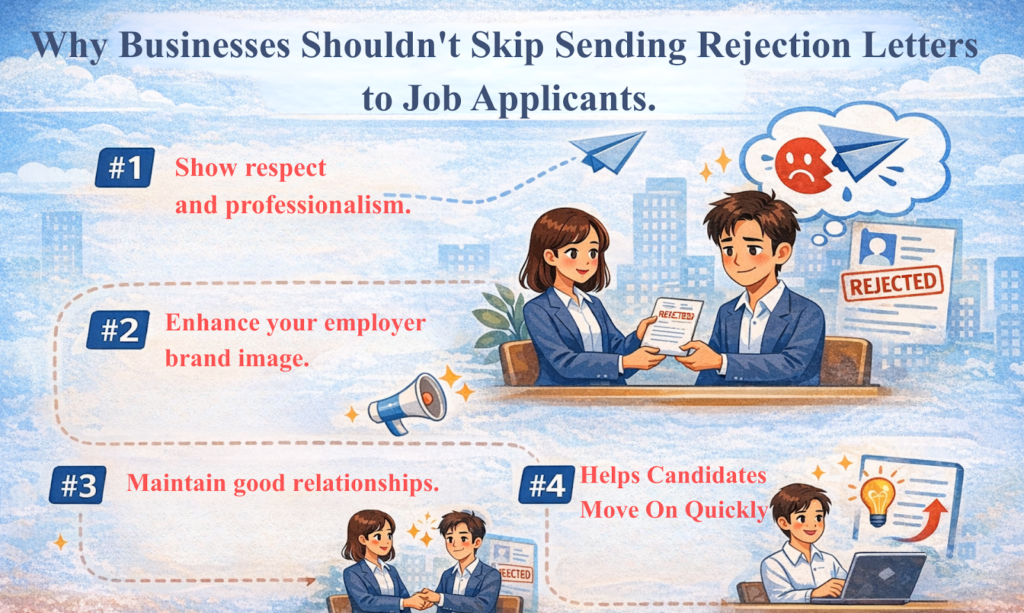
Rejection Email Templates by Stage
Template 1: Post-Resume Screening Rejection
Subject Line: [Company Name] – Application Status for [Position Name]
Dear [Candidate Name],
Thank you for applying to the [Position Name] role at [Company Name]. We appreciate your interest and the time you invested in your application.
We have carefully reviewed your resume. At this time, your experience does not align with the priority requirements for this position. However, we would like to keep your profile in our candidate database and will contact you if a more suitable role becomes available.
We wish you success in your job search and hope to connect in the future.
Best regards,
[Recruitment Team – Company Name]
Template 2: Phone or Screening Interview Rejection
Subject Line: Thank You for Your Interest – Interview Update
Dear [Candidate Name],
Thank you for our conversation on [Date/Day]. I appreciated your enthusiasm and insights regarding [relevant topic].
After internal discussion, we have decided not to advance your application to the next round. The primary reason is that we are seeking candidates with more specialized experience in [specific skill] to meet our immediate project timeline.
We hope to collaborate with you on future opportunities and wish you the best.
Sincerely,
[Your Name/HR Title]
Template 3: In-Person Interview Rejection (Final Round)
Subject Line: [Company Name] – Interview Result for [Position Name]
Dear [Candidate Name],
First, I want to thank you for visiting our office and taking the time to meet with our team on [Date]. We were genuinely impressed by your [specific strength: strategic thinking/presentation skills].
This recruitment cycle was highly competitive. After careful consideration of all candidates, we selected someone whose background more closely aligned with [specific requirement: hands-on experience in X/cultural fit]. This decision reflects the strength of our candidate pool, not a deficiency in your qualifications.
We believe your skills will lead to great success, and we would welcome staying connected on LinkedIn. We may reach out about future opportunities that match your expertise.
Sincerely,
[Hiring Manager Signature]
Template 4: Talent Pool Rejection (High-Potential Candidates)
Subject Line: Thank You – [Candidate Name], We’d Like to Stay in Touch
Dear [Candidate Name],
Thank you for your outstanding performance in our recent interviews. Our management team genuinely values your professional capabilities.
Although we cannot extend an offer at this moment due to [objective reason: budget constraints/position filled], we believe you would be an excellent cultural fit at [Company Name].
If you agree, we would like to add you to our “Priority Candidates” list. When an equivalent position opens, you will be contacted before we conduct public recruitment.
Thank you, and we look forward to future collaboration.
Warm regards,
[Signature]
Download our rejection email templates here.
Common Rejection Email Mistakes to Avoid
- Ghosting: Silence is the worst response. Send rejections within 1-2 weeks of the interview date.
- Cold, Robotic Tone: Avoid clichéd phrases. Add a personal touch to show genuine respect for the candidate.
- Harsh Criticism: Never criticize personal competence harshly. Focus on “not fitting current requirements” instead of “poor skills.”
- Information Errors: Using the wrong name or position is unacceptable. Proofread carefully before sending.
Conclusion
Recruitment is more than finding talent—it is about building relationships. Professional rejection emails plant seeds of goodwill that benefit your organization long-term. Even in disappointment, thoughtful communication elevates your employer brand and contributes to a more respectful job market.
For assistance with recruitment strategy, employer branding, and HR management in Vietnam, contact Wacontre Accounting Services. Hotline: (028) 3820 1213 or email [email protected]. For Japanese clients, call (050) 5534 5505.
Deliver the news directly but diplomatically. Use softening phrases: “Although we were impressed with…” or “However, after careful consideration…” Provide a reason focused on “fit for this position” rather than judging personal competence. For early-stage rejections, a general reason suffices. For candidates in deep interview rounds, offer more constructive feedback when possible.
4. Closing: Best Wishes and Future Opportunity
End on an encouraging note. Wish them well in their job search. If they are high-potential, offer to keep their resume in your “Talent Pool” for future positions.
Rejection Email Templates by Stage
Template 1: Post-Resume Screening Rejection
Subject Line: [Company Name] – Application Status for [Position Name]
Dear [Candidate Name],
Thank you for applying to the [Position Name] role at [Company Name]. We appreciate your interest and the time you invested in your application.
We have carefully reviewed your resume. At this time, your experience does not align with the priority requirements for this position. However, we would like to keep your profile in our candidate database and will contact you if a more suitable role becomes available.
We wish you success in your job search and hope to connect in the future.
Best regards,
[Recruitment Team – Company Name]
Template 2: Phone or Screening Interview Rejection
Subject Line: Thank You for Your Interest – Interview Update
Dear [Candidate Name],
Thank you for our conversation on [Date/Day]. I appreciated your enthusiasm and insights regarding [relevant topic].
After internal discussion, we have decided not to advance your application to the next round. The primary reason is that we are seeking candidates with more specialized experience in [specific skill] to meet our immediate project timeline.
We hope to collaborate with you on future opportunities and wish you the best.
Sincerely,
[Your Name/HR Title]
Template 3: In-Person Interview Rejection (Final Round)
Subject Line: [Company Name] – Interview Result for [Position Name]
Dear [Candidate Name],
First, I want to thank you for visiting our office and taking the time to meet with our team on [Date]. We were genuinely impressed by your [specific strength: strategic thinking/presentation skills].
This recruitment cycle was highly competitive. After careful consideration of all candidates, we selected someone whose background more closely aligned with [specific requirement: hands-on experience in X/cultural fit]. This decision reflects the strength of our candidate pool, not a deficiency in your qualifications.
We believe your skills will lead to great success, and we would welcome staying connected on LinkedIn. We may reach out about future opportunities that match your expertise.
Sincerely,
[Hiring Manager Signature]
Template 4: Talent Pool Rejection (High-Potential Candidates)
Subject Line: Thank You – [Candidate Name], We’d Like to Stay in Touch
Dear [Candidate Name],
Thank you for your outstanding performance in our recent interviews. Our management team genuinely values your professional capabilities.
Although we cannot extend an offer at this moment due to [objective reason: budget constraints/position filled], we believe you would be an excellent cultural fit at [Company Name].
If you agree, we would like to add you to our “Priority Candidates” list. When an equivalent position opens, you will be contacted before we conduct public recruitment.
Thank you, and we look forward to future collaboration.
Warm regards,
[Signature]
Download our rejection email templates here.
Common Rejection Email Mistakes to Avoid
- Ghosting: Silence is the worst response. Send rejections within 1-2 weeks of the interview date.
- Cold, Robotic Tone: Avoid clichéd phrases. Add a personal touch to show genuine respect for the candidate.
- Harsh Criticism: Never criticize personal competence harshly. Focus on “not fitting current requirements” instead of “poor skills.”
- Information Errors: Using the wrong name or position is unacceptable. Proofread carefully before sending.
Conclusion
Recruitment is more than finding talent—it is about building relationships. Professional rejection emails plant seeds of goodwill that benefit your organization long-term. Even in disappointment, thoughtful communication elevates your employer brand and contributes to a more respectful job market.
For assistance with recruitment strategy, employer branding, and HR management in Vietnam, contact Wacontre Accounting Services. Hotline: (028) 3820 1213 or email [email protected]. For Japanese clients, call (050) 5534 5505.
3. Body: Clear Decision and Reason
Deliver the news directly but diplomatically. Use softening phrases: “Although we were impressed with…” or “However, after careful consideration…” Provide a reason focused on “fit for this position” rather than judging personal competence. For early-stage rejections, a general reason suffices. For candidates in deep interview rounds, offer more constructive feedback when possible.
4. Closing: Best Wishes and Future Opportunity
End on an encouraging note. Wish them well in their job search. If they are high-potential, offer to keep their resume in your “Talent Pool” for future positions.
Rejection Email Templates by Stage
Template 1: Post-Resume Screening Rejection
Subject Line: [Company Name] – Application Status for [Position Name]
Dear [Candidate Name],
Thank you for applying to the [Position Name] role at [Company Name]. We appreciate your interest and the time you invested in your application.
We have carefully reviewed your resume. At this time, your experience does not align with the priority requirements for this position. However, we would like to keep your profile in our candidate database and will contact you if a more suitable role becomes available.
We wish you success in your job search and hope to connect in the future.
Best regards,
[Recruitment Team – Company Name]
Template 2: Phone or Screening Interview Rejection
Subject Line: Thank You for Your Interest – Interview Update
Dear [Candidate Name],
Thank you for our conversation on [Date/Day]. I appreciated your enthusiasm and insights regarding [relevant topic].
After internal discussion, we have decided not to advance your application to the next round. The primary reason is that we are seeking candidates with more specialized experience in [specific skill] to meet our immediate project timeline.
We hope to collaborate with you on future opportunities and wish you the best.
Sincerely,
[Your Name/HR Title]
Template 3: In-Person Interview Rejection (Final Round)
Subject Line: [Company Name] – Interview Result for [Position Name]
Dear [Candidate Name],
First, I want to thank you for visiting our office and taking the time to meet with our team on [Date]. We were genuinely impressed by your [specific strength: strategic thinking/presentation skills].
This recruitment cycle was highly competitive. After careful consideration of all candidates, we selected someone whose background more closely aligned with [specific requirement: hands-on experience in X/cultural fit]. This decision reflects the strength of our candidate pool, not a deficiency in your qualifications.
We believe your skills will lead to great success, and we would welcome staying connected on LinkedIn. We may reach out about future opportunities that match your expertise.
Sincerely,
[Hiring Manager Signature]
Template 4: Talent Pool Rejection (High-Potential Candidates)
Subject Line: Thank You – [Candidate Name], We’d Like to Stay in Touch
Dear [Candidate Name],
Thank you for your outstanding performance in our recent interviews. Our management team genuinely values your professional capabilities.
Although we cannot extend an offer at this moment due to [objective reason: budget constraints/position filled], we believe you would be an excellent cultural fit at [Company Name].
If you agree, we would like to add you to our “Priority Candidates” list. When an equivalent position opens, you will be contacted before we conduct public recruitment.
Thank you, and we look forward to future collaboration.
Warm regards,
[Signature]
Download our rejection email templates here.
Common Rejection Email Mistakes to Avoid
- Ghosting: Silence is the worst response. Send rejections within 1-2 weeks of the interview date.
- Cold, Robotic Tone: Avoid clichéd phrases. Add a personal touch to show genuine respect for the candidate.
- Harsh Criticism: Never criticize personal competence harshly. Focus on “not fitting current requirements” instead of “poor skills.”
- Information Errors: Using the wrong name or position is unacceptable. Proofread carefully before sending.
Conclusion
Recruitment is more than finding talent—it is about building relationships. Professional rejection emails plant seeds of goodwill that benefit your organization long-term. Even in disappointment, thoughtful communication elevates your employer brand and contributes to a more respectful job market.
For assistance with recruitment strategy, employer branding, and HR management in Vietnam, contact Wacontre Accounting Services. Hotline: (028) 3820 1213 or email [email protected]. For Japanese clients, call (050) 5534 5505.
Begin by thanking the candidate for their time and interest. Personalize the opening by mentioning a positive aspect from their interview or CV. This demonstrates you remember them as an individual, not just a generic applicant.
3. Body: Clear Decision and Reason
Deliver the news directly but diplomatically. Use softening phrases: “Although we were impressed with…” or “However, after careful consideration…” Provide a reason focused on “fit for this position” rather than judging personal competence. For early-stage rejections, a general reason suffices. For candidates in deep interview rounds, offer more constructive feedback when possible.
4. Closing: Best Wishes and Future Opportunity
End on an encouraging note. Wish them well in their job search. If they are high-potential, offer to keep their resume in your “Talent Pool” for future positions.
Rejection Email Templates by Stage
Template 1: Post-Resume Screening Rejection
Subject Line: [Company Name] – Application Status for [Position Name]
Dear [Candidate Name],
Thank you for applying to the [Position Name] role at [Company Name]. We appreciate your interest and the time you invested in your application.
We have carefully reviewed your resume. At this time, your experience does not align with the priority requirements for this position. However, we would like to keep your profile in our candidate database and will contact you if a more suitable role becomes available.
We wish you success in your job search and hope to connect in the future.
Best regards,
[Recruitment Team – Company Name]
Template 2: Phone or Screening Interview Rejection
Subject Line: Thank You for Your Interest – Interview Update
Dear [Candidate Name],
Thank you for our conversation on [Date/Day]. I appreciated your enthusiasm and insights regarding [relevant topic].
After internal discussion, we have decided not to advance your application to the next round. The primary reason is that we are seeking candidates with more specialized experience in [specific skill] to meet our immediate project timeline.
We hope to collaborate with you on future opportunities and wish you the best.
Sincerely,
[Your Name/HR Title]
Template 3: In-Person Interview Rejection (Final Round)
Subject Line: [Company Name] – Interview Result for [Position Name]
Dear [Candidate Name],
First, I want to thank you for visiting our office and taking the time to meet with our team on [Date]. We were genuinely impressed by your [specific strength: strategic thinking/presentation skills].
This recruitment cycle was highly competitive. After careful consideration of all candidates, we selected someone whose background more closely aligned with [specific requirement: hands-on experience in X/cultural fit]. This decision reflects the strength of our candidate pool, not a deficiency in your qualifications.
We believe your skills will lead to great success, and we would welcome staying connected on LinkedIn. We may reach out about future opportunities that match your expertise.
Sincerely,
[Hiring Manager Signature]
Template 4: Talent Pool Rejection (High-Potential Candidates)
Subject Line: Thank You – [Candidate Name], We’d Like to Stay in Touch
Dear [Candidate Name],
Thank you for your outstanding performance in our recent interviews. Our management team genuinely values your professional capabilities.
Although we cannot extend an offer at this moment due to [objective reason: budget constraints/position filled], we believe you would be an excellent cultural fit at [Company Name].
If you agree, we would like to add you to our “Priority Candidates” list. When an equivalent position opens, you will be contacted before we conduct public recruitment.
Thank you, and we look forward to future collaboration.
Warm regards,
[Signature]
Download our rejection email templates here.
Common Rejection Email Mistakes to Avoid
- Ghosting: Silence is the worst response. Send rejections within 1-2 weeks of the interview date.
- Cold, Robotic Tone: Avoid clichéd phrases. Add a personal touch to show genuine respect for the candidate.
- Harsh Criticism: Never criticize personal competence harshly. Focus on “not fitting current requirements” instead of “poor skills.”
- Information Errors: Using the wrong name or position is unacceptable. Proofread carefully before sending.
Conclusion
Recruitment is more than finding talent—it is about building relationships. Professional rejection emails plant seeds of goodwill that benefit your organization long-term. Even in disappointment, thoughtful communication elevates your employer brand and contributes to a more respectful job market.
For assistance with recruitment strategy, employer branding, and HR management in Vietnam, contact Wacontre Accounting Services. Hotline: (028) 3820 1213 or email [email protected]. For Japanese clients, call (050) 5534 5505.
2. Opening: Gratitude and Personalization
Begin by thanking the candidate for their time and interest. Personalize the opening by mentioning a positive aspect from their interview or CV. This demonstrates you remember them as an individual, not just a generic applicant.
3. Body: Clear Decision and Reason
Deliver the news directly but diplomatically. Use softening phrases: “Although we were impressed with…” or “However, after careful consideration…” Provide a reason focused on “fit for this position” rather than judging personal competence. For early-stage rejections, a general reason suffices. For candidates in deep interview rounds, offer more constructive feedback when possible.
4. Closing: Best Wishes and Future Opportunity
End on an encouraging note. Wish them well in their job search. If they are high-potential, offer to keep their resume in your “Talent Pool” for future positions.
Rejection Email Templates by Stage
Template 1: Post-Resume Screening Rejection
Subject Line: [Company Name] – Application Status for [Position Name]
Dear [Candidate Name],
Thank you for applying to the [Position Name] role at [Company Name]. We appreciate your interest and the time you invested in your application.
We have carefully reviewed your resume. At this time, your experience does not align with the priority requirements for this position. However, we would like to keep your profile in our candidate database and will contact you if a more suitable role becomes available.
We wish you success in your job search and hope to connect in the future.
Best regards,
[Recruitment Team – Company Name]
Template 2: Phone or Screening Interview Rejection
Subject Line: Thank You for Your Interest – Interview Update
Dear [Candidate Name],
Thank you for our conversation on [Date/Day]. I appreciated your enthusiasm and insights regarding [relevant topic].
After internal discussion, we have decided not to advance your application to the next round. The primary reason is that we are seeking candidates with more specialized experience in [specific skill] to meet our immediate project timeline.
We hope to collaborate with you on future opportunities and wish you the best.
Sincerely,
[Your Name/HR Title]
Template 3: In-Person Interview Rejection (Final Round)
Subject Line: [Company Name] – Interview Result for [Position Name]
Dear [Candidate Name],
First, I want to thank you for visiting our office and taking the time to meet with our team on [Date]. We were genuinely impressed by your [specific strength: strategic thinking/presentation skills].
This recruitment cycle was highly competitive. After careful consideration of all candidates, we selected someone whose background more closely aligned with [specific requirement: hands-on experience in X/cultural fit]. This decision reflects the strength of our candidate pool, not a deficiency in your qualifications.
We believe your skills will lead to great success, and we would welcome staying connected on LinkedIn. We may reach out about future opportunities that match your expertise.
Sincerely,
[Hiring Manager Signature]
Template 4: Talent Pool Rejection (High-Potential Candidates)
Subject Line: Thank You – [Candidate Name], We’d Like to Stay in Touch
Dear [Candidate Name],
Thank you for your outstanding performance in our recent interviews. Our management team genuinely values your professional capabilities.
Although we cannot extend an offer at this moment due to [objective reason: budget constraints/position filled], we believe you would be an excellent cultural fit at [Company Name].
If you agree, we would like to add you to our “Priority Candidates” list. When an equivalent position opens, you will be contacted before we conduct public recruitment.
Thank you, and we look forward to future collaboration.
Warm regards,
[Signature]
Download our rejection email templates here.
Common Rejection Email Mistakes to Avoid
- Ghosting: Silence is the worst response. Send rejections within 1-2 weeks of the interview date.
- Cold, Robotic Tone: Avoid clichéd phrases. Add a personal touch to show genuine respect for the candidate.
- Harsh Criticism: Never criticize personal competence harshly. Focus on “not fitting current requirements” instead of “poor skills.”
- Information Errors: Using the wrong name or position is unacceptable. Proofread carefully before sending.
Conclusion
Recruitment is more than finding talent—it is about building relationships. Professional rejection emails plant seeds of goodwill that benefit your organization long-term. Even in disappointment, thoughtful communication elevates your employer brand and contributes to a more respectful job market.
For assistance with recruitment strategy, employer branding, and HR management in Vietnam, contact Wacontre Accounting Services. Hotline: (028) 3820 1213 or email [email protected]. For Japanese clients, call (050) 5534 5505.
Use neutral, transparent language that clearly indicates the decision without being harsh. Example: “[Company Name] – Interview Update for [Position Name]”
2. Opening: Gratitude and Personalization
Begin by thanking the candidate for their time and interest. Personalize the opening by mentioning a positive aspect from their interview or CV. This demonstrates you remember them as an individual, not just a generic applicant.
3. Body: Clear Decision and Reason
Deliver the news directly but diplomatically. Use softening phrases: “Although we were impressed with…” or “However, after careful consideration…” Provide a reason focused on “fit for this position” rather than judging personal competence. For early-stage rejections, a general reason suffices. For candidates in deep interview rounds, offer more constructive feedback when possible.
4. Closing: Best Wishes and Future Opportunity
End on an encouraging note. Wish them well in their job search. If they are high-potential, offer to keep their resume in your “Talent Pool” for future positions.
Rejection Email Templates by Stage
Template 1: Post-Resume Screening Rejection
Subject Line: [Company Name] – Application Status for [Position Name]
Dear [Candidate Name],
Thank you for applying to the [Position Name] role at [Company Name]. We appreciate your interest and the time you invested in your application.
We have carefully reviewed your resume. At this time, your experience does not align with the priority requirements for this position. However, we would like to keep your profile in our candidate database and will contact you if a more suitable role becomes available.
We wish you success in your job search and hope to connect in the future.
Best regards,
[Recruitment Team – Company Name]
Template 2: Phone or Screening Interview Rejection
Subject Line: Thank You for Your Interest – Interview Update
Dear [Candidate Name],
Thank you for our conversation on [Date/Day]. I appreciated your enthusiasm and insights regarding [relevant topic].
After internal discussion, we have decided not to advance your application to the next round. The primary reason is that we are seeking candidates with more specialized experience in [specific skill] to meet our immediate project timeline.
We hope to collaborate with you on future opportunities and wish you the best.
Sincerely,
[Your Name/HR Title]
Template 3: In-Person Interview Rejection (Final Round)
Subject Line: [Company Name] – Interview Result for [Position Name]
Dear [Candidate Name],
First, I want to thank you for visiting our office and taking the time to meet with our team on [Date]. We were genuinely impressed by your [specific strength: strategic thinking/presentation skills].
This recruitment cycle was highly competitive. After careful consideration of all candidates, we selected someone whose background more closely aligned with [specific requirement: hands-on experience in X/cultural fit]. This decision reflects the strength of our candidate pool, not a deficiency in your qualifications.
We believe your skills will lead to great success, and we would welcome staying connected on LinkedIn. We may reach out about future opportunities that match your expertise.
Sincerely,
[Hiring Manager Signature]
Template 4: Talent Pool Rejection (High-Potential Candidates)
Subject Line: Thank You – [Candidate Name], We’d Like to Stay in Touch
Dear [Candidate Name],
Thank you for your outstanding performance in our recent interviews. Our management team genuinely values your professional capabilities.
Although we cannot extend an offer at this moment due to [objective reason: budget constraints/position filled], we believe you would be an excellent cultural fit at [Company Name].
If you agree, we would like to add you to our “Priority Candidates” list. When an equivalent position opens, you will be contacted before we conduct public recruitment.
Thank you, and we look forward to future collaboration.
Warm regards,
[Signature]
Download our rejection email templates here.
Common Rejection Email Mistakes to Avoid
- Ghosting: Silence is the worst response. Send rejections within 1-2 weeks of the interview date.
- Cold, Robotic Tone: Avoid clichéd phrases. Add a personal touch to show genuine respect for the candidate.
- Harsh Criticism: Never criticize personal competence harshly. Focus on “not fitting current requirements” instead of “poor skills.”
- Information Errors: Using the wrong name or position is unacceptable. Proofread carefully before sending.
Conclusion
Recruitment is more than finding talent—it is about building relationships. Professional rejection emails plant seeds of goodwill that benefit your organization long-term. Even in disappointment, thoughtful communication elevates your employer brand and contributes to a more respectful job market.
For assistance with recruitment strategy, employer branding, and HR management in Vietnam, contact Wacontre Accounting Services. Hotline: (028) 3820 1213 or email [email protected]. For Japanese clients, call (050) 5534 5505.
1. Subject Line: Clear and Professional
Use neutral, transparent language that clearly indicates the decision without being harsh. Example: “[Company Name] – Interview Update for [Position Name]”
2. Opening: Gratitude and Personalization
Begin by thanking the candidate for their time and interest. Personalize the opening by mentioning a positive aspect from their interview or CV. This demonstrates you remember them as an individual, not just a generic applicant.
3. Body: Clear Decision and Reason
Deliver the news directly but diplomatically. Use softening phrases: “Although we were impressed with…” or “However, after careful consideration…” Provide a reason focused on “fit for this position” rather than judging personal competence. For early-stage rejections, a general reason suffices. For candidates in deep interview rounds, offer more constructive feedback when possible.
4. Closing: Best Wishes and Future Opportunity
End on an encouraging note. Wish them well in their job search. If they are high-potential, offer to keep their resume in your “Talent Pool” for future positions.
Rejection Email Templates by Stage
Template 1: Post-Resume Screening Rejection
Subject Line: [Company Name] – Application Status for [Position Name]
Dear [Candidate Name],
Thank you for applying to the [Position Name] role at [Company Name]. We appreciate your interest and the time you invested in your application.
We have carefully reviewed your resume. At this time, your experience does not align with the priority requirements for this position. However, we would like to keep your profile in our candidate database and will contact you if a more suitable role becomes available.
We wish you success in your job search and hope to connect in the future.
Best regards,
[Recruitment Team – Company Name]
Template 2: Phone or Screening Interview Rejection
Subject Line: Thank You for Your Interest – Interview Update
Dear [Candidate Name],
Thank you for our conversation on [Date/Day]. I appreciated your enthusiasm and insights regarding [relevant topic].
After internal discussion, we have decided not to advance your application to the next round. The primary reason is that we are seeking candidates with more specialized experience in [specific skill] to meet our immediate project timeline.
We hope to collaborate with you on future opportunities and wish you the best.
Sincerely,
[Your Name/HR Title]
Template 3: In-Person Interview Rejection (Final Round)
Subject Line: [Company Name] – Interview Result for [Position Name]
Dear [Candidate Name],
First, I want to thank you for visiting our office and taking the time to meet with our team on [Date]. We were genuinely impressed by your [specific strength: strategic thinking/presentation skills].
This recruitment cycle was highly competitive. After careful consideration of all candidates, we selected someone whose background more closely aligned with [specific requirement: hands-on experience in X/cultural fit]. This decision reflects the strength of our candidate pool, not a deficiency in your qualifications.
We believe your skills will lead to great success, and we would welcome staying connected on LinkedIn. We may reach out about future opportunities that match your expertise.
Sincerely,
[Hiring Manager Signature]
Template 4: Talent Pool Rejection (High-Potential Candidates)
Subject Line: Thank You – [Candidate Name], We’d Like to Stay in Touch
Dear [Candidate Name],
Thank you for your outstanding performance in our recent interviews. Our management team genuinely values your professional capabilities.
Although we cannot extend an offer at this moment due to [objective reason: budget constraints/position filled], we believe you would be an excellent cultural fit at [Company Name].
If you agree, we would like to add you to our “Priority Candidates” list. When an equivalent position opens, you will be contacted before we conduct public recruitment.
Thank you, and we look forward to future collaboration.
Warm regards,
[Signature]
Download our rejection email templates here.
Common Rejection Email Mistakes to Avoid
- Ghosting: Silence is the worst response. Send rejections within 1-2 weeks of the interview date.
- Cold, Robotic Tone: Avoid clichéd phrases. Add a personal touch to show genuine respect for the candidate.
- Harsh Criticism: Never criticize personal competence harshly. Focus on “not fitting current requirements” instead of “poor skills.”
- Information Errors: Using the wrong name or position is unacceptable. Proofread carefully before sending.
Conclusion
Recruitment is more than finding talent—it is about building relationships. Professional rejection emails plant seeds of goodwill that benefit your organization long-term. Even in disappointment, thoughtful communication elevates your employer brand and contributes to a more respectful job market.
For assistance with recruitment strategy, employer branding, and HR management in Vietnam, contact Wacontre Accounting Services. Hotline: (028) 3820 1213 or email [email protected]. For Japanese clients, call (050) 5534 5505.
Use the “Sandwich” approach: open positively, deliver the news tactfully, and close encouragingly.
1. Subject Line: Clear and Professional
Use neutral, transparent language that clearly indicates the decision without being harsh. Example: “[Company Name] – Interview Update for [Position Name]”
2. Opening: Gratitude and Personalization
Begin by thanking the candidate for their time and interest. Personalize the opening by mentioning a positive aspect from their interview or CV. This demonstrates you remember them as an individual, not just a generic applicant.
3. Body: Clear Decision and Reason
Deliver the news directly but diplomatically. Use softening phrases: “Although we were impressed with…” or “However, after careful consideration…” Provide a reason focused on “fit for this position” rather than judging personal competence. For early-stage rejections, a general reason suffices. For candidates in deep interview rounds, offer more constructive feedback when possible.
4. Closing: Best Wishes and Future Opportunity
End on an encouraging note. Wish them well in their job search. If they are high-potential, offer to keep their resume in your “Talent Pool” for future positions.
Rejection Email Templates by Stage
Template 1: Post-Resume Screening Rejection
Subject Line: [Company Name] – Application Status for [Position Name]
Dear [Candidate Name],
Thank you for applying to the [Position Name] role at [Company Name]. We appreciate your interest and the time you invested in your application.
We have carefully reviewed your resume. At this time, your experience does not align with the priority requirements for this position. However, we would like to keep your profile in our candidate database and will contact you if a more suitable role becomes available.
We wish you success in your job search and hope to connect in the future.
Best regards,
[Recruitment Team – Company Name]
Template 2: Phone or Screening Interview Rejection
Subject Line: Thank You for Your Interest – Interview Update
Dear [Candidate Name],
Thank you for our conversation on [Date/Day]. I appreciated your enthusiasm and insights regarding [relevant topic].
After internal discussion, we have decided not to advance your application to the next round. The primary reason is that we are seeking candidates with more specialized experience in [specific skill] to meet our immediate project timeline.
We hope to collaborate with you on future opportunities and wish you the best.
Sincerely,
[Your Name/HR Title]
Template 3: In-Person Interview Rejection (Final Round)
Subject Line: [Company Name] – Interview Result for [Position Name]
Dear [Candidate Name],
First, I want to thank you for visiting our office and taking the time to meet with our team on [Date]. We were genuinely impressed by your [specific strength: strategic thinking/presentation skills].
This recruitment cycle was highly competitive. After careful consideration of all candidates, we selected someone whose background more closely aligned with [specific requirement: hands-on experience in X/cultural fit]. This decision reflects the strength of our candidate pool, not a deficiency in your qualifications.
We believe your skills will lead to great success, and we would welcome staying connected on LinkedIn. We may reach out about future opportunities that match your expertise.
Sincerely,
[Hiring Manager Signature]
Template 4: Talent Pool Rejection (High-Potential Candidates)
Subject Line: Thank You – [Candidate Name], We’d Like to Stay in Touch
Dear [Candidate Name],
Thank you for your outstanding performance in our recent interviews. Our management team genuinely values your professional capabilities.
Although we cannot extend an offer at this moment due to [objective reason: budget constraints/position filled], we believe you would be an excellent cultural fit at [Company Name].
If you agree, we would like to add you to our “Priority Candidates” list. When an equivalent position opens, you will be contacted before we conduct public recruitment.
Thank you, and we look forward to future collaboration.
Warm regards,
[Signature]
Download our rejection email templates here.
Common Rejection Email Mistakes to Avoid
- Ghosting: Silence is the worst response. Send rejections within 1-2 weeks of the interview date.
- Cold, Robotic Tone: Avoid clichéd phrases. Add a personal touch to show genuine respect for the candidate.
- Harsh Criticism: Never criticize personal competence harshly. Focus on “not fitting current requirements” instead of “poor skills.”
- Information Errors: Using the wrong name or position is unacceptable. Proofread carefully before sending.
Conclusion
Recruitment is more than finding talent—it is about building relationships. Professional rejection emails plant seeds of goodwill that benefit your organization long-term. Even in disappointment, thoughtful communication elevates your employer brand and contributes to a more respectful job market.
For assistance with recruitment strategy, employer branding, and HR management in Vietnam, contact Wacontre Accounting Services. Hotline: (028) 3820 1213 or email [email protected]. For Japanese clients, call (050) 5534 5505.
Structure of a Professional Rejection Email
Use the “Sandwich” approach: open positively, deliver the news tactfully, and close encouragingly.
1. Subject Line: Clear and Professional
Use neutral, transparent language that clearly indicates the decision without being harsh. Example: “[Company Name] – Interview Update for [Position Name]”
2. Opening: Gratitude and Personalization
Begin by thanking the candidate for their time and interest. Personalize the opening by mentioning a positive aspect from their interview or CV. This demonstrates you remember them as an individual, not just a generic applicant.
3. Body: Clear Decision and Reason
Deliver the news directly but diplomatically. Use softening phrases: “Although we were impressed with…” or “However, after careful consideration…” Provide a reason focused on “fit for this position” rather than judging personal competence. For early-stage rejections, a general reason suffices. For candidates in deep interview rounds, offer more constructive feedback when possible.
4. Closing: Best Wishes and Future Opportunity
End on an encouraging note. Wish them well in their job search. If they are high-potential, offer to keep their resume in your “Talent Pool” for future positions.
Rejection Email Templates by Stage
Template 1: Post-Resume Screening Rejection
Subject Line: [Company Name] – Application Status for [Position Name]
Dear [Candidate Name],
Thank you for applying to the [Position Name] role at [Company Name]. We appreciate your interest and the time you invested in your application.
We have carefully reviewed your resume. At this time, your experience does not align with the priority requirements for this position. However, we would like to keep your profile in our candidate database and will contact you if a more suitable role becomes available.
We wish you success in your job search and hope to connect in the future.
Best regards,
[Recruitment Team – Company Name]
Template 2: Phone or Screening Interview Rejection
Subject Line: Thank You for Your Interest – Interview Update
Dear [Candidate Name],
Thank you for our conversation on [Date/Day]. I appreciated your enthusiasm and insights regarding [relevant topic].
After internal discussion, we have decided not to advance your application to the next round. The primary reason is that we are seeking candidates with more specialized experience in [specific skill] to meet our immediate project timeline.
We hope to collaborate with you on future opportunities and wish you the best.
Sincerely,
[Your Name/HR Title]
Template 3: In-Person Interview Rejection (Final Round)
Subject Line: [Company Name] – Interview Result for [Position Name]
Dear [Candidate Name],
First, I want to thank you for visiting our office and taking the time to meet with our team on [Date]. We were genuinely impressed by your [specific strength: strategic thinking/presentation skills].
This recruitment cycle was highly competitive. After careful consideration of all candidates, we selected someone whose background more closely aligned with [specific requirement: hands-on experience in X/cultural fit]. This decision reflects the strength of our candidate pool, not a deficiency in your qualifications.
We believe your skills will lead to great success, and we would welcome staying connected on LinkedIn. We may reach out about future opportunities that match your expertise.
Sincerely,
[Hiring Manager Signature]
Template 4: Talent Pool Rejection (High-Potential Candidates)
Subject Line: Thank You – [Candidate Name], We’d Like to Stay in Touch
Dear [Candidate Name],
Thank you for your outstanding performance in our recent interviews. Our management team genuinely values your professional capabilities.
Although we cannot extend an offer at this moment due to [objective reason: budget constraints/position filled], we believe you would be an excellent cultural fit at [Company Name].
If you agree, we would like to add you to our “Priority Candidates” list. When an equivalent position opens, you will be contacted before we conduct public recruitment.
Thank you, and we look forward to future collaboration.
Warm regards,
[Signature]
Download our rejection email templates here.
Common Rejection Email Mistakes to Avoid
- Ghosting: Silence is the worst response. Send rejections within 1-2 weeks of the interview date.
- Cold, Robotic Tone: Avoid clichéd phrases. Add a personal touch to show genuine respect for the candidate.
- Harsh Criticism: Never criticize personal competence harshly. Focus on “not fitting current requirements” instead of “poor skills.”
- Information Errors: Using the wrong name or position is unacceptable. Proofread carefully before sending.
Conclusion
Recruitment is more than finding talent—it is about building relationships. Professional rejection emails plant seeds of goodwill that benefit your organization long-term. Even in disappointment, thoughtful communication elevates your employer brand and contributes to a more respectful job market.
For assistance with recruitment strategy, employer branding, and HR management in Vietnam, contact Wacontre Accounting Services. Hotline: (028) 3820 1213 or email [email protected]. For Japanese clients, call (050) 5534 5505.
Structure of a Professional Rejection Email
Use the “Sandwich” approach: open positively, deliver the news tactfully, and close encouragingly.
1. Subject Line: Clear and Professional
Use neutral, transparent language that clearly indicates the decision without being harsh. Example: “[Company Name] – Interview Update for [Position Name]”
2. Opening: Gratitude and Personalization
Begin by thanking the candidate for their time and interest. Personalize the opening by mentioning a positive aspect from their interview or CV. This demonstrates you remember them as an individual, not just a generic applicant.
3. Body: Clear Decision and Reason
Deliver the news directly but diplomatically. Use softening phrases: “Although we were impressed with…” or “However, after careful consideration…” Provide a reason focused on “fit for this position” rather than judging personal competence. For early-stage rejections, a general reason suffices. For candidates in deep interview rounds, offer more constructive feedback when possible.
4. Closing: Best Wishes and Future Opportunity
End on an encouraging note. Wish them well in their job search. If they are high-potential, offer to keep their resume in your “Talent Pool” for future positions.
Rejection Email Templates by Stage
Template 1: Post-Resume Screening Rejection
Subject Line: [Company Name] – Application Status for [Position Name]
Dear [Candidate Name],
Thank you for applying to the [Position Name] role at [Company Name]. We appreciate your interest and the time you invested in your application.
We have carefully reviewed your resume. At this time, your experience does not align with the priority requirements for this position. However, we would like to keep your profile in our candidate database and will contact you if a more suitable role becomes available.
We wish you success in your job search and hope to connect in the future.
Best regards,
[Recruitment Team – Company Name]
Template 2: Phone or Screening Interview Rejection
Subject Line: Thank You for Your Interest – Interview Update
Dear [Candidate Name],
Thank you for our conversation on [Date/Day]. I appreciated your enthusiasm and insights regarding [relevant topic].
After internal discussion, we have decided not to advance your application to the next round. The primary reason is that we are seeking candidates with more specialized experience in [specific skill] to meet our immediate project timeline.
We hope to collaborate with you on future opportunities and wish you the best.
Sincerely,
[Your Name/HR Title]
Template 3: In-Person Interview Rejection (Final Round)
Subject Line: [Company Name] – Interview Result for [Position Name]
Dear [Candidate Name],
First, I want to thank you for visiting our office and taking the time to meet with our team on [Date]. We were genuinely impressed by your [specific strength: strategic thinking/presentation skills].
This recruitment cycle was highly competitive. After careful consideration of all candidates, we selected someone whose background more closely aligned with [specific requirement: hands-on experience in X/cultural fit]. This decision reflects the strength of our candidate pool, not a deficiency in your qualifications.
We believe your skills will lead to great success, and we would welcome staying connected on LinkedIn. We may reach out about future opportunities that match your expertise.
Sincerely,
[Hiring Manager Signature]
Template 4: Talent Pool Rejection (High-Potential Candidates)
Subject Line: Thank You – [Candidate Name], We’d Like to Stay in Touch
Dear [Candidate Name],
Thank you for your outstanding performance in our recent interviews. Our management team genuinely values your professional capabilities.
Although we cannot extend an offer at this moment due to [objective reason: budget constraints/position filled], we believe you would be an excellent cultural fit at [Company Name].
If you agree, we would like to add you to our “Priority Candidates” list. When an equivalent position opens, you will be contacted before we conduct public recruitment.
Thank you, and we look forward to future collaboration.
Warm regards,
[Signature]
Download our rejection email templates here.
Common Rejection Email Mistakes to Avoid
- Ghosting: Silence is the worst response. Send rejections within 1-2 weeks of the interview date.
- Cold, Robotic Tone: Avoid clichéd phrases. Add a personal touch to show genuine respect for the candidate.
- Harsh Criticism: Never criticize personal competence harshly. Focus on “not fitting current requirements” instead of “poor skills.”
- Information Errors: Using the wrong name or position is unacceptable. Proofread carefully before sending.
Conclusion
Recruitment is more than finding talent—it is about building relationships. Professional rejection emails plant seeds of goodwill that benefit your organization long-term. Even in disappointment, thoughtful communication elevates your employer brand and contributes to a more respectful job market.
For assistance with recruitment strategy, employer branding, and HR management in Vietnam, contact Wacontre Accounting Services. Hotline: (028) 3820 1213 or email [email protected]. For Japanese clients, call (050) 5534 5505.
4. Helps Candidates Move Forward
Waiting for interview results creates stress. A timely rejection email—even if unwelcome—provides closure and allows candidates to focus on other opportunities. This clarity also improves the overall job market.
Structure of a Professional Rejection Email
Use the “Sandwich” approach: open positively, deliver the news tactfully, and close encouragingly.
1. Subject Line: Clear and Professional
Use neutral, transparent language that clearly indicates the decision without being harsh. Example: “[Company Name] – Interview Update for [Position Name]”
2. Opening: Gratitude and Personalization
Begin by thanking the candidate for their time and interest. Personalize the opening by mentioning a positive aspect from their interview or CV. This demonstrates you remember them as an individual, not just a generic applicant.
3. Body: Clear Decision and Reason
Deliver the news directly but diplomatically. Use softening phrases: “Although we were impressed with…” or “However, after careful consideration…” Provide a reason focused on “fit for this position” rather than judging personal competence. For early-stage rejections, a general reason suffices. For candidates in deep interview rounds, offer more constructive feedback when possible.
4. Closing: Best Wishes and Future Opportunity
End on an encouraging note. Wish them well in their job search. If they are high-potential, offer to keep their resume in your “Talent Pool” for future positions.
Rejection Email Templates by Stage
Template 1: Post-Resume Screening Rejection
Subject Line: [Company Name] – Application Status for [Position Name]
Dear [Candidate Name],
Thank you for applying to the [Position Name] role at [Company Name]. We appreciate your interest and the time you invested in your application.
We have carefully reviewed your resume. At this time, your experience does not align with the priority requirements for this position. However, we would like to keep your profile in our candidate database and will contact you if a more suitable role becomes available.
We wish you success in your job search and hope to connect in the future.
Best regards,
[Recruitment Team – Company Name]
Template 2: Phone or Screening Interview Rejection
Subject Line: Thank You for Your Interest – Interview Update
Dear [Candidate Name],
Thank you for our conversation on [Date/Day]. I appreciated your enthusiasm and insights regarding [relevant topic].
After internal discussion, we have decided not to advance your application to the next round. The primary reason is that we are seeking candidates with more specialized experience in [specific skill] to meet our immediate project timeline.
We hope to collaborate with you on future opportunities and wish you the best.
Sincerely,
[Your Name/HR Title]
Template 3: In-Person Interview Rejection (Final Round)
Subject Line: [Company Name] – Interview Result for [Position Name]
Dear [Candidate Name],
First, I want to thank you for visiting our office and taking the time to meet with our team on [Date]. We were genuinely impressed by your [specific strength: strategic thinking/presentation skills].
This recruitment cycle was highly competitive. After careful consideration of all candidates, we selected someone whose background more closely aligned with [specific requirement: hands-on experience in X/cultural fit]. This decision reflects the strength of our candidate pool, not a deficiency in your qualifications.
We believe your skills will lead to great success, and we would welcome staying connected on LinkedIn. We may reach out about future opportunities that match your expertise.
Sincerely,
[Hiring Manager Signature]
Template 4: Talent Pool Rejection (High-Potential Candidates)
Subject Line: Thank You – [Candidate Name], We’d Like to Stay in Touch
Dear [Candidate Name],
Thank you for your outstanding performance in our recent interviews. Our management team genuinely values your professional capabilities.
Although we cannot extend an offer at this moment due to [objective reason: budget constraints/position filled], we believe you would be an excellent cultural fit at [Company Name].
If you agree, we would like to add you to our “Priority Candidates” list. When an equivalent position opens, you will be contacted before we conduct public recruitment.
Thank you, and we look forward to future collaboration.
Warm regards,
[Signature]
Download our rejection email templates here.
Common Rejection Email Mistakes to Avoid
- Ghosting: Silence is the worst response. Send rejections within 1-2 weeks of the interview date.
- Cold, Robotic Tone: Avoid clichéd phrases. Add a personal touch to show genuine respect for the candidate.
- Harsh Criticism: Never criticize personal competence harshly. Focus on “not fitting current requirements” instead of “poor skills.”
- Information Errors: Using the wrong name or position is unacceptable. Proofread carefully before sending.
Conclusion
Recruitment is more than finding talent—it is about building relationships. Professional rejection emails plant seeds of goodwill that benefit your organization long-term. Even in disappointment, thoughtful communication elevates your employer brand and contributes to a more respectful job market.
For assistance with recruitment strategy, employer branding, and HR management in Vietnam, contact Wacontre Accounting Services. Hotline: (028) 3820 1213 or email [email protected]. For Japanese clients, call (050) 5534 5505.
Today’s rejected candidate may be tomorrow’s perfect hire (boomerang candidate), partner, or client. Professional rejection emails keep the door open for future collaboration and prevent burning bridges.
4. Helps Candidates Move Forward
Waiting for interview results creates stress. A timely rejection email—even if unwelcome—provides closure and allows candidates to focus on other opportunities. This clarity also improves the overall job market.
Structure of a Professional Rejection Email
Use the “Sandwich” approach: open positively, deliver the news tactfully, and close encouragingly.
1. Subject Line: Clear and Professional
Use neutral, transparent language that clearly indicates the decision without being harsh. Example: “[Company Name] – Interview Update for [Position Name]”
2. Opening: Gratitude and Personalization
Begin by thanking the candidate for their time and interest. Personalize the opening by mentioning a positive aspect from their interview or CV. This demonstrates you remember them as an individual, not just a generic applicant.
3. Body: Clear Decision and Reason
Deliver the news directly but diplomatically. Use softening phrases: “Although we were impressed with…” or “However, after careful consideration…” Provide a reason focused on “fit for this position” rather than judging personal competence. For early-stage rejections, a general reason suffices. For candidates in deep interview rounds, offer more constructive feedback when possible.
4. Closing: Best Wishes and Future Opportunity
End on an encouraging note. Wish them well in their job search. If they are high-potential, offer to keep their resume in your “Talent Pool” for future positions.
Rejection Email Templates by Stage
Template 1: Post-Resume Screening Rejection
Subject Line: [Company Name] – Application Status for [Position Name]
Dear [Candidate Name],
Thank you for applying to the [Position Name] role at [Company Name]. We appreciate your interest and the time you invested in your application.
We have carefully reviewed your resume. At this time, your experience does not align with the priority requirements for this position. However, we would like to keep your profile in our candidate database and will contact you if a more suitable role becomes available.
We wish you success in your job search and hope to connect in the future.
Best regards,
[Recruitment Team – Company Name]
Template 2: Phone or Screening Interview Rejection
Subject Line: Thank You for Your Interest – Interview Update
Dear [Candidate Name],
Thank you for our conversation on [Date/Day]. I appreciated your enthusiasm and insights regarding [relevant topic].
After internal discussion, we have decided not to advance your application to the next round. The primary reason is that we are seeking candidates with more specialized experience in [specific skill] to meet our immediate project timeline.
We hope to collaborate with you on future opportunities and wish you the best.
Sincerely,
[Your Name/HR Title]
Template 3: In-Person Interview Rejection (Final Round)
Subject Line: [Company Name] – Interview Result for [Position Name]
Dear [Candidate Name],
First, I want to thank you for visiting our office and taking the time to meet with our team on [Date]. We were genuinely impressed by your [specific strength: strategic thinking/presentation skills].
This recruitment cycle was highly competitive. After careful consideration of all candidates, we selected someone whose background more closely aligned with [specific requirement: hands-on experience in X/cultural fit]. This decision reflects the strength of our candidate pool, not a deficiency in your qualifications.
We believe your skills will lead to great success, and we would welcome staying connected on LinkedIn. We may reach out about future opportunities that match your expertise.
Sincerely,
[Hiring Manager Signature]
Template 4: Talent Pool Rejection (High-Potential Candidates)
Subject Line: Thank You – [Candidate Name], We’d Like to Stay in Touch
Dear [Candidate Name],
Thank you for your outstanding performance in our recent interviews. Our management team genuinely values your professional capabilities.
Although we cannot extend an offer at this moment due to [objective reason: budget constraints/position filled], we believe you would be an excellent cultural fit at [Company Name].
If you agree, we would like to add you to our “Priority Candidates” list. When an equivalent position opens, you will be contacted before we conduct public recruitment.
Thank you, and we look forward to future collaboration.
Warm regards,
[Signature]
Download our rejection email templates here.
Common Rejection Email Mistakes to Avoid
- Ghosting: Silence is the worst response. Send rejections within 1-2 weeks of the interview date.
- Cold, Robotic Tone: Avoid clichéd phrases. Add a personal touch to show genuine respect for the candidate.
- Harsh Criticism: Never criticize personal competence harshly. Focus on “not fitting current requirements” instead of “poor skills.”
- Information Errors: Using the wrong name or position is unacceptable. Proofread carefully before sending.
Conclusion
Recruitment is more than finding talent—it is about building relationships. Professional rejection emails plant seeds of goodwill that benefit your organization long-term. Even in disappointment, thoughtful communication elevates your employer brand and contributes to a more respectful job market.
For assistance with recruitment strategy, employer branding, and HR management in Vietnam, contact Wacontre Accounting Services. Hotline: (028) 3820 1213 or email [email protected]. For Japanese clients, call (050) 5534 5505.
3. Maintains Networking Opportunities
Today’s rejected candidate may be tomorrow’s perfect hire (boomerang candidate), partner, or client. Professional rejection emails keep the door open for future collaboration and prevent burning bridges.
4. Helps Candidates Move Forward
Waiting for interview results creates stress. A timely rejection email—even if unwelcome—provides closure and allows candidates to focus on other opportunities. This clarity also improves the overall job market.
Structure of a Professional Rejection Email
Use the “Sandwich” approach: open positively, deliver the news tactfully, and close encouragingly.
1. Subject Line: Clear and Professional
Use neutral, transparent language that clearly indicates the decision without being harsh. Example: “[Company Name] – Interview Update for [Position Name]”
2. Opening: Gratitude and Personalization
Begin by thanking the candidate for their time and interest. Personalize the opening by mentioning a positive aspect from their interview or CV. This demonstrates you remember them as an individual, not just a generic applicant.
3. Body: Clear Decision and Reason
Deliver the news directly but diplomatically. Use softening phrases: “Although we were impressed with…” or “However, after careful consideration…” Provide a reason focused on “fit for this position” rather than judging personal competence. For early-stage rejections, a general reason suffices. For candidates in deep interview rounds, offer more constructive feedback when possible.
4. Closing: Best Wishes and Future Opportunity
End on an encouraging note. Wish them well in their job search. If they are high-potential, offer to keep their resume in your “Talent Pool” for future positions.
Rejection Email Templates by Stage
Template 1: Post-Resume Screening Rejection
Subject Line: [Company Name] – Application Status for [Position Name]
Dear [Candidate Name],
Thank you for applying to the [Position Name] role at [Company Name]. We appreciate your interest and the time you invested in your application.
We have carefully reviewed your resume. At this time, your experience does not align with the priority requirements for this position. However, we would like to keep your profile in our candidate database and will contact you if a more suitable role becomes available.
We wish you success in your job search and hope to connect in the future.
Best regards,
[Recruitment Team – Company Name]
Template 2: Phone or Screening Interview Rejection
Subject Line: Thank You for Your Interest – Interview Update
Dear [Candidate Name],
Thank you for our conversation on [Date/Day]. I appreciated your enthusiasm and insights regarding [relevant topic].
After internal discussion, we have decided not to advance your application to the next round. The primary reason is that we are seeking candidates with more specialized experience in [specific skill] to meet our immediate project timeline.
We hope to collaborate with you on future opportunities and wish you the best.
Sincerely,
[Your Name/HR Title]
Template 3: In-Person Interview Rejection (Final Round)
Subject Line: [Company Name] – Interview Result for [Position Name]
Dear [Candidate Name],
First, I want to thank you for visiting our office and taking the time to meet with our team on [Date]. We were genuinely impressed by your [specific strength: strategic thinking/presentation skills].
This recruitment cycle was highly competitive. After careful consideration of all candidates, we selected someone whose background more closely aligned with [specific requirement: hands-on experience in X/cultural fit]. This decision reflects the strength of our candidate pool, not a deficiency in your qualifications.
We believe your skills will lead to great success, and we would welcome staying connected on LinkedIn. We may reach out about future opportunities that match your expertise.
Sincerely,
[Hiring Manager Signature]
Template 4: Talent Pool Rejection (High-Potential Candidates)
Subject Line: Thank You – [Candidate Name], We’d Like to Stay in Touch
Dear [Candidate Name],
Thank you for your outstanding performance in our recent interviews. Our management team genuinely values your professional capabilities.
Although we cannot extend an offer at this moment due to [objective reason: budget constraints/position filled], we believe you would be an excellent cultural fit at [Company Name].
If you agree, we would like to add you to our “Priority Candidates” list. When an equivalent position opens, you will be contacted before we conduct public recruitment.
Thank you, and we look forward to future collaboration.
Warm regards,
[Signature]
Download our rejection email templates here.
Common Rejection Email Mistakes to Avoid
- Ghosting: Silence is the worst response. Send rejections within 1-2 weeks of the interview date.
- Cold, Robotic Tone: Avoid clichéd phrases. Add a personal touch to show genuine respect for the candidate.
- Harsh Criticism: Never criticize personal competence harshly. Focus on “not fitting current requirements” instead of “poor skills.”
- Information Errors: Using the wrong name or position is unacceptable. Proofread carefully before sending.
Conclusion
Recruitment is more than finding talent—it is about building relationships. Professional rejection emails plant seeds of goodwill that benefit your organization long-term. Even in disappointment, thoughtful communication elevates your employer brand and contributes to a more respectful job market.
For assistance with recruitment strategy, employer branding, and HR management in Vietnam, contact Wacontre Accounting Services. Hotline: (028) 3820 1213 or email [email protected]. For Japanese clients, call (050) 5534 5505.
In the digital age, candidates share their experiences on LinkedIn, Glassdoor, and social media. A rejected candidate who receives a thoughtful, constructive email becomes a brand ambassador. Silence or a curt rejection creates detractors who can damage your reputation.
3. Maintains Networking Opportunities
Today’s rejected candidate may be tomorrow’s perfect hire (boomerang candidate), partner, or client. Professional rejection emails keep the door open for future collaboration and prevent burning bridges.
4. Helps Candidates Move Forward
Waiting for interview results creates stress. A timely rejection email—even if unwelcome—provides closure and allows candidates to focus on other opportunities. This clarity also improves the overall job market.
Structure of a Professional Rejection Email
Use the “Sandwich” approach: open positively, deliver the news tactfully, and close encouragingly.
1. Subject Line: Clear and Professional
Use neutral, transparent language that clearly indicates the decision without being harsh. Example: “[Company Name] – Interview Update for [Position Name]”
2. Opening: Gratitude and Personalization
Begin by thanking the candidate for their time and interest. Personalize the opening by mentioning a positive aspect from their interview or CV. This demonstrates you remember them as an individual, not just a generic applicant.
3. Body: Clear Decision and Reason
Deliver the news directly but diplomatically. Use softening phrases: “Although we were impressed with…” or “However, after careful consideration…” Provide a reason focused on “fit for this position” rather than judging personal competence. For early-stage rejections, a general reason suffices. For candidates in deep interview rounds, offer more constructive feedback when possible.
4. Closing: Best Wishes and Future Opportunity
End on an encouraging note. Wish them well in their job search. If they are high-potential, offer to keep their resume in your “Talent Pool” for future positions.
Rejection Email Templates by Stage
Template 1: Post-Resume Screening Rejection
Subject Line: [Company Name] – Application Status for [Position Name]
Dear [Candidate Name],
Thank you for applying to the [Position Name] role at [Company Name]. We appreciate your interest and the time you invested in your application.
We have carefully reviewed your resume. At this time, your experience does not align with the priority requirements for this position. However, we would like to keep your profile in our candidate database and will contact you if a more suitable role becomes available.
We wish you success in your job search and hope to connect in the future.
Best regards,
[Recruitment Team – Company Name]
Template 2: Phone or Screening Interview Rejection
Subject Line: Thank You for Your Interest – Interview Update
Dear [Candidate Name],
Thank you for our conversation on [Date/Day]. I appreciated your enthusiasm and insights regarding [relevant topic].
After internal discussion, we have decided not to advance your application to the next round. The primary reason is that we are seeking candidates with more specialized experience in [specific skill] to meet our immediate project timeline.
We hope to collaborate with you on future opportunities and wish you the best.
Sincerely,
[Your Name/HR Title]
Template 3: In-Person Interview Rejection (Final Round)
Subject Line: [Company Name] – Interview Result for [Position Name]
Dear [Candidate Name],
First, I want to thank you for visiting our office and taking the time to meet with our team on [Date]. We were genuinely impressed by your [specific strength: strategic thinking/presentation skills].
This recruitment cycle was highly competitive. After careful consideration of all candidates, we selected someone whose background more closely aligned with [specific requirement: hands-on experience in X/cultural fit]. This decision reflects the strength of our candidate pool, not a deficiency in your qualifications.
We believe your skills will lead to great success, and we would welcome staying connected on LinkedIn. We may reach out about future opportunities that match your expertise.
Sincerely,
[Hiring Manager Signature]
Template 4: Talent Pool Rejection (High-Potential Candidates)
Subject Line: Thank You – [Candidate Name], We’d Like to Stay in Touch
Dear [Candidate Name],
Thank you for your outstanding performance in our recent interviews. Our management team genuinely values your professional capabilities.
Although we cannot extend an offer at this moment due to [objective reason: budget constraints/position filled], we believe you would be an excellent cultural fit at [Company Name].
If you agree, we would like to add you to our “Priority Candidates” list. When an equivalent position opens, you will be contacted before we conduct public recruitment.
Thank you, and we look forward to future collaboration.
Warm regards,
[Signature]
Download our rejection email templates here.
Common Rejection Email Mistakes to Avoid
- Ghosting: Silence is the worst response. Send rejections within 1-2 weeks of the interview date.
- Cold, Robotic Tone: Avoid clichéd phrases. Add a personal touch to show genuine respect for the candidate.
- Harsh Criticism: Never criticize personal competence harshly. Focus on “not fitting current requirements” instead of “poor skills.”
- Information Errors: Using the wrong name or position is unacceptable. Proofread carefully before sending.
Conclusion
Recruitment is more than finding talent—it is about building relationships. Professional rejection emails plant seeds of goodwill that benefit your organization long-term. Even in disappointment, thoughtful communication elevates your employer brand and contributes to a more respectful job market.
For assistance with recruitment strategy, employer branding, and HR management in Vietnam, contact Wacontre Accounting Services. Hotline: (028) 3820 1213 or email [email protected]. For Japanese clients, call (050) 5534 5505.
2. Protects Employer Brand
In the digital age, candidates share their experiences on LinkedIn, Glassdoor, and social media. A rejected candidate who receives a thoughtful, constructive email becomes a brand ambassador. Silence or a curt rejection creates detractors who can damage your reputation.
3. Maintains Networking Opportunities
Today’s rejected candidate may be tomorrow’s perfect hire (boomerang candidate), partner, or client. Professional rejection emails keep the door open for future collaboration and prevent burning bridges.
4. Helps Candidates Move Forward
Waiting for interview results creates stress. A timely rejection email—even if unwelcome—provides closure and allows candidates to focus on other opportunities. This clarity also improves the overall job market.
Structure of a Professional Rejection Email
Use the “Sandwich” approach: open positively, deliver the news tactfully, and close encouragingly.
1. Subject Line: Clear and Professional
Use neutral, transparent language that clearly indicates the decision without being harsh. Example: “[Company Name] – Interview Update for [Position Name]”
2. Opening: Gratitude and Personalization
Begin by thanking the candidate for their time and interest. Personalize the opening by mentioning a positive aspect from their interview or CV. This demonstrates you remember them as an individual, not just a generic applicant.
3. Body: Clear Decision and Reason
Deliver the news directly but diplomatically. Use softening phrases: “Although we were impressed with…” or “However, after careful consideration…” Provide a reason focused on “fit for this position” rather than judging personal competence. For early-stage rejections, a general reason suffices. For candidates in deep interview rounds, offer more constructive feedback when possible.
4. Closing: Best Wishes and Future Opportunity
End on an encouraging note. Wish them well in their job search. If they are high-potential, offer to keep their resume in your “Talent Pool” for future positions.
Rejection Email Templates by Stage
Template 1: Post-Resume Screening Rejection
Subject Line: [Company Name] – Application Status for [Position Name]
Dear [Candidate Name],
Thank you for applying to the [Position Name] role at [Company Name]. We appreciate your interest and the time you invested in your application.
We have carefully reviewed your resume. At this time, your experience does not align with the priority requirements for this position. However, we would like to keep your profile in our candidate database and will contact you if a more suitable role becomes available.
We wish you success in your job search and hope to connect in the future.
Best regards,
[Recruitment Team – Company Name]
Template 2: Phone or Screening Interview Rejection
Subject Line: Thank You for Your Interest – Interview Update
Dear [Candidate Name],
Thank you for our conversation on [Date/Day]. I appreciated your enthusiasm and insights regarding [relevant topic].
After internal discussion, we have decided not to advance your application to the next round. The primary reason is that we are seeking candidates with more specialized experience in [specific skill] to meet our immediate project timeline.
We hope to collaborate with you on future opportunities and wish you the best.
Sincerely,
[Your Name/HR Title]
Template 3: In-Person Interview Rejection (Final Round)
Subject Line: [Company Name] – Interview Result for [Position Name]
Dear [Candidate Name],
First, I want to thank you for visiting our office and taking the time to meet with our team on [Date]. We were genuinely impressed by your [specific strength: strategic thinking/presentation skills].
This recruitment cycle was highly competitive. After careful consideration of all candidates, we selected someone whose background more closely aligned with [specific requirement: hands-on experience in X/cultural fit]. This decision reflects the strength of our candidate pool, not a deficiency in your qualifications.
We believe your skills will lead to great success, and we would welcome staying connected on LinkedIn. We may reach out about future opportunities that match your expertise.
Sincerely,
[Hiring Manager Signature]
Template 4: Talent Pool Rejection (High-Potential Candidates)
Subject Line: Thank You – [Candidate Name], We’d Like to Stay in Touch
Dear [Candidate Name],
Thank you for your outstanding performance in our recent interviews. Our management team genuinely values your professional capabilities.
Although we cannot extend an offer at this moment due to [objective reason: budget constraints/position filled], we believe you would be an excellent cultural fit at [Company Name].
If you agree, we would like to add you to our “Priority Candidates” list. When an equivalent position opens, you will be contacted before we conduct public recruitment.
Thank you, and we look forward to future collaboration.
Warm regards,
[Signature]
Download our rejection email templates here.
Common Rejection Email Mistakes to Avoid
- Ghosting: Silence is the worst response. Send rejections within 1-2 weeks of the interview date.
- Cold, Robotic Tone: Avoid clichéd phrases. Add a personal touch to show genuine respect for the candidate.
- Harsh Criticism: Never criticize personal competence harshly. Focus on “not fitting current requirements” instead of “poor skills.”
- Information Errors: Using the wrong name or position is unacceptable. Proofread carefully before sending.
Conclusion
Recruitment is more than finding talent—it is about building relationships. Professional rejection emails plant seeds of goodwill that benefit your organization long-term. Even in disappointment, thoughtful communication elevates your employer brand and contributes to a more respectful job market.
For assistance with recruitment strategy, employer branding, and HR management in Vietnam, contact Wacontre Accounting Services. Hotline: (028) 3820 1213 or email [email protected]. For Japanese clients, call (050) 5534 5505.
Candidates invest significant time and emotional energy in interviews. Responding with a sincere, well-crafted rejection email shows you value their effort and respect their candidacy, regardless of the outcome.
2. Protects Employer Brand
In the digital age, candidates share their experiences on LinkedIn, Glassdoor, and social media. A rejected candidate who receives a thoughtful, constructive email becomes a brand ambassador. Silence or a curt rejection creates detractors who can damage your reputation.
3. Maintains Networking Opportunities
Today’s rejected candidate may be tomorrow’s perfect hire (boomerang candidate), partner, or client. Professional rejection emails keep the door open for future collaboration and prevent burning bridges.
4. Helps Candidates Move Forward
Waiting for interview results creates stress. A timely rejection email—even if unwelcome—provides closure and allows candidates to focus on other opportunities. This clarity also improves the overall job market.
Structure of a Professional Rejection Email
Use the “Sandwich” approach: open positively, deliver the news tactfully, and close encouragingly.
1. Subject Line: Clear and Professional
Use neutral, transparent language that clearly indicates the decision without being harsh. Example: “[Company Name] – Interview Update for [Position Name]”
2. Opening: Gratitude and Personalization
Begin by thanking the candidate for their time and interest. Personalize the opening by mentioning a positive aspect from their interview or CV. This demonstrates you remember them as an individual, not just a generic applicant.
3. Body: Clear Decision and Reason
Deliver the news directly but diplomatically. Use softening phrases: “Although we were impressed with…” or “However, after careful consideration…” Provide a reason focused on “fit for this position” rather than judging personal competence. For early-stage rejections, a general reason suffices. For candidates in deep interview rounds, offer more constructive feedback when possible.
4. Closing: Best Wishes and Future Opportunity
End on an encouraging note. Wish them well in their job search. If they are high-potential, offer to keep their resume in your “Talent Pool” for future positions.
Rejection Email Templates by Stage
Template 1: Post-Resume Screening Rejection
Subject Line: [Company Name] – Application Status for [Position Name]
Dear [Candidate Name],
Thank you for applying to the [Position Name] role at [Company Name]. We appreciate your interest and the time you invested in your application.
We have carefully reviewed your resume. At this time, your experience does not align with the priority requirements for this position. However, we would like to keep your profile in our candidate database and will contact you if a more suitable role becomes available.
We wish you success in your job search and hope to connect in the future.
Best regards,
[Recruitment Team – Company Name]
Template 2: Phone or Screening Interview Rejection
Subject Line: Thank You for Your Interest – Interview Update
Dear [Candidate Name],
Thank you for our conversation on [Date/Day]. I appreciated your enthusiasm and insights regarding [relevant topic].
After internal discussion, we have decided not to advance your application to the next round. The primary reason is that we are seeking candidates with more specialized experience in [specific skill] to meet our immediate project timeline.
We hope to collaborate with you on future opportunities and wish you the best.
Sincerely,
[Your Name/HR Title]
Template 3: In-Person Interview Rejection (Final Round)
Subject Line: [Company Name] – Interview Result for [Position Name]
Dear [Candidate Name],
First, I want to thank you for visiting our office and taking the time to meet with our team on [Date]. We were genuinely impressed by your [specific strength: strategic thinking/presentation skills].
This recruitment cycle was highly competitive. After careful consideration of all candidates, we selected someone whose background more closely aligned with [specific requirement: hands-on experience in X/cultural fit]. This decision reflects the strength of our candidate pool, not a deficiency in your qualifications.
We believe your skills will lead to great success, and we would welcome staying connected on LinkedIn. We may reach out about future opportunities that match your expertise.
Sincerely,
[Hiring Manager Signature]
Template 4: Talent Pool Rejection (High-Potential Candidates)
Subject Line: Thank You – [Candidate Name], We’d Like to Stay in Touch
Dear [Candidate Name],
Thank you for your outstanding performance in our recent interviews. Our management team genuinely values your professional capabilities.
Although we cannot extend an offer at this moment due to [objective reason: budget constraints/position filled], we believe you would be an excellent cultural fit at [Company Name].
If you agree, we would like to add you to our “Priority Candidates” list. When an equivalent position opens, you will be contacted before we conduct public recruitment.
Thank you, and we look forward to future collaboration.
Warm regards,
[Signature]
Download our rejection email templates here.
Common Rejection Email Mistakes to Avoid
- Ghosting: Silence is the worst response. Send rejections within 1-2 weeks of the interview date.
- Cold, Robotic Tone: Avoid clichéd phrases. Add a personal touch to show genuine respect for the candidate.
- Harsh Criticism: Never criticize personal competence harshly. Focus on “not fitting current requirements” instead of “poor skills.”
- Information Errors: Using the wrong name or position is unacceptable. Proofread carefully before sending.
Conclusion
Recruitment is more than finding talent—it is about building relationships. Professional rejection emails plant seeds of goodwill that benefit your organization long-term. Even in disappointment, thoughtful communication elevates your employer brand and contributes to a more respectful job market.
For assistance with recruitment strategy, employer branding, and HR management in Vietnam, contact Wacontre Accounting Services. Hotline: (028) 3820 1213 or email [email protected]. For Japanese clients, call (050) 5534 5505.
1. Demonstrates Respect and Professionalism
Candidates invest significant time and emotional energy in interviews. Responding with a sincere, well-crafted rejection email shows you value their effort and respect their candidacy, regardless of the outcome.
2. Protects Employer Brand
In the digital age, candidates share their experiences on LinkedIn, Glassdoor, and social media. A rejected candidate who receives a thoughtful, constructive email becomes a brand ambassador. Silence or a curt rejection creates detractors who can damage your reputation.
3. Maintains Networking Opportunities
Today’s rejected candidate may be tomorrow’s perfect hire (boomerang candidate), partner, or client. Professional rejection emails keep the door open for future collaboration and prevent burning bridges.
4. Helps Candidates Move Forward
Waiting for interview results creates stress. A timely rejection email—even if unwelcome—provides closure and allows candidates to focus on other opportunities. This clarity also improves the overall job market.
Structure of a Professional Rejection Email
Use the “Sandwich” approach: open positively, deliver the news tactfully, and close encouragingly.
1. Subject Line: Clear and Professional
Use neutral, transparent language that clearly indicates the decision without being harsh. Example: “[Company Name] – Interview Update for [Position Name]”
2. Opening: Gratitude and Personalization
Begin by thanking the candidate for their time and interest. Personalize the opening by mentioning a positive aspect from their interview or CV. This demonstrates you remember them as an individual, not just a generic applicant.
3. Body: Clear Decision and Reason
Deliver the news directly but diplomatically. Use softening phrases: “Although we were impressed with…” or “However, after careful consideration…” Provide a reason focused on “fit for this position” rather than judging personal competence. For early-stage rejections, a general reason suffices. For candidates in deep interview rounds, offer more constructive feedback when possible.
4. Closing: Best Wishes and Future Opportunity
End on an encouraging note. Wish them well in their job search. If they are high-potential, offer to keep their resume in your “Talent Pool” for future positions.
Rejection Email Templates by Stage
Template 1: Post-Resume Screening Rejection
Subject Line: [Company Name] – Application Status for [Position Name]
Dear [Candidate Name],
Thank you for applying to the [Position Name] role at [Company Name]. We appreciate your interest and the time you invested in your application.
We have carefully reviewed your resume. At this time, your experience does not align with the priority requirements for this position. However, we would like to keep your profile in our candidate database and will contact you if a more suitable role becomes available.
We wish you success in your job search and hope to connect in the future.
Best regards,
[Recruitment Team – Company Name]
Template 2: Phone or Screening Interview Rejection
Subject Line: Thank You for Your Interest – Interview Update
Dear [Candidate Name],
Thank you for our conversation on [Date/Day]. I appreciated your enthusiasm and insights regarding [relevant topic].
After internal discussion, we have decided not to advance your application to the next round. The primary reason is that we are seeking candidates with more specialized experience in [specific skill] to meet our immediate project timeline.
We hope to collaborate with you on future opportunities and wish you the best.
Sincerely,
[Your Name/HR Title]
Template 3: In-Person Interview Rejection (Final Round)
Subject Line: [Company Name] – Interview Result for [Position Name]
Dear [Candidate Name],
First, I want to thank you for visiting our office and taking the time to meet with our team on [Date]. We were genuinely impressed by your [specific strength: strategic thinking/presentation skills].
This recruitment cycle was highly competitive. After careful consideration of all candidates, we selected someone whose background more closely aligned with [specific requirement: hands-on experience in X/cultural fit]. This decision reflects the strength of our candidate pool, not a deficiency in your qualifications.
We believe your skills will lead to great success, and we would welcome staying connected on LinkedIn. We may reach out about future opportunities that match your expertise.
Sincerely,
[Hiring Manager Signature]
Template 4: Talent Pool Rejection (High-Potential Candidates)
Subject Line: Thank You – [Candidate Name], We’d Like to Stay in Touch
Dear [Candidate Name],
Thank you for your outstanding performance in our recent interviews. Our management team genuinely values your professional capabilities.
Although we cannot extend an offer at this moment due to [objective reason: budget constraints/position filled], we believe you would be an excellent cultural fit at [Company Name].
If you agree, we would like to add you to our “Priority Candidates” list. When an equivalent position opens, you will be contacted before we conduct public recruitment.
Thank you, and we look forward to future collaboration.
Warm regards,
[Signature]
Download our rejection email templates here.
Common Rejection Email Mistakes to Avoid
- Ghosting: Silence is the worst response. Send rejections within 1-2 weeks of the interview date.
- Cold, Robotic Tone: Avoid clichéd phrases. Add a personal touch to show genuine respect for the candidate.
- Harsh Criticism: Never criticize personal competence harshly. Focus on “not fitting current requirements” instead of “poor skills.”
- Information Errors: Using the wrong name or position is unacceptable. Proofread carefully before sending.
Conclusion
Recruitment is more than finding talent—it is about building relationships. Professional rejection emails plant seeds of goodwill that benefit your organization long-term. Even in disappointment, thoughtful communication elevates your employer brand and contributes to a more respectful job market.
For assistance with recruitment strategy, employer branding, and HR management in Vietnam, contact Wacontre Accounting Services. Hotline: (028) 3820 1213 or email [email protected]. For Japanese clients, call (050) 5534 5505.
Many recruiters hesitate to send rejections, believing silence is acceptable. This approach damages your employer brand. Here’s why rejection emails are essential:
1. Demonstrates Respect and Professionalism
Candidates invest significant time and emotional energy in interviews. Responding with a sincere, well-crafted rejection email shows you value their effort and respect their candidacy, regardless of the outcome.
2. Protects Employer Brand
In the digital age, candidates share their experiences on LinkedIn, Glassdoor, and social media. A rejected candidate who receives a thoughtful, constructive email becomes a brand ambassador. Silence or a curt rejection creates detractors who can damage your reputation.
3. Maintains Networking Opportunities
Today’s rejected candidate may be tomorrow’s perfect hire (boomerang candidate), partner, or client. Professional rejection emails keep the door open for future collaboration and prevent burning bridges.
4. Helps Candidates Move Forward
Waiting for interview results creates stress. A timely rejection email—even if unwelcome—provides closure and allows candidates to focus on other opportunities. This clarity also improves the overall job market.
Structure of a Professional Rejection Email
Use the “Sandwich” approach: open positively, deliver the news tactfully, and close encouragingly.
1. Subject Line: Clear and Professional
Use neutral, transparent language that clearly indicates the decision without being harsh. Example: “[Company Name] – Interview Update for [Position Name]”
2. Opening: Gratitude and Personalization
Begin by thanking the candidate for their time and interest. Personalize the opening by mentioning a positive aspect from their interview or CV. This demonstrates you remember them as an individual, not just a generic applicant.
3. Body: Clear Decision and Reason
Deliver the news directly but diplomatically. Use softening phrases: “Although we were impressed with…” or “However, after careful consideration…” Provide a reason focused on “fit for this position” rather than judging personal competence. For early-stage rejections, a general reason suffices. For candidates in deep interview rounds, offer more constructive feedback when possible.
4. Closing: Best Wishes and Future Opportunity
End on an encouraging note. Wish them well in their job search. If they are high-potential, offer to keep their resume in your “Talent Pool” for future positions.
Rejection Email Templates by Stage
Template 1: Post-Resume Screening Rejection
Subject Line: [Company Name] – Application Status for [Position Name]
Dear [Candidate Name],
Thank you for applying to the [Position Name] role at [Company Name]. We appreciate your interest and the time you invested in your application.
We have carefully reviewed your resume. At this time, your experience does not align with the priority requirements for this position. However, we would like to keep your profile in our candidate database and will contact you if a more suitable role becomes available.
We wish you success in your job search and hope to connect in the future.
Best regards,
[Recruitment Team – Company Name]
Template 2: Phone or Screening Interview Rejection
Subject Line: Thank You for Your Interest – Interview Update
Dear [Candidate Name],
Thank you for our conversation on [Date/Day]. I appreciated your enthusiasm and insights regarding [relevant topic].
After internal discussion, we have decided not to advance your application to the next round. The primary reason is that we are seeking candidates with more specialized experience in [specific skill] to meet our immediate project timeline.
We hope to collaborate with you on future opportunities and wish you the best.
Sincerely,
[Your Name/HR Title]
Template 3: In-Person Interview Rejection (Final Round)
Subject Line: [Company Name] – Interview Result for [Position Name]
Dear [Candidate Name],
First, I want to thank you for visiting our office and taking the time to meet with our team on [Date]. We were genuinely impressed by your [specific strength: strategic thinking/presentation skills].
This recruitment cycle was highly competitive. After careful consideration of all candidates, we selected someone whose background more closely aligned with [specific requirement: hands-on experience in X/cultural fit]. This decision reflects the strength of our candidate pool, not a deficiency in your qualifications.
We believe your skills will lead to great success, and we would welcome staying connected on LinkedIn. We may reach out about future opportunities that match your expertise.
Sincerely,
[Hiring Manager Signature]
Template 4: Talent Pool Rejection (High-Potential Candidates)
Subject Line: Thank You – [Candidate Name], We’d Like to Stay in Touch
Dear [Candidate Name],
Thank you for your outstanding performance in our recent interviews. Our management team genuinely values your professional capabilities.
Although we cannot extend an offer at this moment due to [objective reason: budget constraints/position filled], we believe you would be an excellent cultural fit at [Company Name].
If you agree, we would like to add you to our “Priority Candidates” list. When an equivalent position opens, you will be contacted before we conduct public recruitment.
Thank you, and we look forward to future collaboration.
Warm regards,
[Signature]
Download our rejection email templates here.
Common Rejection Email Mistakes to Avoid
- Ghosting: Silence is the worst response. Send rejections within 1-2 weeks of the interview date.
- Cold, Robotic Tone: Avoid clichéd phrases. Add a personal touch to show genuine respect for the candidate.
- Harsh Criticism: Never criticize personal competence harshly. Focus on “not fitting current requirements” instead of “poor skills.”
- Information Errors: Using the wrong name or position is unacceptable. Proofread carefully before sending.
Conclusion
Recruitment is more than finding talent—it is about building relationships. Professional rejection emails plant seeds of goodwill that benefit your organization long-term. Even in disappointment, thoughtful communication elevates your employer brand and contributes to a more respectful job market.
For assistance with recruitment strategy, employer branding, and HR management in Vietnam, contact Wacontre Accounting Services. Hotline: (028) 3820 1213 or email [email protected]. For Japanese clients, call (050) 5534 5505.
Why Professional Rejection Emails Matter
Many recruiters hesitate to send rejections, believing silence is acceptable. This approach damages your employer brand. Here’s why rejection emails are essential:
1. Demonstrates Respect and Professionalism
Candidates invest significant time and emotional energy in interviews. Responding with a sincere, well-crafted rejection email shows you value their effort and respect their candidacy, regardless of the outcome.
2. Protects Employer Brand
In the digital age, candidates share their experiences on LinkedIn, Glassdoor, and social media. A rejected candidate who receives a thoughtful, constructive email becomes a brand ambassador. Silence or a curt rejection creates detractors who can damage your reputation.
3. Maintains Networking Opportunities
Today’s rejected candidate may be tomorrow’s perfect hire (boomerang candidate), partner, or client. Professional rejection emails keep the door open for future collaboration and prevent burning bridges.
4. Helps Candidates Move Forward
Waiting for interview results creates stress. A timely rejection email—even if unwelcome—provides closure and allows candidates to focus on other opportunities. This clarity also improves the overall job market.
Structure of a Professional Rejection Email
Use the “Sandwich” approach: open positively, deliver the news tactfully, and close encouragingly.
1. Subject Line: Clear and Professional
Use neutral, transparent language that clearly indicates the decision without being harsh. Example: “[Company Name] – Interview Update for [Position Name]”
2. Opening: Gratitude and Personalization
Begin by thanking the candidate for their time and interest. Personalize the opening by mentioning a positive aspect from their interview or CV. This demonstrates you remember them as an individual, not just a generic applicant.
3. Body: Clear Decision and Reason
Deliver the news directly but diplomatically. Use softening phrases: “Although we were impressed with…” or “However, after careful consideration…” Provide a reason focused on “fit for this position” rather than judging personal competence. For early-stage rejections, a general reason suffices. For candidates in deep interview rounds, offer more constructive feedback when possible.
4. Closing: Best Wishes and Future Opportunity
End on an encouraging note. Wish them well in their job search. If they are high-potential, offer to keep their resume in your “Talent Pool” for future positions.
Rejection Email Templates by Stage
Template 1: Post-Resume Screening Rejection
Subject Line: [Company Name] – Application Status for [Position Name]
Dear [Candidate Name],
Thank you for applying to the [Position Name] role at [Company Name]. We appreciate your interest and the time you invested in your application.
We have carefully reviewed your resume. At this time, your experience does not align with the priority requirements for this position. However, we would like to keep your profile in our candidate database and will contact you if a more suitable role becomes available.
We wish you success in your job search and hope to connect in the future.
Best regards,
[Recruitment Team – Company Name]
Template 2: Phone or Screening Interview Rejection
Subject Line: Thank You for Your Interest – Interview Update
Dear [Candidate Name],
Thank you for our conversation on [Date/Day]. I appreciated your enthusiasm and insights regarding [relevant topic].
After internal discussion, we have decided not to advance your application to the next round. The primary reason is that we are seeking candidates with more specialized experience in [specific skill] to meet our immediate project timeline.
We hope to collaborate with you on future opportunities and wish you the best.
Sincerely,
[Your Name/HR Title]
Template 3: In-Person Interview Rejection (Final Round)
Subject Line: [Company Name] – Interview Result for [Position Name]
Dear [Candidate Name],
First, I want to thank you for visiting our office and taking the time to meet with our team on [Date]. We were genuinely impressed by your [specific strength: strategic thinking/presentation skills].
This recruitment cycle was highly competitive. After careful consideration of all candidates, we selected someone whose background more closely aligned with [specific requirement: hands-on experience in X/cultural fit]. This decision reflects the strength of our candidate pool, not a deficiency in your qualifications.
We believe your skills will lead to great success, and we would welcome staying connected on LinkedIn. We may reach out about future opportunities that match your expertise.
Sincerely,
[Hiring Manager Signature]
Template 4: Talent Pool Rejection (High-Potential Candidates)
Subject Line: Thank You – [Candidate Name], We’d Like to Stay in Touch
Dear [Candidate Name],
Thank you for your outstanding performance in our recent interviews. Our management team genuinely values your professional capabilities.
Although we cannot extend an offer at this moment due to [objective reason: budget constraints/position filled], we believe you would be an excellent cultural fit at [Company Name].
If you agree, we would like to add you to our “Priority Candidates” list. When an equivalent position opens, you will be contacted before we conduct public recruitment.
Thank you, and we look forward to future collaboration.
Warm regards,
[Signature]
Download our rejection email templates here.
Common Rejection Email Mistakes to Avoid
- Ghosting: Silence is the worst response. Send rejections within 1-2 weeks of the interview date.
- Cold, Robotic Tone: Avoid clichéd phrases. Add a personal touch to show genuine respect for the candidate.
- Harsh Criticism: Never criticize personal competence harshly. Focus on “not fitting current requirements” instead of “poor skills.”
- Information Errors: Using the wrong name or position is unacceptable. Proofread carefully before sending.
Conclusion
Recruitment is more than finding talent—it is about building relationships. Professional rejection emails plant seeds of goodwill that benefit your organization long-term. Even in disappointment, thoughtful communication elevates your employer brand and contributes to a more respectful job market.
For assistance with recruitment strategy, employer branding, and HR management in Vietnam, contact Wacontre Accounting Services. Hotline: (028) 3820 1213 or email [email protected]. For Japanese clients, call (050) 5534 5505.
A rejection email is a formal notification from an employer to a candidate who was not selected for a position. Beyond a simple administrative notice, it is a critical component of candidate experience and employer branding. A thoughtfully crafted rejection email validates the candidate’s effort, provides closure, and demonstrates your company’s professionalism and respect for all applicants.
Why Professional Rejection Emails Matter
Many recruiters hesitate to send rejections, believing silence is acceptable. This approach damages your employer brand. Here’s why rejection emails are essential:
1. Demonstrates Respect and Professionalism
Candidates invest significant time and emotional energy in interviews. Responding with a sincere, well-crafted rejection email shows you value their effort and respect their candidacy, regardless of the outcome.
2. Protects Employer Brand
In the digital age, candidates share their experiences on LinkedIn, Glassdoor, and social media. A rejected candidate who receives a thoughtful, constructive email becomes a brand ambassador. Silence or a curt rejection creates detractors who can damage your reputation.
3. Maintains Networking Opportunities
Today’s rejected candidate may be tomorrow’s perfect hire (boomerang candidate), partner, or client. Professional rejection emails keep the door open for future collaboration and prevent burning bridges.
4. Helps Candidates Move Forward
Waiting for interview results creates stress. A timely rejection email—even if unwelcome—provides closure and allows candidates to focus on other opportunities. This clarity also improves the overall job market.
Structure of a Professional Rejection Email
Use the “Sandwich” approach: open positively, deliver the news tactfully, and close encouragingly.
1. Subject Line: Clear and Professional
Use neutral, transparent language that clearly indicates the decision without being harsh. Example: “[Company Name] – Interview Update for [Position Name]”
2. Opening: Gratitude and Personalization
Begin by thanking the candidate for their time and interest. Personalize the opening by mentioning a positive aspect from their interview or CV. This demonstrates you remember them as an individual, not just a generic applicant.
3. Body: Clear Decision and Reason
Deliver the news directly but diplomatically. Use softening phrases: “Although we were impressed with…” or “However, after careful consideration…” Provide a reason focused on “fit for this position” rather than judging personal competence. For early-stage rejections, a general reason suffices. For candidates in deep interview rounds, offer more constructive feedback when possible.
4. Closing: Best Wishes and Future Opportunity
End on an encouraging note. Wish them well in their job search. If they are high-potential, offer to keep their resume in your “Talent Pool” for future positions.
Rejection Email Templates by Stage
Template 1: Post-Resume Screening Rejection
Subject Line: [Company Name] – Application Status for [Position Name]
Dear [Candidate Name],
Thank you for applying to the [Position Name] role at [Company Name]. We appreciate your interest and the time you invested in your application.
We have carefully reviewed your resume. At this time, your experience does not align with the priority requirements for this position. However, we would like to keep your profile in our candidate database and will contact you if a more suitable role becomes available.
We wish you success in your job search and hope to connect in the future.
Best regards,
[Recruitment Team – Company Name]
Template 2: Phone or Screening Interview Rejection
Subject Line: Thank You for Your Interest – Interview Update
Dear [Candidate Name],
Thank you for our conversation on [Date/Day]. I appreciated your enthusiasm and insights regarding [relevant topic].
After internal discussion, we have decided not to advance your application to the next round. The primary reason is that we are seeking candidates with more specialized experience in [specific skill] to meet our immediate project timeline.
We hope to collaborate with you on future opportunities and wish you the best.
Sincerely,
[Your Name/HR Title]
Template 3: In-Person Interview Rejection (Final Round)
Subject Line: [Company Name] – Interview Result for [Position Name]
Dear [Candidate Name],
First, I want to thank you for visiting our office and taking the time to meet with our team on [Date]. We were genuinely impressed by your [specific strength: strategic thinking/presentation skills].
This recruitment cycle was highly competitive. After careful consideration of all candidates, we selected someone whose background more closely aligned with [specific requirement: hands-on experience in X/cultural fit]. This decision reflects the strength of our candidate pool, not a deficiency in your qualifications.
We believe your skills will lead to great success, and we would welcome staying connected on LinkedIn. We may reach out about future opportunities that match your expertise.
Sincerely,
[Hiring Manager Signature]
Template 4: Talent Pool Rejection (High-Potential Candidates)
Subject Line: Thank You – [Candidate Name], We’d Like to Stay in Touch
Dear [Candidate Name],
Thank you for your outstanding performance in our recent interviews. Our management team genuinely values your professional capabilities.
Although we cannot extend an offer at this moment due to [objective reason: budget constraints/position filled], we believe you would be an excellent cultural fit at [Company Name].
If you agree, we would like to add you to our “Priority Candidates” list. When an equivalent position opens, you will be contacted before we conduct public recruitment.
Thank you, and we look forward to future collaboration.
Warm regards,
[Signature]
Download our rejection email templates here.
Common Rejection Email Mistakes to Avoid
- Ghosting: Silence is the worst response. Send rejections within 1-2 weeks of the interview date.
- Cold, Robotic Tone: Avoid clichéd phrases. Add a personal touch to show genuine respect for the candidate.
- Harsh Criticism: Never criticize personal competence harshly. Focus on “not fitting current requirements” instead of “poor skills.”
- Information Errors: Using the wrong name or position is unacceptable. Proofread carefully before sending.
Conclusion
Recruitment is more than finding talent—it is about building relationships. Professional rejection emails plant seeds of goodwill that benefit your organization long-term. Even in disappointment, thoughtful communication elevates your employer brand and contributes to a more respectful job market.
For assistance with recruitment strategy, employer branding, and HR management in Vietnam, contact Wacontre Accounting Services. Hotline: (028) 3820 1213 or email [email protected]. For Japanese clients, call (050) 5534 5505.
A rejection email is a formal notification from an employer to a candidate who was not selected for a position. Beyond a simple administrative notice, it is a critical component of candidate experience and employer branding. A thoughtfully crafted rejection email validates the candidate’s effort, provides closure, and demonstrates your company’s professionalism and respect for all applicants.
Why Professional Rejection Emails Matter
Many recruiters hesitate to send rejections, believing silence is acceptable. This approach damages your employer brand. Here’s why rejection emails are essential:
1. Demonstrates Respect and Professionalism
Candidates invest significant time and emotional energy in interviews. Responding with a sincere, well-crafted rejection email shows you value their effort and respect their candidacy, regardless of the outcome.
2. Protects Employer Brand
In the digital age, candidates share their experiences on LinkedIn, Glassdoor, and social media. A rejected candidate who receives a thoughtful, constructive email becomes a brand ambassador. Silence or a curt rejection creates detractors who can damage your reputation.
3. Maintains Networking Opportunities
Today’s rejected candidate may be tomorrow’s perfect hire (boomerang candidate), partner, or client. Professional rejection emails keep the door open for future collaboration and prevent burning bridges.
4. Helps Candidates Move Forward
Waiting for interview results creates stress. A timely rejection email—even if unwelcome—provides closure and allows candidates to focus on other opportunities. This clarity also improves the overall job market.
Structure of a Professional Rejection Email
Use the “Sandwich” approach: open positively, deliver the news tactfully, and close encouragingly.
1. Subject Line: Clear and Professional
Use neutral, transparent language that clearly indicates the decision without being harsh. Example: “[Company Name] – Interview Update for [Position Name]”
2. Opening: Gratitude and Personalization
Begin by thanking the candidate for their time and interest. Personalize the opening by mentioning a positive aspect from their interview or CV. This demonstrates you remember them as an individual, not just a generic applicant.
3. Body: Clear Decision and Reason
Deliver the news directly but diplomatically. Use softening phrases: “Although we were impressed with…” or “However, after careful consideration…” Provide a reason focused on “fit for this position” rather than judging personal competence. For early-stage rejections, a general reason suffices. For candidates in deep interview rounds, offer more constructive feedback when possible.
4. Closing: Best Wishes and Future Opportunity
End on an encouraging note. Wish them well in their job search. If they are high-potential, offer to keep their resume in your “Talent Pool” for future positions.
Rejection Email Templates by Stage
Template 1: Post-Resume Screening Rejection
Subject Line: [Company Name] – Application Status for [Position Name]
Dear [Candidate Name],
Thank you for applying to the [Position Name] role at [Company Name]. We appreciate your interest and the time you invested in your application.
We have carefully reviewed your resume. At this time, your experience does not align with the priority requirements for this position. However, we would like to keep your profile in our candidate database and will contact you if a more suitable role becomes available.
We wish you success in your job search and hope to connect in the future.
Best regards,
[Recruitment Team – Company Name]
Template 2: Phone or Screening Interview Rejection
Subject Line: Thank You for Your Interest – Interview Update
Dear [Candidate Name],
Thank you for our conversation on [Date/Day]. I appreciated your enthusiasm and insights regarding [relevant topic].
After internal discussion, we have decided not to advance your application to the next round. The primary reason is that we are seeking candidates with more specialized experience in [specific skill] to meet our immediate project timeline.
We hope to collaborate with you on future opportunities and wish you the best.
Sincerely,
[Your Name/HR Title]
Template 3: In-Person Interview Rejection (Final Round)
Subject Line: [Company Name] – Interview Result for [Position Name]
Dear [Candidate Name],
First, I want to thank you for visiting our office and taking the time to meet with our team on [Date]. We were genuinely impressed by your [specific strength: strategic thinking/presentation skills].
This recruitment cycle was highly competitive. After careful consideration of all candidates, we selected someone whose background more closely aligned with [specific requirement: hands-on experience in X/cultural fit]. This decision reflects the strength of our candidate pool, not a deficiency in your qualifications.
We believe your skills will lead to great success, and we would welcome staying connected on LinkedIn. We may reach out about future opportunities that match your expertise.
Sincerely,
[Hiring Manager Signature]
Template 4: Talent Pool Rejection (High-Potential Candidates)
Subject Line: Thank You – [Candidate Name], We’d Like to Stay in Touch
Dear [Candidate Name],
Thank you for your outstanding performance in our recent interviews. Our management team genuinely values your professional capabilities.
Although we cannot extend an offer at this moment due to [objective reason: budget constraints/position filled], we believe you would be an excellent cultural fit at [Company Name].
If you agree, we would like to add you to our “Priority Candidates” list. When an equivalent position opens, you will be contacted before we conduct public recruitment.
Thank you, and we look forward to future collaboration.
Warm regards,
[Signature]
Download our rejection email templates here.
Common Rejection Email Mistakes to Avoid
- Ghosting: Silence is the worst response. Send rejections within 1-2 weeks of the interview date.
- Cold, Robotic Tone: Avoid clichéd phrases. Add a personal touch to show genuine respect for the candidate.
- Harsh Criticism: Never criticize personal competence harshly. Focus on “not fitting current requirements” instead of “poor skills.”
- Information Errors: Using the wrong name or position is unacceptable. Proofread carefully before sending.
Conclusion
Recruitment is more than finding talent—it is about building relationships. Professional rejection emails plant seeds of goodwill that benefit your organization long-term. Even in disappointment, thoughtful communication elevates your employer brand and contributes to a more respectful job market.
For assistance with recruitment strategy, employer branding, and HR management in Vietnam, contact Wacontre Accounting Services. Hotline: (028) 3820 1213 or email [email protected]. For Japanese clients, call (050) 5534 5505.